


An auto component supplier maps ESG risk by fixing its tier position first, then laying the SASB Auto Parts disclosure topics over that position and ranking each one by severity and likelihood. The seven topics apply only to Tier 1 suppliers selling directly to original equipment manufacturers. Buyer demand and value chain emissions then decide which of them get tested first.
Mapping is not listing. Any framework yields a topic list. A map places each topic against the supplier’s own position in the automotive chain, its own sites and its own customer contracts, then ranks what survives.
Fix the tier position before anything else
The SASB Auto Parts standard at version 2023-12 covers only Tier 1 suppliers selling parts directly to original equipment manufacturers, and expressly excludes captive suppliers and Tier 2 suppliers. Tier position therefore settles whether a published sector topic list exists at all. A Tier 2 or Tier 3 supplier has no citable SASB list, and builds its map from process exposures and the questions its Tier 1 customer passes down.
The layers, and what each one settles
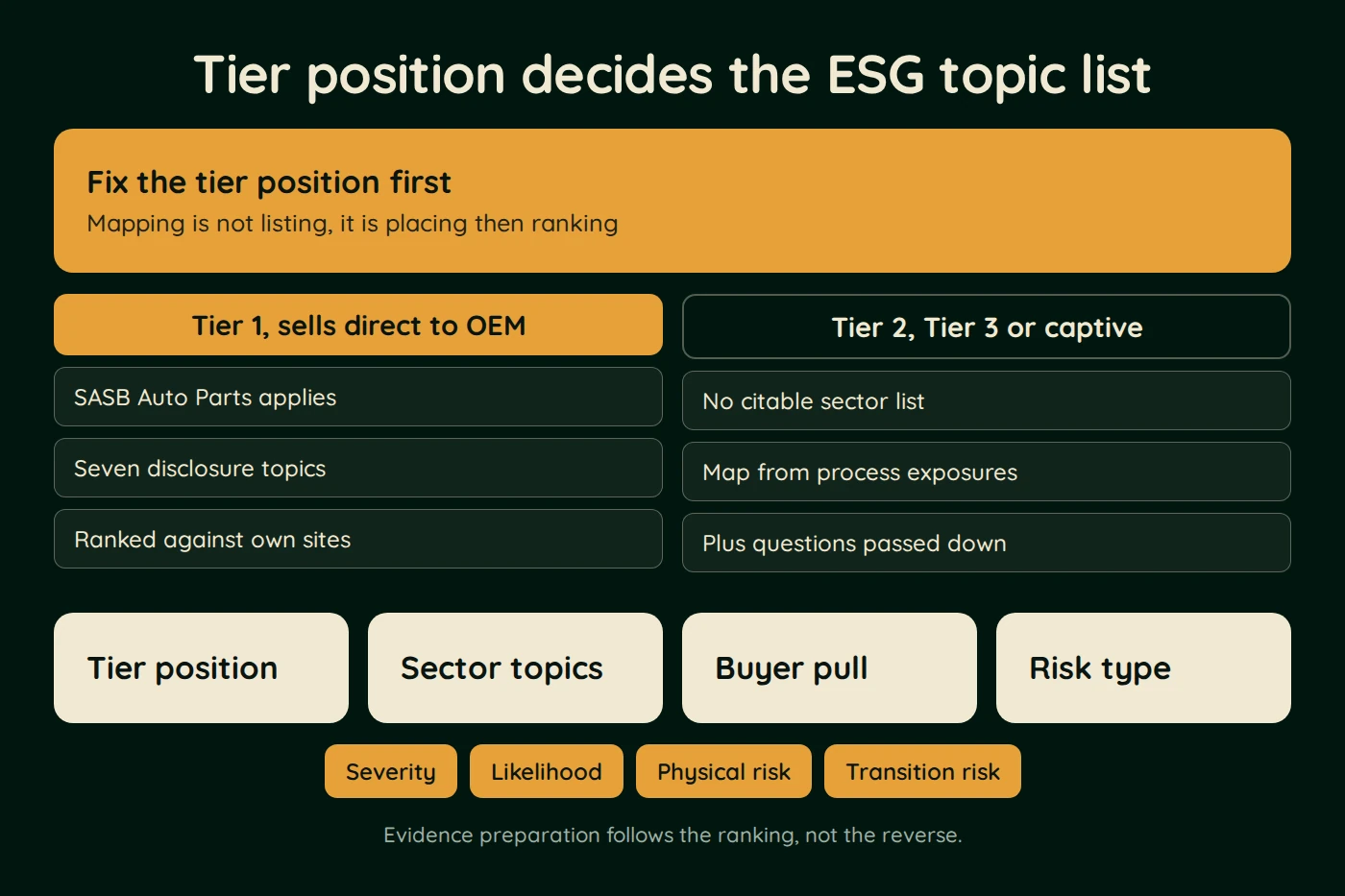
| Layer | What it settles | Published basis |
|---|---|---|
| Tier position | Whether a sector topic list applies | SASB Auto Parts industry description |
| Sector topics | The candidate exposures for a Tier 1 supplier | Auto Parts version 2023-12, seven disclosure topics |
| Buyer pull | Which exposures a listed customer asks about | SEBI value chain scope, circular dated 28 March 2025 |
| Risk type | Whether an exposure is physical or transition | IFRS S2 classification requirement |
For a Tier 1 supplier the candidate set is the seven Auto Parts disclosure topics:
- Energy Management
- Waste Management
- Product Safety
- Design for Fuel Efficiency
- Materials Sourcing
- Materials Efficiency
- Competitive Behaviour
Several sit in the product rather than the plant, so the map cannot stop at the factory gate.
Weighting by the customer pull
A supplier’s operational emissions surface in its customer’s Scope 3 inventory, so the pull sets much of the weighting. In India that pull is defined by contribution, not by tier. A SEBI circular dated 28 March 2025 applies value chain ESG disclosure to the top 250 listed entities by market capitalisation on a voluntary basis from FY 2025-26, and defines the value chain as partners individually comprising 2 percent or more of purchases and sales by value respectively, with an option to cover 75 percent instead. Assessment or assurance of those disclosures is separately voluntary from FY 2026-27 and rests with an independent third party, never with an adviser.
Ranking then follows the OECD sequence: a broad scoping exercise across operations and business relationships, then in-depth assessment of the prioritised areas. Each exposure is classified under IFRS S2 as physical or transition, separating flood or heat risk at a plant from the policy, legal, technological, market and reputational pressure that powertrain change puts on a parts portfolio. Evidence preparation follows the ranking, not the reverse.
Sources: SASB Auto Parts Standard, version 2023-12, SEBI circular dated 28 March 2025
ESG advisory services covers exposure mapping and evidence preparation for automotive suppliers, and the ESG guide sets out the underlying risk and materiality method. The free ESG risk assessment tool produces the same map for a component supplier, with no sign up and no email capture.