


CBAM covers six sectors listed in Annex I of Regulation (EU) 2023/956: iron and steel, aluminium, cement, fertilisers, electricity and hydrogen. Cement and fertilisers price both direct and indirect emissions; the other four cover direct emissions only in the definitive regime that began 1 January 2026.
The Carbon Border Adjustment Mechanism (CBAM) applies to six carbon-intensive sectors named in Annex I of Regulation (EU) 2023/956. The definitive period began 1 January 2026, though importers do not buy certificates until 1 February 2027 and file the first annual declaration by 30 September 2027. The table below maps each sector to its main Combined Nomenclature (CN) codes and typical products.
Sectors and CN codes covered
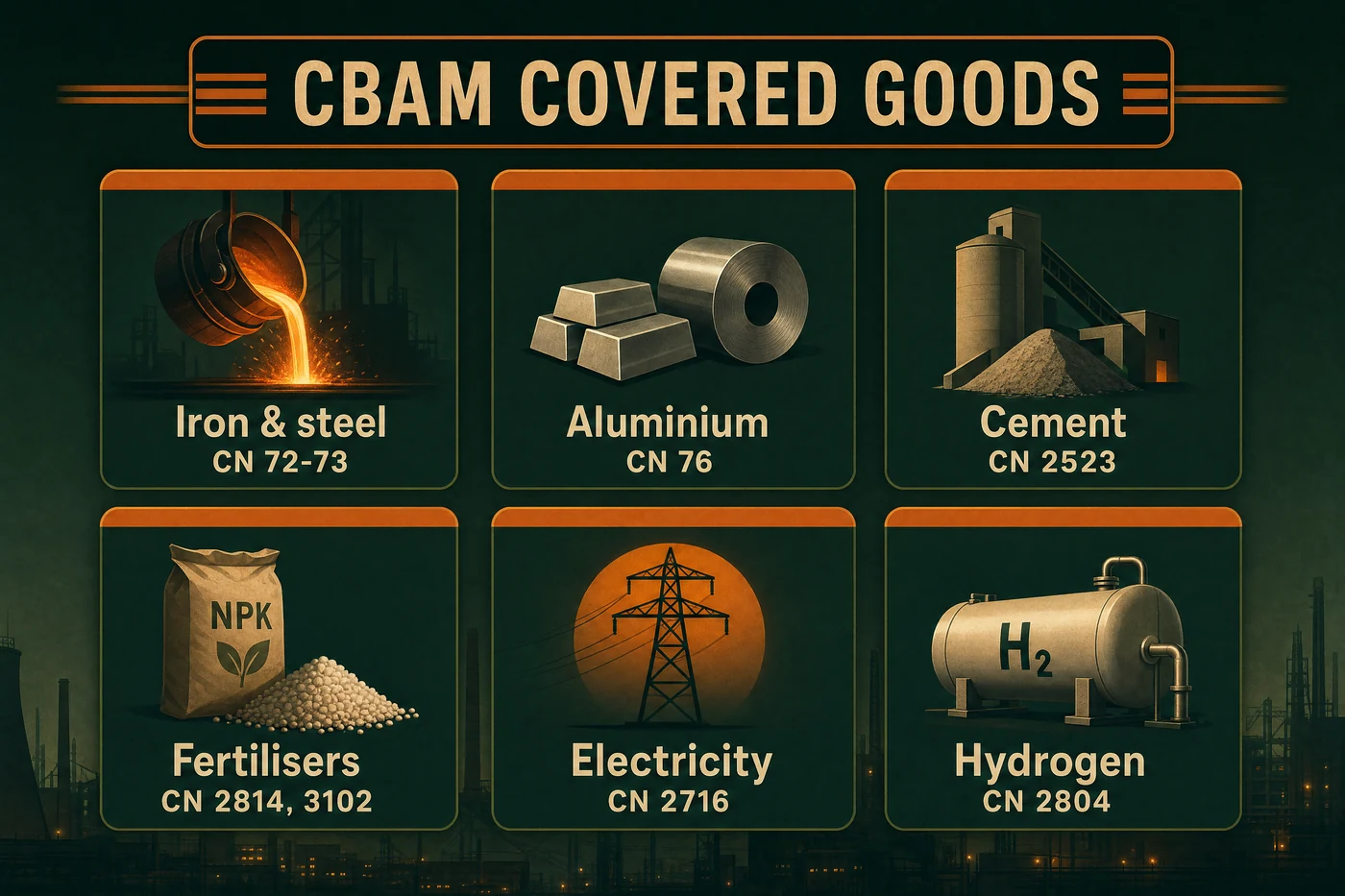
| Sector | Key CN heading(s) | Example products |
|---|---|---|
| Iron and steel | CN chapters 72 and 73, iron ore 2601 12 00 | Pig iron, flat and long products, tubes, screws and bolts |
| Aluminium | CN chapter 76 | Unwrought aluminium, bars, wire, plates, foil, tubes |
| Cement | CN 2523, calcined kaolinic clays 2507 00 80 | Clinker, white and grey Portland, aluminous cement |
| Fertilisers | CN 2814, 2808, 2834 21, 3102 and 3105 | Ammonia, nitric acid, potassium nitrate, urea |
| Electricity | CN 2716 00 00 (measured in MWh) | Imported grid electricity |
| Hydrogen | CN 2804 10 00 | Imported hydrogen |
Only cement and fertilisers price both direct and indirect (electricity) emissions; iron and steel, aluminium, electricity and hydrogen count direct emissions only.
Who is exempt, and what is not yet covered
A single 50-tonne mass-based de-minimis threshold now exempts importers bringing in 50 tonnes or less of CBAM goods per year, removing roughly 90% of importers while retaining over 99% of embedded emissions; electricity and hydrogen imports stay in scope regardless. As of mid-2026 the scope remains these six sectors, with proposed extension to some chemicals and polymers not yet enacted. GreenSutra’s consultants map product codes and embedded-emission data through CBAM Solutions, and the CBAM guide explains reporting duties step by step.
Sources: Regulation (EU) 2023/956 – EUR-Lex · Regulation (EU) 2025/2083 – EUR-Lex · CBAM – European Commission