


The CBAM definitive period, live from 1 January 2026, replaces the reporting-only transitional phase with financial liability: covered goods may enter only through an authorised CBAM declarant, embedded emissions move to a single annual CBAM declaration verified by an accredited verifier, and CBAM certificates cover a rising payable share.
From reporting to financial liability
The transitional period ran from October 2023 to December 2025 as a data exercise only. Any importer could bring in CBAM goods and file quarterly CBAM reports with no payment attached. The CBAM definitive period, applying since 1 January 2026, converts that reporting into a financial obligation and restricts imports of covered goods to an authorised CBAM declarant. Organisations assessing the shift can map the change through end-to-end CBAM compliance support, which covers declarant status, embedded-emissions calculation and certificate exposure.
Transitional versus definitive at a glance
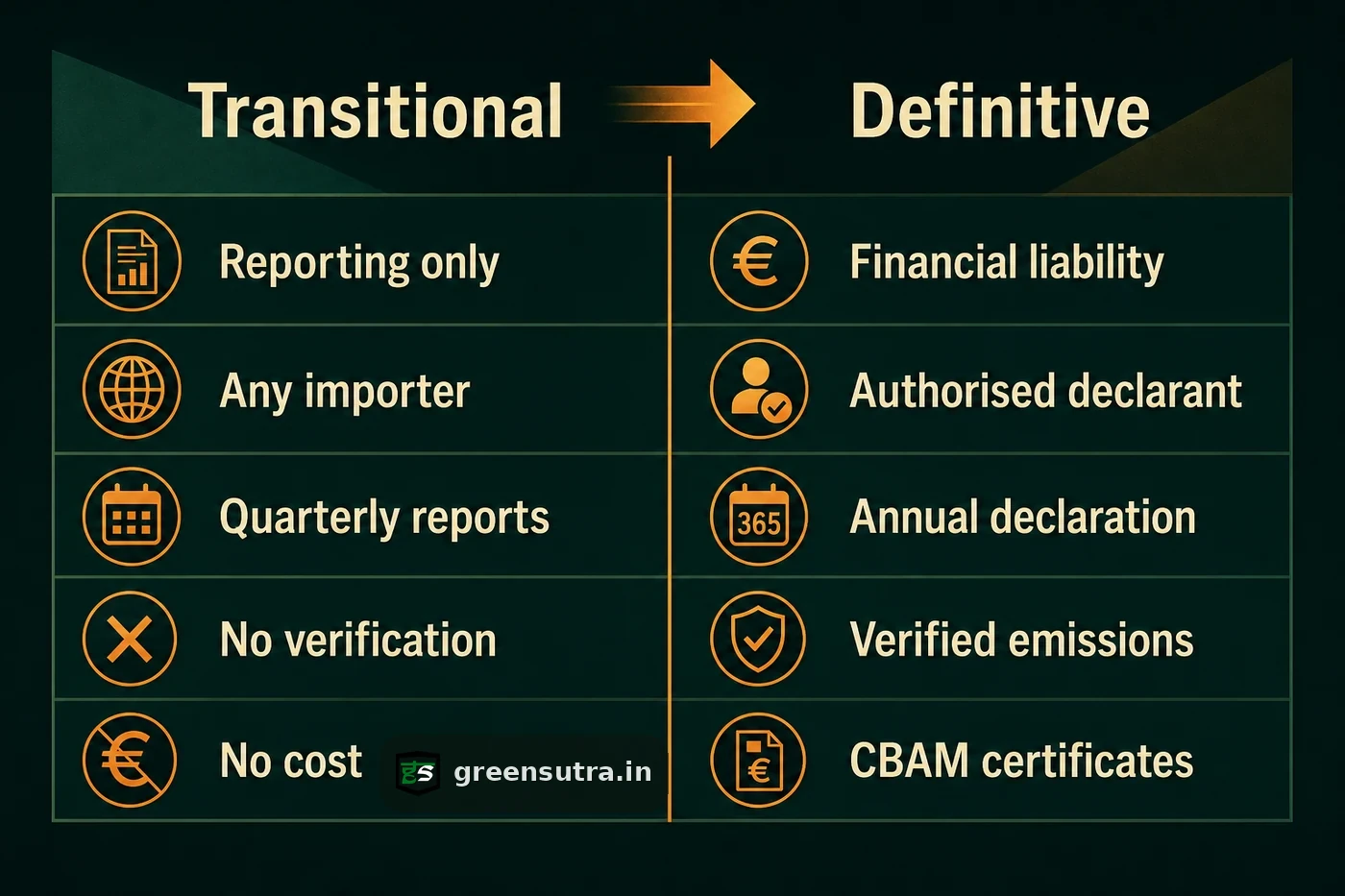
| Aspect | Transitional (Oct 2023 to Dec 2025) | Definitive (from 1 January 2026) |
|---|---|---|
| Nature | Reporting only, no payment | Financial liability |
| Who may import | Any importer | Authorised CBAM declarant only |
| Filing | Quarterly CBAM reports | Single annual CBAM declaration |
| Verification | Not required | Declared actual emissions verified by an accredited verifier |
| Cost | None | CBAM certificates on a rising payable share |
What the definitive period requires
Under the definitive regime, reporting becomes a single annual CBAM declaration, and a rising payable share of the declared emissions is settled with CBAM certificates. Declared actual emissions must be verified by an independent accredited verifier; default values need no verification. Although the definitive period starts on 1 January 2026, certificate purchase and surrender begin only on 1 February 2027, so 2026 liability is calculated first and settled later. The core obligations are:
- Authorised CBAM declarant status, with the application window for uninterrupted importing closed on 31 March 2026.
- A single annual CBAM declaration, first due 30 September 2027 for 2026 imports.
- CBAM certificates, one per tonne of CO2e, purchasable from 1 February 2027.
- A payable share rising from 2.5 per cent in 2026 to 100 per cent in 2034 as EU ETS free allocation is withdrawn.
- A certificate price tracking the EU ETS, published as a quarterly average in 2026 (Q1 2026 at EUR 75.36 per certificate).
Penalties also apply: an authorised declarant that under-surrenders pays EUR 100 per tonne of CO2e not covered, and parties importing without declarant status face three to five times that rate. GreenSutra’s consultants often see exporters treat the definitive period as a simple continuation of transitional reporting, when it changes both liability and process. A structured CBAM guide helps separate the two phases before the first declaration falls due.
Sources: Regulation (EU) 2023/956 · Regulation (EU) 2025/2083 · European Commission CBAM