

CBAM covers molecular hydrogen under CN 2804 10 on direct emissions only, with no de-minimis, so every consignment is priced from the first tonne. India’s fossil default of 14.03 tCO2e per tonne marks up to 15.43 in 2026, while verified renewable electrolysis near 0.4 to 2.7 sits far below, making low-carbon data the competitive lever.
How CBAM prices molecular hydrogen
Hydrogen is one of the six product groups covered by CBAM, on a single combined nomenclature line, CN 2804 10 (2804 10 00). Only direct emissions are counted, so the production route sets almost the entire figure. The 50 tonne de-minimis threshold that applies to cement, iron and steel, aluminium and fertilisers excludes hydrogen, which means every consignment stays in scope from the first tonne.
India’s default value for hydrogen is a fossil-based 14.03 tCO2e per tonne. With the mark-up applied on top of the base, that default becomes 15.43 in 2026, 16.84 in 2027 and 18.24 from 2028. The certificate price tracks the EU ETS, a Q1 2026 average of EUR 75.36 per tonne CO2e, and the payable share climbs from 2.5 percent of embedded emissions in 2026 to 100 percent by 2034.
The intensity gap that decides competitiveness
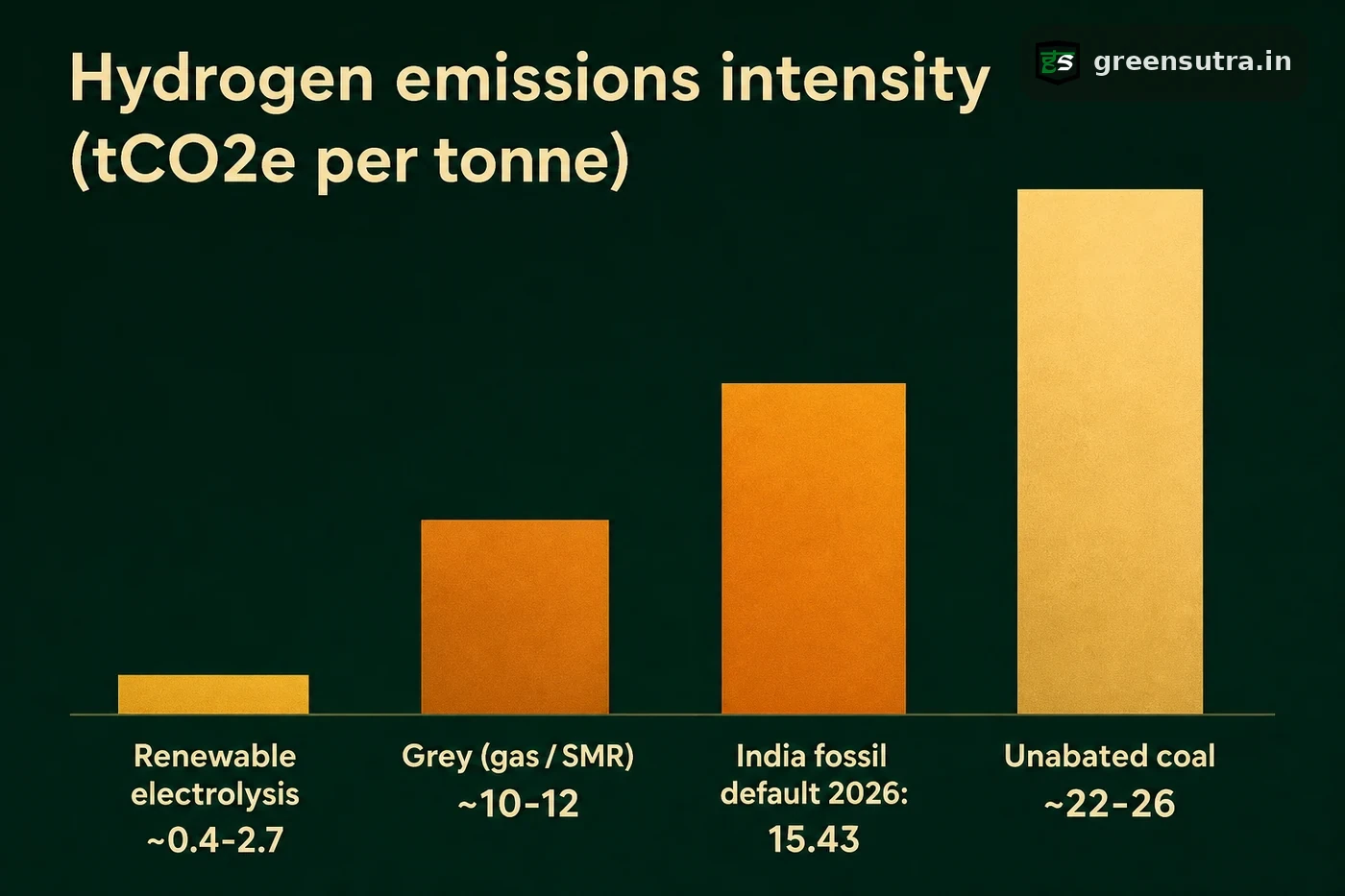
The production route, not the destination, decides the CBAM exposure of a hydrogen shipment. The gap between routes is wide:
| Production route | Direct intensity (tCO2e per tonne, route figures indicative) |
|---|---|
| Renewable electrolysis | about 0.4 to 2.7 |
| India fossil default, 2026 basis | 15.43 |
| Unabated gas or SMR, grey | about 10 to 12 |
| Unabated coal | about 22 to 26 |
The India default of 14.03 sits between the grey and the coal routes, well above renewable electrolysis. A verified renewable, electrolysis installation can therefore declare far below the fossil default, and that verified figure is the competitive lever. GreenSutra, as a consultant, calculates and prepares the installation data, while an independent accredited verifier confirms it before it replaces the marked-up default.
What it means for the export ambition
Cross-border trade in molecular hydrogen is small because hydrogen is hard and costly to ship, so most long-distance volume moves as ammonia, a separate CBAM good in the fertiliser group under CN 2814 with an India default of 3.28. India’s National Green Hydrogen Mission, approved on 4 January 2023 with an outlay of Rs 19,744 crore, targets at least 5 MMT per year of green hydrogen by 2030 and states the aim to become a global hub for production, use and export. The European Union aims to import 10 million tonnes of renewable hydrogen by 2030, and an early green-ammonia offtake of up to 500,000 tonnes per year between Uniper and AM Green was signed in January 2025, with a first shipment expected around 2028. The India-EU free trade agreement of 27 January 2026 grants no CBAM exemption and opens a technical dialogue on recognition only, so verified low-carbon data remains the decisive factor. The CBAM cost calculator models the exposure by product, volume and year, a CBAM discovery session maps the emissions data gap, and a CBAM consulting service prepares installation data for verification by an accredited verifier.
Sources: Regulation (EU) 2023/956 · Implementing Regulation (EU) 2025/2621 · European Commission CBAM