


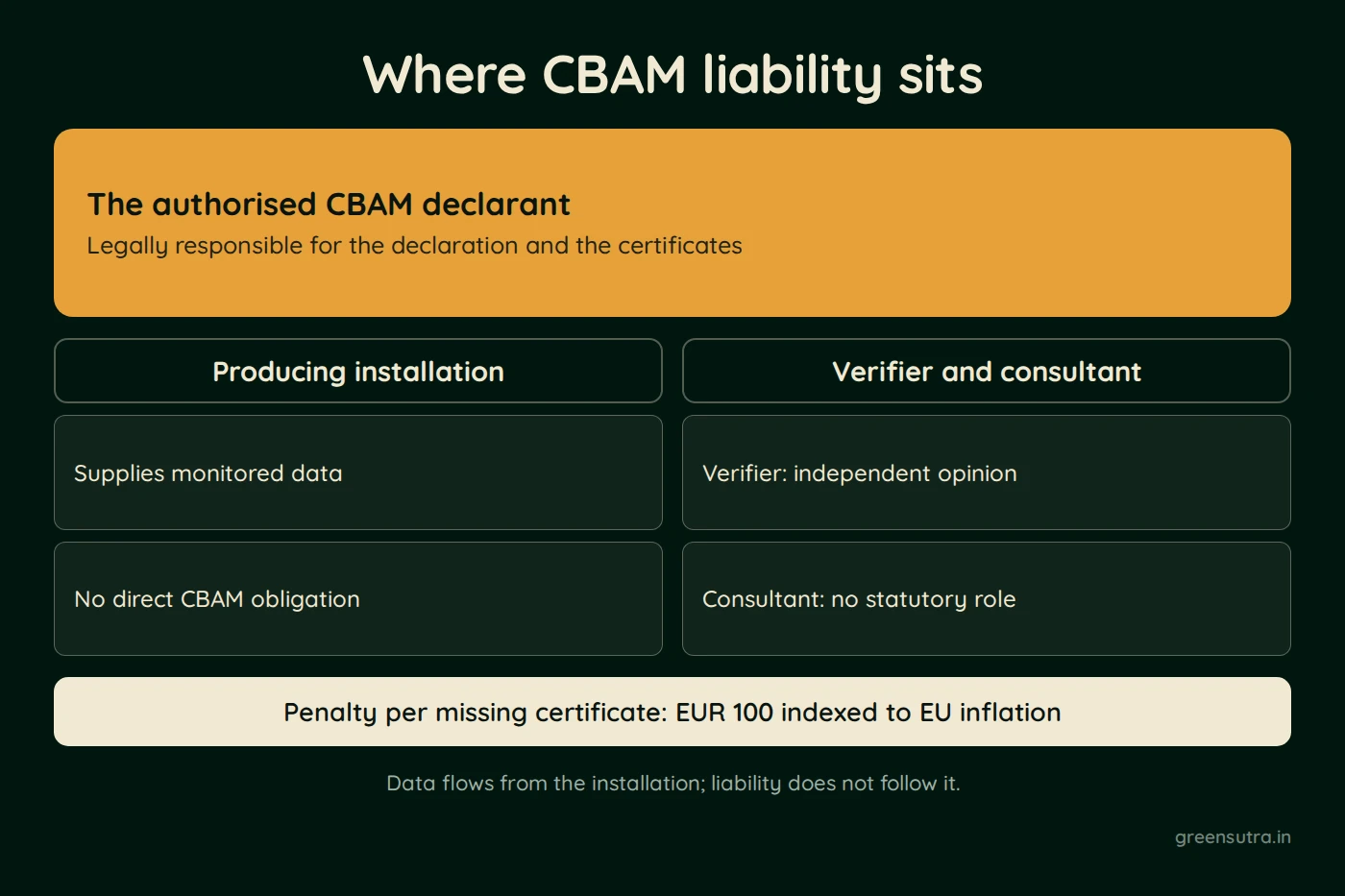
The authorised CBAM declarant carries legal responsibility for the declaration, including where the underlying emissions data came from a non-EU supplier. Responsibility does not transfer to the producer. Failure to surrender enough certificates attracts a penalty for each missing certificate, and the missing certificates must still be surrendered.
Data flows from the producing installation, but liability does not follow it. From 2026 only a party holding authorised CBAM declarant status may import CBAM goods into the Union, and the declaration is the declarant’s. Importers at or below the 50 tonne yearly threshold, and applicants who applied by 31 March 2026 and may import provisionally, are the exceptions.
Where liability sits
| Party | Position |
|---|---|
| Authorised CBAM declarant | Legally responsible for the annual declaration and for surrendering certificates |
| Non-EU producing installation | Supplies monitored emissions data; carries no direct CBAM obligation to the Union |
| Accredited verifier | Provides an independent opinion on the declared embedded emissions |
| Consultant | Prepares the calculation and the declaration; carries no statutory role |
Articles 8(2) and 10(7) of Regulation (EU) 2023/956 let a declarant use verified information that an operator discloses through the registry. That is a data-transfer mechanism, not a transfer of responsibility.
The penalty structure
Failure to surrender sufficient certificates attracts the EU ETS excess emissions penalty for each certificate not surrendered, at the rate for the year of import. That rate is EUR 100 per tonne of CO2e, raised in line with European consumer prices. The penalty is additive: paying it does not discharge the obligation, and the missing certificates must still be surrendered. Article 26(1a) lets the competent authority reduce it where an operator, verifier or carbon price certifier gave incorrect information.
A higher penalty applies to goods introduced by a party that is not an authorised CBAM declarant, set at three to five times that indexed penalty for each certificate not surrendered.
Figures in circulation that quote one euro amount for both cases mix up the two provisions. The standard rate and the unlawful-introduction rate are separate.
What this means commercially for an exporter
An exporter carries no direct EU penalty exposure, but it carries the commercial consequence. A declarant facing a penalty for each missing certificate because supplier data proved unsupportable may move to a supplier whose data holds, or fall back on default values, whose mark-up rises through 2028 for most goods, and price that back into the contract.
Sources: Regulation (EU) 2023/956, Regulation (EU) 2025/2083
Data that survives verification is a commercial asset for the exporter even though the legal duty sits with the authorised CBAM declarant. CBAM solutions covers defensible embedded emissions preparation, and the CBAM cost calculator sets out how the resulting figures translate into exposure.