


A non-EU parent is caught where it generates more than EUR 450 million net turnover in the Union, individually or consolidated, in each of the last two consecutive financial years, and has an EU subsidiary or branch exceeding EUR 200 million net turnover in the preceding year. Third-country reporting starts for financial years beginning in 2028.
Most non-EU groups encounter CSRD indirectly, as a buyer requirement passed down a supply chain. The third country rule is the narrow route by which a group becomes directly obligated in its own right, and the distinction matters because the two produce very different workloads.
The test
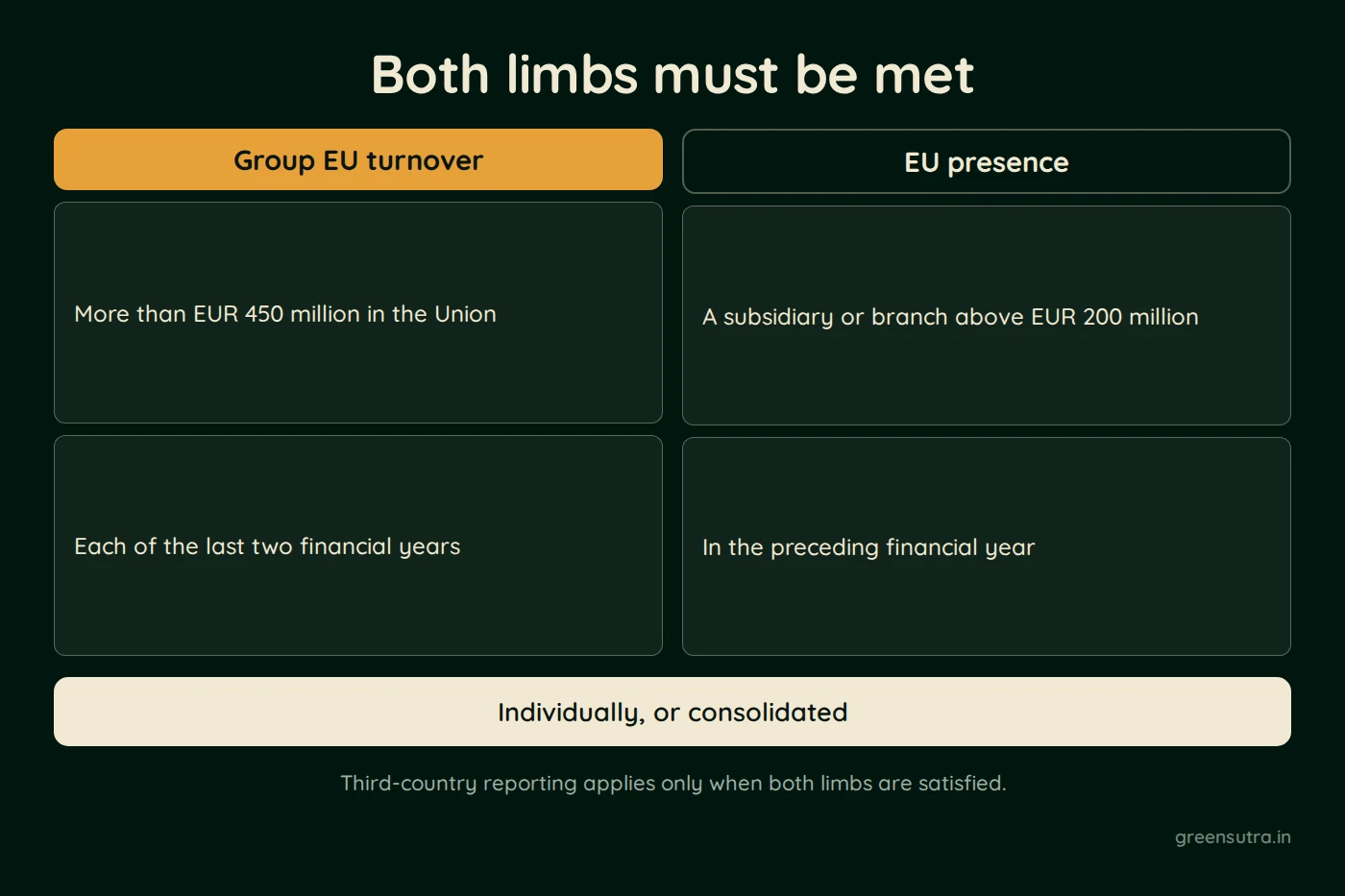
| Limb | Threshold | Measured over |
|---|---|---|
| Group EU turnover | More than EUR 450 million net turnover generated in the Union, individually or on a consolidated basis | Each of the last two consecutive financial years |
| EU presence | A subsidiary or branch in the Union exceeding EUR 200 million net turnover | The preceding financial year |
Both limbs must be satisfied. The two-consecutive-years requirement on the first limb means a single strong year does not trigger the obligation, and equally that a group already above the line does not fall out after one weaker year.
The timetable is not the general one
Reporting for third-country undertakings starts for financial years beginning in 2028, with reports following in 2029 and 2030. That is later than the 1 January 2027 date applying to EU undertakings under the narrowed general scope. Applying the general date to a non-EU parent overstates the obligation by a full year, and it is one of the most common errors in summaries written for non-EU audiences.
Direct obligation against contractual pressure
A group below these thresholds is not obligated by CSRD at all. It may still receive detailed sustainability requests from EU customers, but those are contractual and sit outside the statutory framework, including outside the value chain cap that protects smaller undertakings from over-broad requests made for CSRD purposes.
Sources: Directive (EU) 2026/470, Council of the EU press release, 24 February 2026
Establishing which of the two positions a group occupies determines everything that follows. ESG solutions covers scope assessment for groups with EU operations, and the ESG guide sets out the reporting structure that applies once the threshold is crossed.