


Textiles, with a focus on apparel, is a priority product group in the first ESPR Working Plan. Indian exporters should start collecting supply-tier data now: material composition, recycled content, substances of concern, durability, repair and end-of-life. A machine readable data carrier such as a QR code follows, tracked against the indicative textile delegated act.
Why textiles sit near the front of the queue
The first ESPR and Energy Labelling Working Plan, Communication COM(2025) 187 final, names textiles, with a focus on apparel, as a priority product group. It was adopted on 16 April 2025, covers 2025 to 2030 and also lists furniture, tyres, mattresses, iron and steel and aluminium. Under the Ecodesign for Sustainable Products Regulation, Regulation (EU) 2024/1781, a covered product may be placed on the EU market only once a Digital Product Passport is available (Article 9). The Working Plan gives textiles and apparel an indicative adoption year of 2027, earlier than furniture (2028) and mattresses (2029). Exporters of these goods should expect an earlier delegated act than for those groups. India has no domestic DPP law; the obligation is the European Union’s and reaches goods placed on the EU market regardless of where they are manufactured.
Start supply-tier data collection now
The passport duty sits with the economic operators that place the garment on the EU market, such as the manufacturer or the EU importer. Most of the data sits with their suppliers, so early collection matters most. The textile delegated act is not adopted, so the passport fields are not yet fixed. A May 2026 study for the Joint Research Centre proposes data in areas such as these, to be kept accurate, complete and up to date across the value chain:
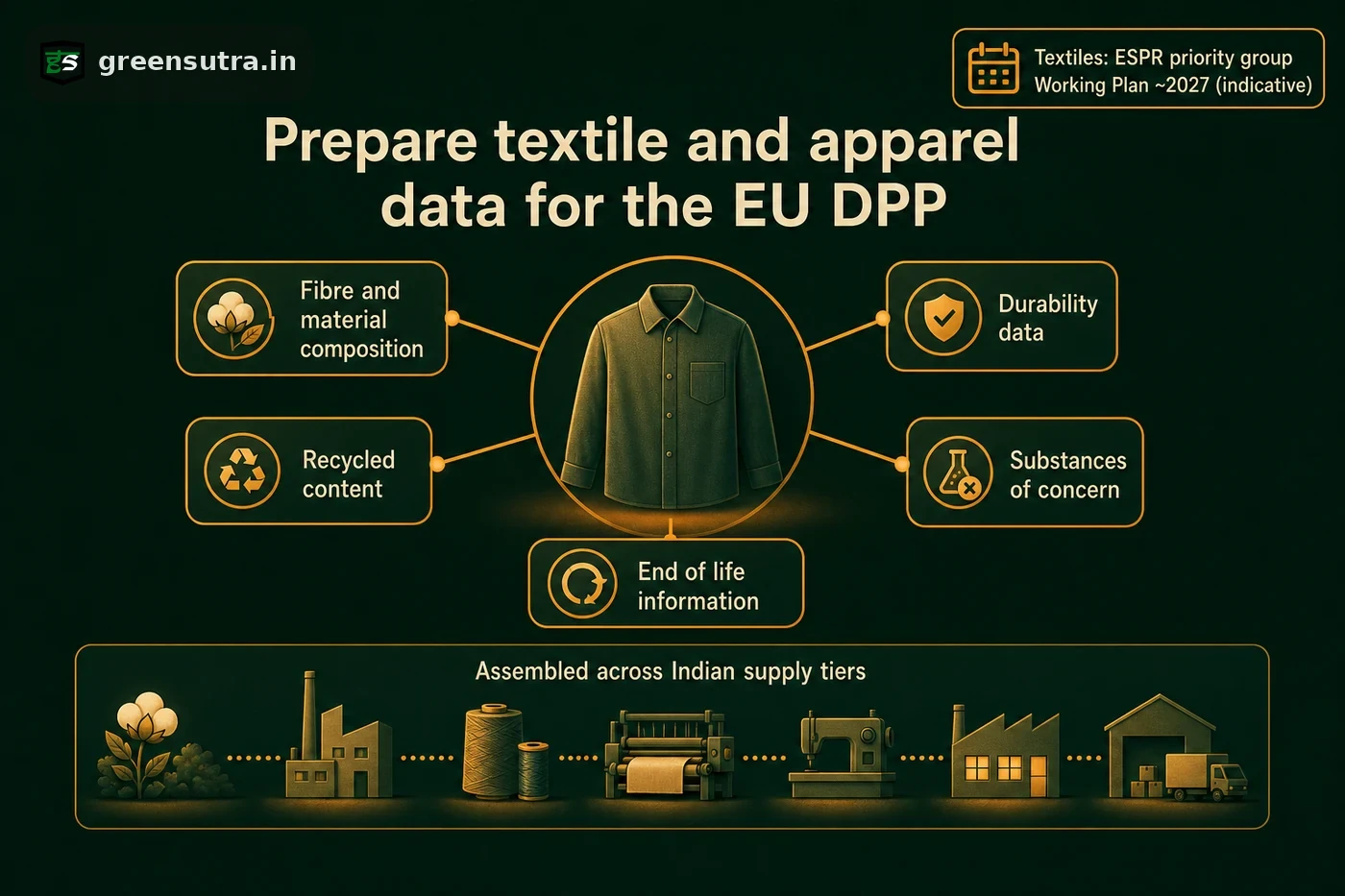
| Data field | What apparel exporters assemble |
|---|---|
| Material composition | Fibre make-up of each product |
| Recycled content | Share of recycled input |
| Substances of concern | Restricted chemicals present |
| Durability | Expected product life |
| Repair | Repairability information |
| End of life | Recyclability and disposal route |
This data sits across multiple Indian supply tiers, from spinning and weaving to finishing, so tracing it takes the longest lead time. The same product level data also underpins a life cycle assessment and the carbon footprint of a product, so the effort compounds across export requirements. A structured DPP readiness guide sets out the full field list.
Ready a carrier and track the delegated act
Alongside the data, exporters plan the unique product identifier every passport needs. They also plan operator and facility identifiers if the textile act requires them, and prepare a machine-readable data carrier such as a QR code. A May 2026 study for the Joint Research Centre recommends item-level product identifiers for apparel, with batch and model IDs alongside. That is advice to the Commission, not adopted policy; the textile delegated act will set the level. Each product group’s delegated act picks the carrier type. Since 15 July 2026, Implementing Decision (EU) 2026/1736 has cited EN 18219 for unique identifiers and EN 18220 for data carriers as harmonised standards. Building on those standards avoids locking into one vendor early. The Working Plan year for textiles, 2027, is a target for adopting the delegated act, not a start date. Under ESPR Article 4(4), the act can apply no earlier than 18 months after it enters into force, except in justified cases. As of 19 October 2026, no ESPR delegated act for a product group has been adopted. Separately, the EU DPP registry went live on 20 July 2026, and Implementing Regulation (EU) 2026/1778 has governed it since 6 August 2026. Its user guide of 16 September 2026 says no passport can be registered yet. A DPP discovery brief and Digital Product Passport readiness sequence this data and carrier work against those dates.
Sources: Regulation (EU) 2024/1781 (ESPR) · COM(2025) 187 final ESPR Working Plan