


ESG data across multiple sites is collected by issuing one standard site level template to every location, then consolidating the returned files against fixed rules under version control. Each metric follows a defined chain from meter or register to report. Site count and the maturity of existing records are among the main drivers of scope.
Multi site ESG data collection rests on one design decision taken early: what a single site is asked to return, in what unit, and against what evidence. Consolidation, restatement and assurance readiness are all set by that template.
The meter to report chain
Every reported figure should trace back through an unbroken chain to a physical or documentary source at a named site.
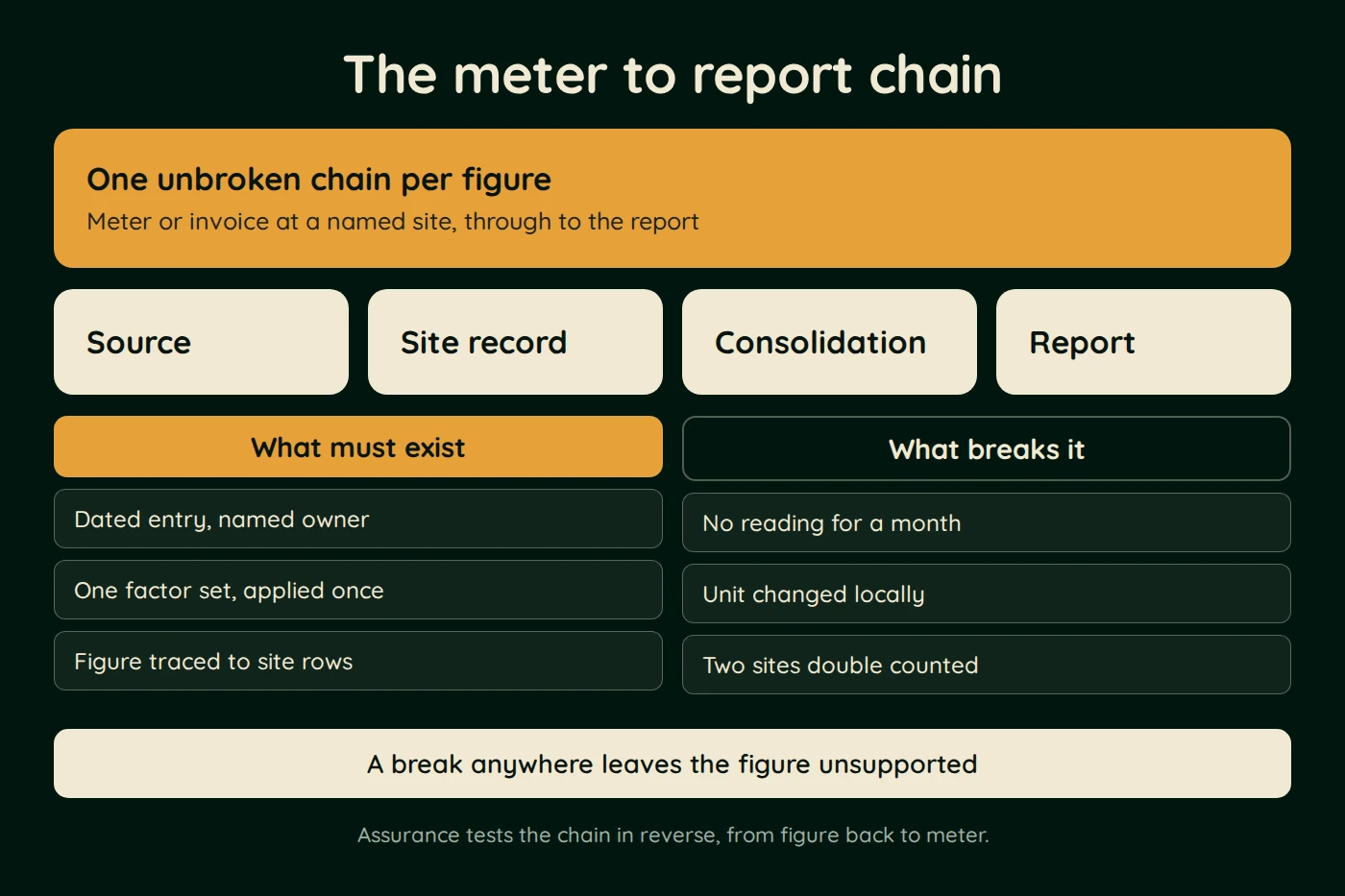
| Stage | What exists | Typical failure |
|---|---|---|
| Source | Meter reading, invoice, payroll record | No reading for a month |
| Site record | Dated entry, named owner | Unit changed locally |
| Consolidation | Group file, factors applied once | Two sites double counted |
| Report | Figure traced to its site rows | Restated without a log |
An independent assurance provider tests that chain in reverse, from the reported number back to the invoice or meter reading, so a break anywhere leaves the figure unsupported.
Designing the site template
The template is derived from the disclosure basis, not from what each site happens to hold. The GRI Standards are modular and structured into Universal, Sector and Topic standards, so the topic standards in play decide the field list. One workbook per site, with locked units, locked periods and a named owner per field, keeps returns comparable. Local variants defeat the exercise.
Consolidation rules and version control
The rules are written before the first return arrives:
- Boundary: which sites are in, and how leased and joint operations count.
- Period: one reporting year, with a stated rule for a site on a different cycle.
- Factors: one conversion factor set, one version, applied centrally.
- Gaps: a documented estimation method for missing months, flagged in the file.
- Restatement: a rule for reopening a prior year when a site corrects a reading.
Version control is the step most often skipped. Each consolidated file carries a version number, a freeze date and a change log tying every restated figure to the site return that moved.
Why site count and data maturity drive the effort
Scope, not a rate, sets the effort. The drivers are the number of sites and the maturity of existing data, the breadth of the materiality scan, the number of pillars and metrics in play, whether overseas buyer questionnaires add formats, and whether the work stops at assessment or runs through to disclosure and assurance support. Site count multiplies collection; maturity decides whether a site is a transcription task or a metering project. Boundary reach is a third driver, and the least commonly attempted: an analysis of financial year 2024 disclosures published in November 2025 found 781 of roughly 1000 filers disclosed Scope 1 and Scope 2 emissions while only 268 reported value chain Scope 3.
Sources: GRI Standards, Corporate emissions disclosures, November 2025
The ESG guide sets out the disclosure bases a site template is built from. ESG solutions covers baseline collection across sites, consolidation and readying the data file for independent verification. Collection gaps across sites are named area by area in the free ESG data gap register.