


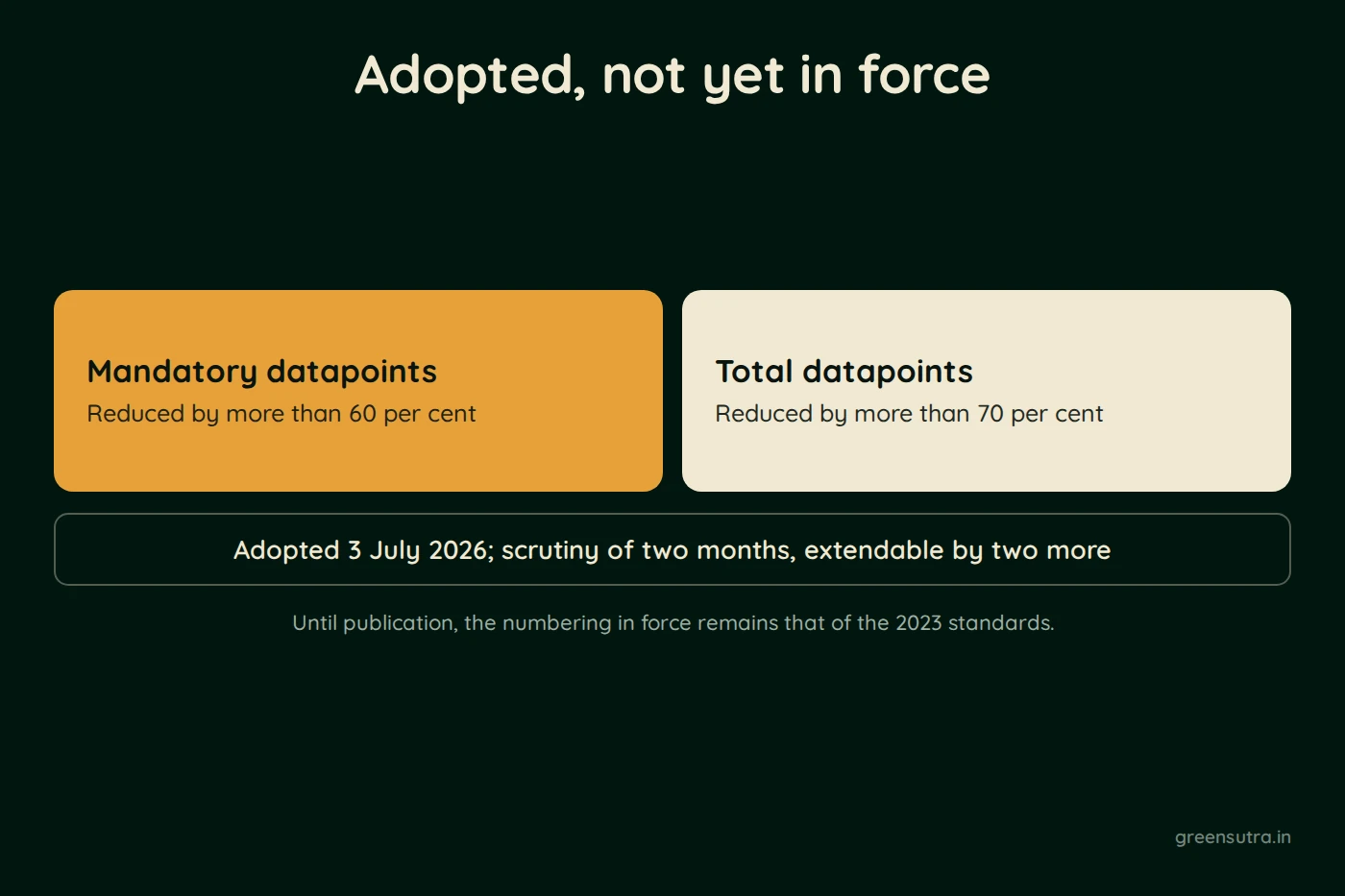
The revised ESRS delegated act, adopted 3 July 2026, reduces mandatory datapoints by more than 60 per cent against ESRS (2023) and total datapoints by more than 70 per cent, removing voluntary disclosures. It applies to financial years beginning on or after 1 January 2027. The act is adopted but not yet in force.
The revision is the largest structural change to the standards since they were first adopted, but its legal status is frequently overstated. Adoption by the Commission is not the same as entry into force.
What changed and what it means for status
| Element | Position |
|---|---|
| Adoption date | 3 July 2026, reference C(2026) 5010 final |
| Mandatory datapoints | Reduced by more than 60 per cent against ESRS (2023) |
| Total datapoints | Reduced by more than 70 per cent |
| Voluntary disclosures | Removed |
| Legal status | Adopted, not yet in force |
| Scrutiny | Two months by the European Parliament and the Council, extendable by a further two months |
| Application | Financial years beginning on or after 1 January 2027 |
Until the act is published in the Official Journal, the numbering in force remains that of the 2023 standards. Any disclosure prepared before publication has to use the numbering that is actually in force, not the revised numbering.
The three-way option for financial year 2026
For financial years falling between 1 January 2026 and 31 December 2026, a company may choose one of three routes rather than a simple early-adoption switch:
1. Apply the existing ESRS. 2. Apply the revised ESRS in full. 3. Apply the existing ESRS with the specified reliefs.
Describing this as “early adoption permitted” collapses three distinct choices into one and loses the middle option, which is the one most preparers actually take.
A caution on the numbers
Several precise counts circulate for the reduction, including a specific mandatory-datapoint percentage and an approximate remaining count. Those figures come from analyst commentary rather than the primary reporting, and earlier drafts carried different numbers again. The safe formulation is more than 60 per cent of mandatory datapoints and more than 70 per cent in total.
Sources: European Commission, revised ESRS delegated act, EFRAG
Choosing between the three financial year 2026 routes is a decision with consequences for comparability. ESG solutions covers reporting transition planning, and the ESG guide sets out the disclosure structure the revised standards retain.