


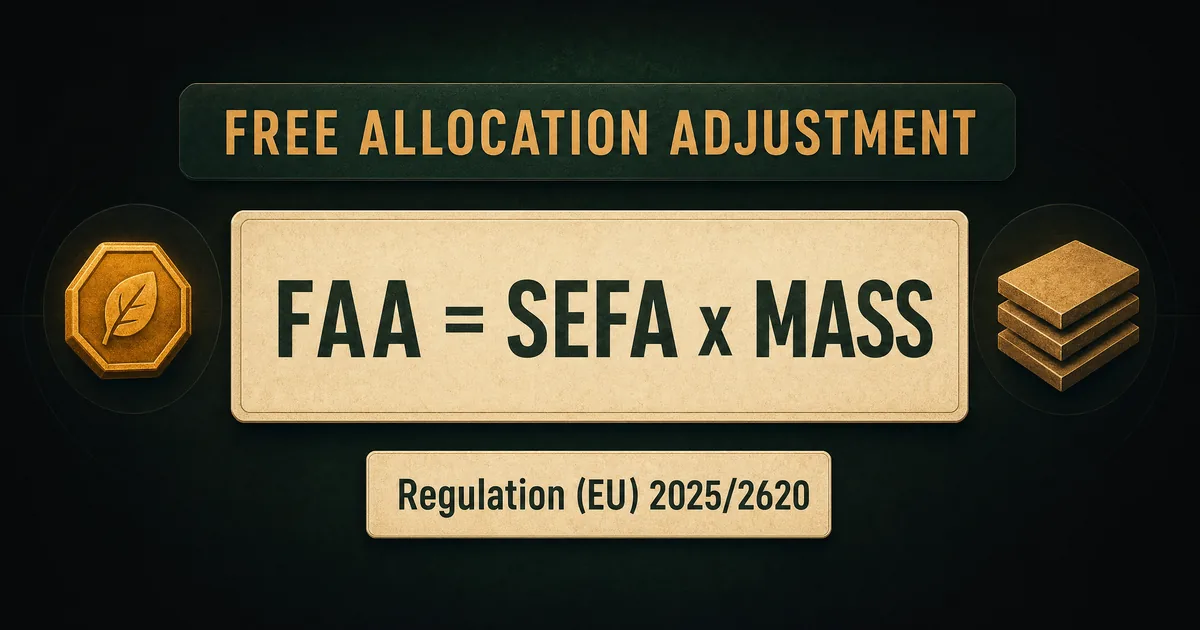
The free allocation adjustment for a good equals its specific embedded free allocation for the year multiplied by the total mass imported during the reporting year (Equation 1, Annex of Implementing Regulation (EU) 2025/2620). SEFA comes from CBAM benchmarks scaled by the CBAM factor and the cross-sectoral correction factor, and the resulting FAA reduces the certificates to surrender.
Commission Implementing Regulation (EU) 2025/2620, adopted 16 December 2025 and applying from 1 January 2026, sets the methodology for the free allocation adjustment referred to in Article 31 of Regulation (EU) 2023/956. Two defined terms carry the calculation. FAA, the free allocation adjustment, is the adjustment to the number of CBAM certificates to be surrendered. SEFA, the specific embedded free allocation, is the free allocation embedded in one tonne of a good, expressed in tonnes of CO2e per tonne.
The formula
Equation 1 in the Annex sets the rule: FAAg = SEFAg,y x Mg. The free allocation adjustment for a good equals its specific embedded free allocation for the year multiplied by the total mass of that good imported during the reporting year.
| Term | Meaning |
|---|---|
| FAAg | Free allocation adjustment for good g |
| SEFAg,y | Specific embedded free allocation for good g in year y, in t CO2e per tonne |
| Mg | Total mass of good g imported during the reporting year |
Where SEFA comes from
With actual data, Annex point 3 calculates SEFA from the production process using CBAM benchmarks derived from EU ETS free-allocation benchmarks, scaled by the CBAM factor set in Article 10a(1a) of Directive 2003/87/EC and by the cross-sectoral correction factor. Where default values are used for the specific embedded emissions in the declaration, Annex point 4 applies predefined default CBAM benchmarks matched to the same production routes and precursor assumptions as the emission defaults.
The declarant includes the FAA in the annual CBAM declaration, and it reduces the certificates to be surrendered. The mechanism mirrors EU free allocation: EU producers in CBAM sectors retain 97.5 per cent of their EU ETS free allocation in 2026, so covered imports effectively face about 2.5 per cent of the gross certificate obligation that year. The payable share rises as free allocation is withdrawn, reaching 100 per cent in 2034, so the adjustment shrinks each year and is never permanent relief.
GreenSutra’s CBAM consultants model the FAA alongside certificate prices when planning certificate budgets for importers. CBAM advisory covers embedded-emissions calculation, declaration preparation and certificate cost planning, and the CBAM cost calculator gives a first estimate of net certificate exposure.
Sources: Implementing Regulation (EU) 2025/2620 · Regulation (EU) 2023/956 · European Commission CBAM