


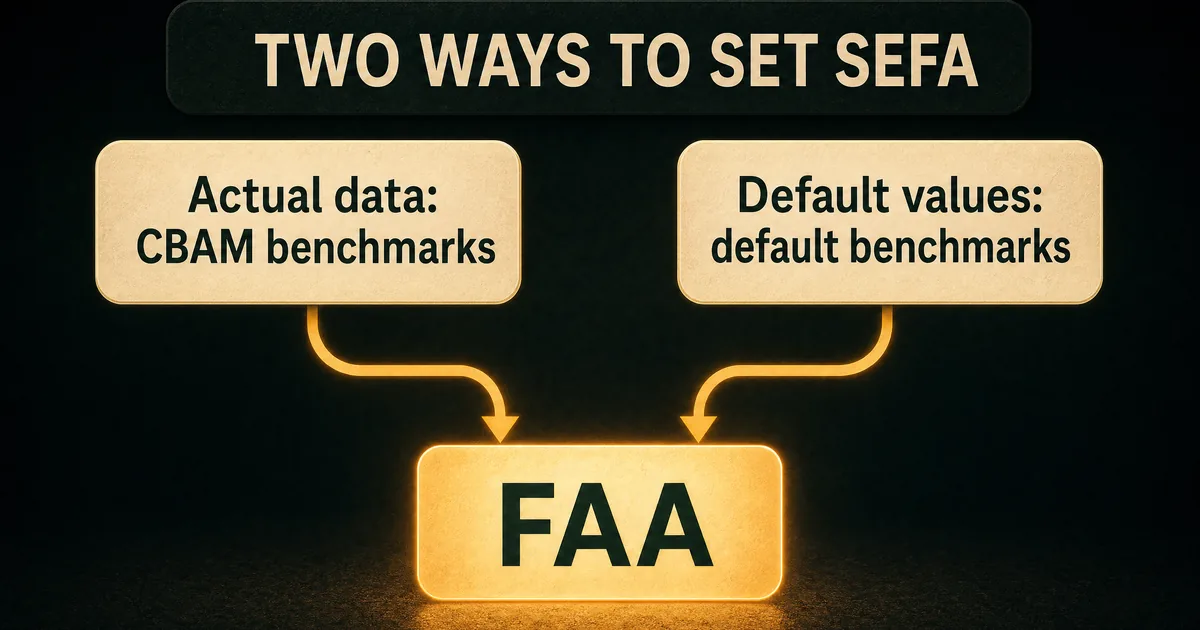
When default values stand in for actual emissions data, SEFA is taken from predefined default CBAM benchmarks matched to the same production routes and precursor assumptions as the emission defaults (IR (EU) 2025/2620, Annex point 4). The result still feeds the free allocation adjustment that reduces the certificates a declarant must surrender.
SEFA, the specific embedded free allocation, is the free allocation embedded in one tonne of a good, expressed in tonnes of CO2e per tonne. Commission Implementing Regulation (EU) 2025/2620, adopted 16 December 2025 and applying from 1 January 2026, sets the methodology for the free allocation adjustment referred to in Article 31 of Regulation (EU) 2023/956. Whichever route produces SEFA, the Annex applies the same core formula (Equation 1): the FAA for a good equals its SEFA for the year multiplied by the total mass of that good imported during the reporting year. The declarant includes the FAA in the annual CBAM declaration, and it reduces the certificates to be surrendered.
Route one: actual production data (Annex point 3)
With actual data, SEFA is calculated from the production process using CBAM benchmarks (BMg*) derived from the EU ETS free-allocation benchmarks, scaled by the CBAM factor (CBAMy, from Article 10a(1a) of Directive 2003/87/EC) and the cross-sectoral correction factor (CSCFy).
Route two: default values (Annex point 4)
Where default values are used for the specific embedded emissions in the declaration, Article 3 and Annex point 4 apply instead: the FAA is calculated from predefined default CBAM benchmarks matched to the same production routes and precursor assumptions as the emission defaults. The allocation side therefore mirrors whatever route the emission defaults assumed.
One distinction prevents most confusion between the two default regimes:
| Instrument | Default type | Effect on the bill |
|---|---|---|
| IR (EU) 2025/2621 | emission defaults | markup increases the emissions base |
| IR (EU) 2025/2620 | allocation defaults | feed the FAA that reduces certificates |
The FAA tracks EU free allocation: EU producers retain 97.5 per cent of their EU ETS free allocation in 2026, so covered imports face about 2.5 per cent of the gross obligation that year, a share that rises step by step to 100 per cent in 2034. GreenSutra’s CBAM consultants model both SEFA routes when planning certificate cost under CBAM advisory engagements. The CBAM guide sets out where default values apply across a product list.
Sources: Implementing Regulation (EU) 2025/2620 · Regulation (EU) 2023/956 · European Commission CBAM