


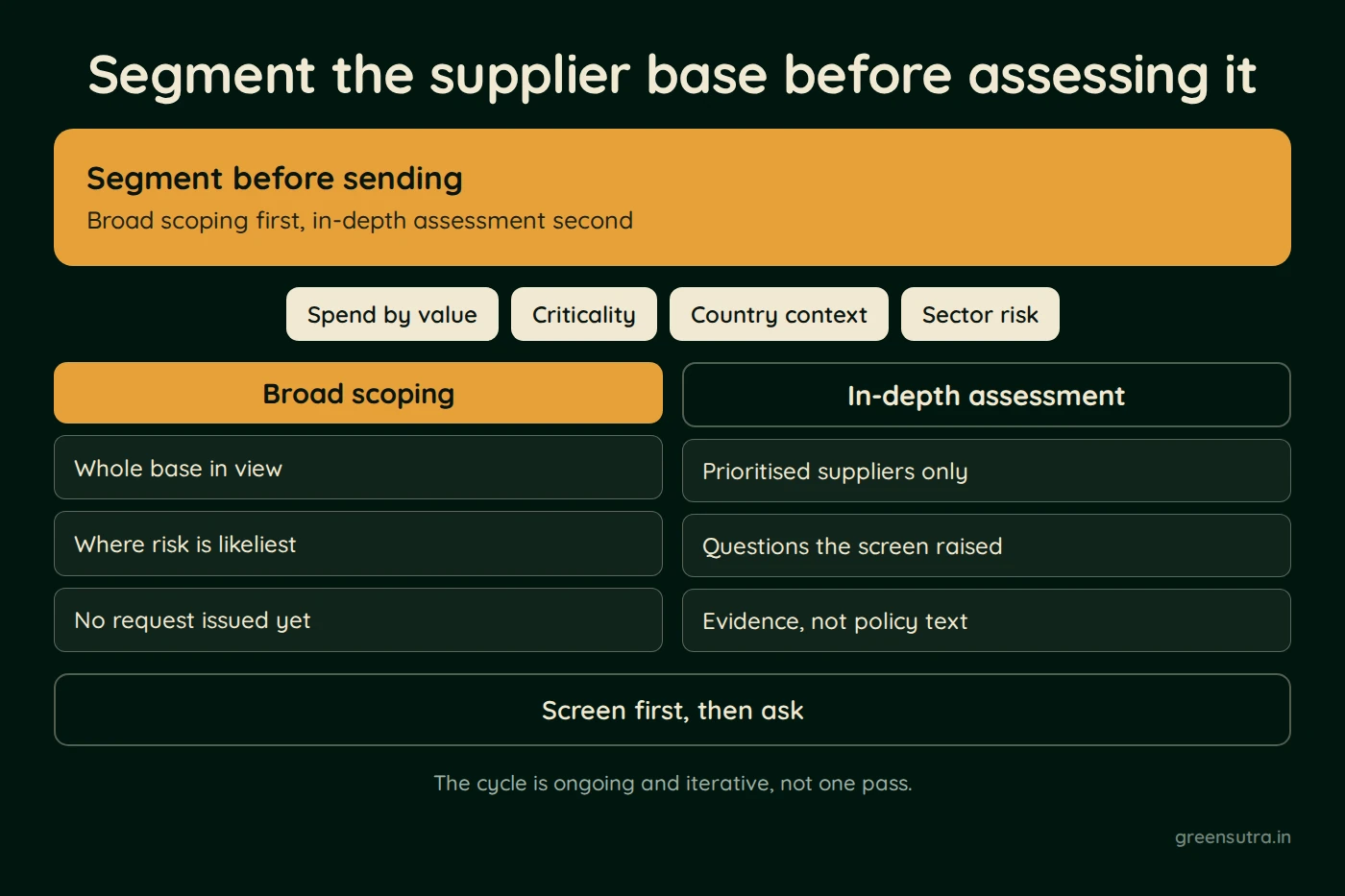
Supplier ESG risk assessment is a repeating cycle that segments the supplier base by risk, screens the prioritised segment, collects questionnaire responses with documentary evidence, drives corrective action and re-screens. The OECD Due Diligence Guidance describes the process as ongoing, iterative and not necessarily sequential. Broad scoping comes first, in-depth assessment second.
Uniform assessment across an entire supplier base is not what the instruments ask for. The OECD Due Diligence Guidance for Responsible Business Conduct sets out six steps, running from embedding responsible business conduct in policies and management systems, through identifying and assessing adverse impacts, ceasing, preventing and mitigating them, tracking results and communicating, to remediation. Segmentation sits inside the second step.
Segmenting the base before anything is sent out
Step 2 splits in two. Step 2.1 is a broad scoping exercise identifying where across operations and supply chains risks are most likely to be present and most significant. Step 2.2 then runs iterative and increasingly in-depth assessments of prioritised operations, suppliers and other business relationships. The commentary to Principle 17 of the UN Guiding Principles allows the same prioritisation where a value chain holds large numbers of entities. Four axes carry most of the sorting.
| Axis | Sorts on | Anchor |
|---|---|---|
| Spend | Share of purchases or sales by value | SEBI defines a value chain partner as individually 2 percent or more of purchases or sales by value, capped optionally at 75 percent coverage |
| Criticality | Sole sourcing and substitutability | Principle 19 commentary turns on the ability to effect change in the wrongful practices of an entity causing a harm |
| Country | Operating context of the producing site | Country of origin is an OECD enquiry route; the EU Deforestation Regulation reaches plot level geolocation |
| Sector | Inherent risk of the process itself | Industry based standards exist because risks and opportunities vary by industry |
The operating sequence
1. Segment the base on the four axes and rank by likely severity, not by contract value alone. 2. Screen the prioritised segment against reasonably available information before issuing any request. 3. Send a questionnaire scoped to the risks the screen actually raised. 4. Test each answer against documentary evidence rather than a policy statement. 5. Agree corrective action with named owners and dates where a gap is confirmed. 6. Re-screen periodically, which the OECD Guidance frames as assessments verifying that mitigation is being pursued.
Two constraints shape the questionnaire step. Under the Corporate Sustainability Due Diligence Directive as amended, scoping runs solely on reasonably available information, and information is requested from business partners only where necessary. Where a supplier already holds an EcoVadis scorecard across Environment, Labour and Human Rights, Ethics and Sustainable Procurement, that assessment is a source obtainable without a fresh request. Neither route transfers responsibility: each enterprise in a business relationship has its own responsibility to identify and address adverse impacts.
Sources: OECD Due Diligence Guidance (2018), UN Guiding Principles, SEBI value chain circular, 28 March 2025
ESG solutions covers supplier segmentation, evidence structuring and corrective action tracking, with platforms scoring submitted data and independent third parties performing any verification. The ESG guide sets out how one evidence base is mapped to each questionnaire format. Supplier and value chain conditions form one of six areas in the free ESG exposure area register.