


Article 9 of Regulation (EU) 2023/956 allows a deduction only for a carbon price effectively paid in the country of origin. Türkiye’s ETS pilot phase runs 2026 to 2027, covering installations above 50,000 tCO2 a year, and allocates allowances free of charge during that phase. Free allocation produces a compliance obligation without a payment.
The Turkish Emissions Trading System was established by the Climate Law of July 2025, and it changes what a Turkish installation must monitor. Whether it changes what a Turkish exporter pays at the EU border is a separate question with a less comfortable answer.
The scheme as it stands
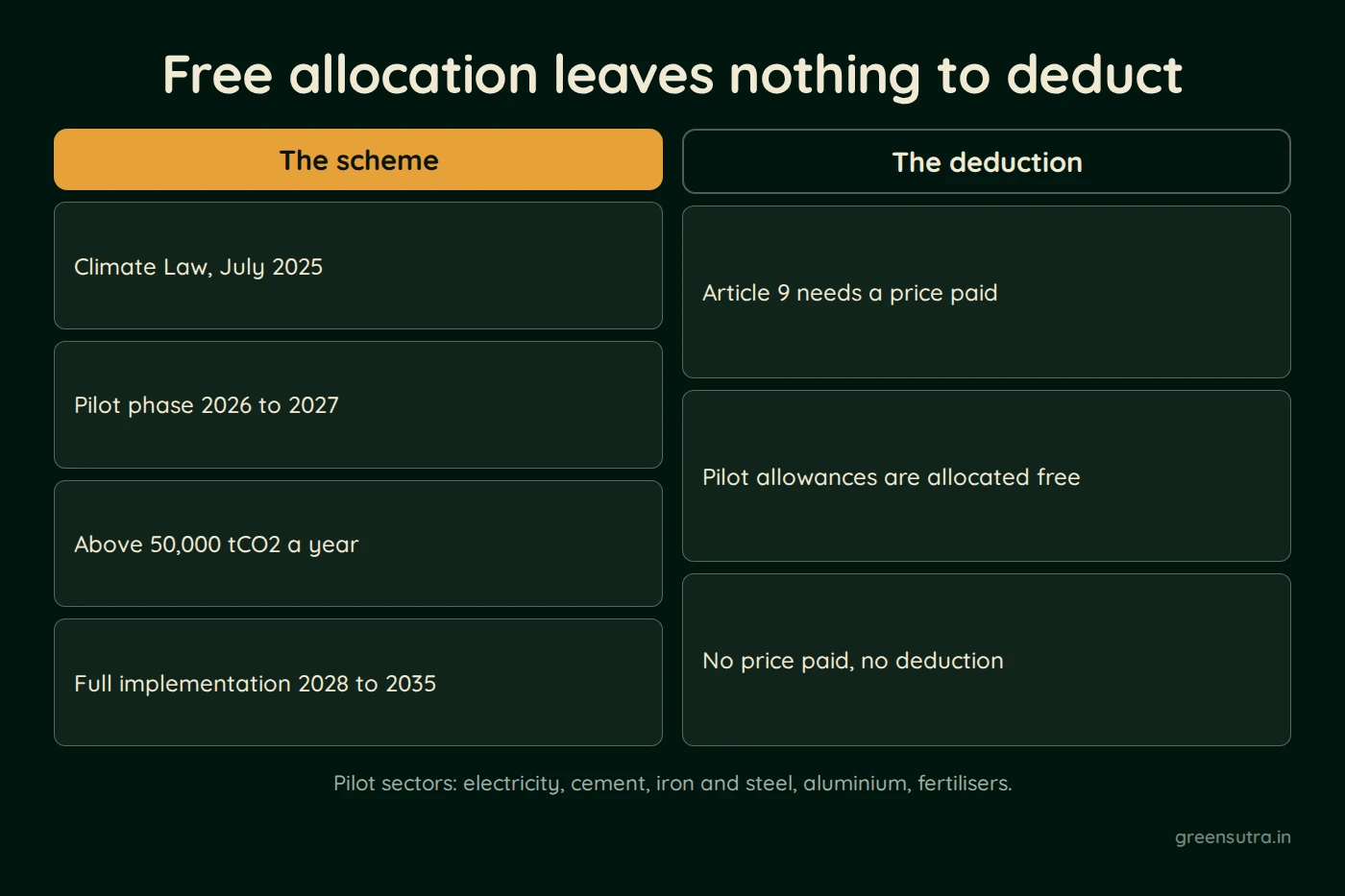
| Element | Position |
|---|---|
| Legal basis | Climate Law, July 2025 |
| Pilot phase | 2026 to 2027 |
| Coverage threshold | Installations emitting more than 50,000 tCO2 a year |
| Sectors | Electricity, cement, iron and steel, aluminium, fertilisers, ceramics, chemicals and refining |
| Pilot allocation | Free of charge |
| Full implementation | Planned 2028 to 2035 |
| Oversight | Carbon Market Board under the Ministry of Environment, Urbanisation and Climate Change, with Energy Exchange Istanbul operating the registry |
Why free allocation matters for Article 9
Article 9 permits a reduction in CBAM certificates to be surrendered where a carbon price has been effectively paid in the country of origin. Free allocation creates a surrender obligation but not a payment. On the face of the provision, an allowance received at no cost and surrendered does not represent a price effectively paid.
That reading is analysis rather than a published ruling. No adopted Commission instrument has decided how freely allocated pilot-phase allowances are treated for Article 9 purposes. An exporter planning on the basis that TR ETS participation will reduce its EU exposure during the pilot is planning on an assumption, and the position should be checked against the Commission instrument on carbon price paid in third countries before it is relied on.
What changes in 2028
The move from free allocation toward the full phase from 2028 is when the Article 9 question becomes materially different, because a price actually paid begins to exist. Until then the practical benefit of TR ETS participation to a Turkish exporter is the monitoring infrastructure it forces into place, which is the same data an EU customer needs.
Sources: Regulation (EU) 2023/956, ICAP, Turkish Emission Trading System
The monitoring data built for TR ETS is the same asset an EU buyer needs for CBAM. CBAM solutions covers embedded emissions calculation for exporters, and the CBAM guide sets out how a carbon price paid in the country of origin is treated.