


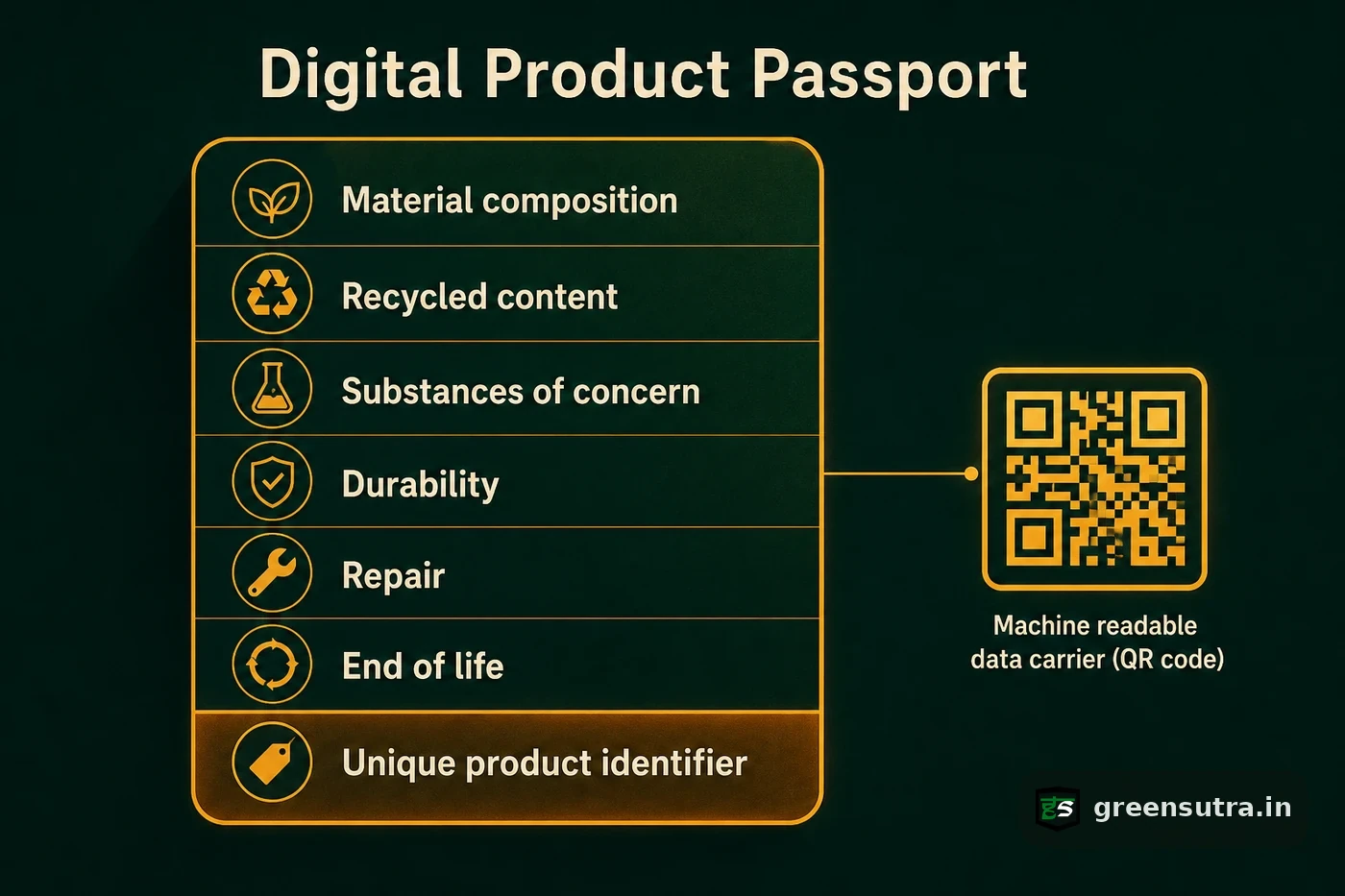
A Digital Product Passport is a structured electronic record introduced by the EU Ecodesign for Sustainable Products Regulation. It holds a product’s identity, material composition, recycled content, substances of concern, durability, repair and end of life information, and is reached by scanning a machine readable data carrier. The exact data set is fixed product group by product group in delegated acts.
The record and its core contents
The Digital Product Passport is a structured electronic record introduced by the Ecodesign for Sustainable Products Regulation, Regulation (EU) 2024/1781. It holds information about a product across its life, linked to a unique product identifier and reached by scanning a machine readable data carrier such as a QR code. Under Article 9 the data must be accurate, complete and up to date. Annex III of the ESPR lists every element a delegated act can require. Besides the product data in the table below, it covers the unique product identifier, the GTIN and commodity codes such as TARIC. Compliance papers belong there too: the declaration of conformity, technical documentation, certificates, manuals and safety information. So do the manufacturer, the importer and its EORI number, the EU-based responsible operator, and the service provider holding the back-up copy.
| Data the record holds | Detail |
|---|---|
| Product identity | A unique product identifier, with unique operator and facility identifiers to the standards in Annex III |
| Material composition | The materials that make up the product across the value chain |
| Recycled content | The share of recycled input in the product |
| Substances of concern | Hazardous or restricted substances present |
| Durability and repair | How long the product lasts and how it is maintained and repaired |
| End of life information | How the product is treated at end of life |
Access, integrity and availability
The passport is more than a data list. Under Article 11 it must be interoperable, give listed actors free and easy access according to their access rights, and keep the data authenticated and intact. The actors named include consumers, repairers, recyclers, market surveillance authorities and customs, each seeing the information their role allows. Each delegated act sets how long the passport must stay available, and ESPR Article 9(2)(i) makes that at least the product’s expected lifetime. The passport must remain available for that period even if the operator becomes insolvent or stops trading in the EU. A back-up copy held by an independent DPP service provider is a separate duty under Article 10(4).
The specifics are set product group by product group
The framework sets the baseline; the detail is delegated. Under Article 9(1) and Article 4, the specific requirements, which data fields, which data carrier, the access rights, whether the passport sits at model, batch or item level, and how long it stays available, are set product group by product group through delegated acts adopted by the European Commission. As of September 2026, no ESPR delegated act for a product group has been adopted. The carrier standards are now published: since 15 July 2026, the EU has cited EN 18219 for unique identifiers and EN 18220 for data carriers. Each delegated act still picks the carrier type, so a QR code, Data Matrix or RFID tag is prepared to fit whatever the act sets. The Digital Product Passport Readiness service assembles this record across the supply chain, the DPP guide sets out each field a passport will need, and a DPP discovery brief opens the engagement.
Sources: Regulation (EU) 2024/1781 (ESPR) · ESPR Chapter III, Articles 9 to 15