


No product needs an EU Digital Product Passport yet. Batteries come first, on 18 February 2027, and other product groups follow one delegated act at a time.
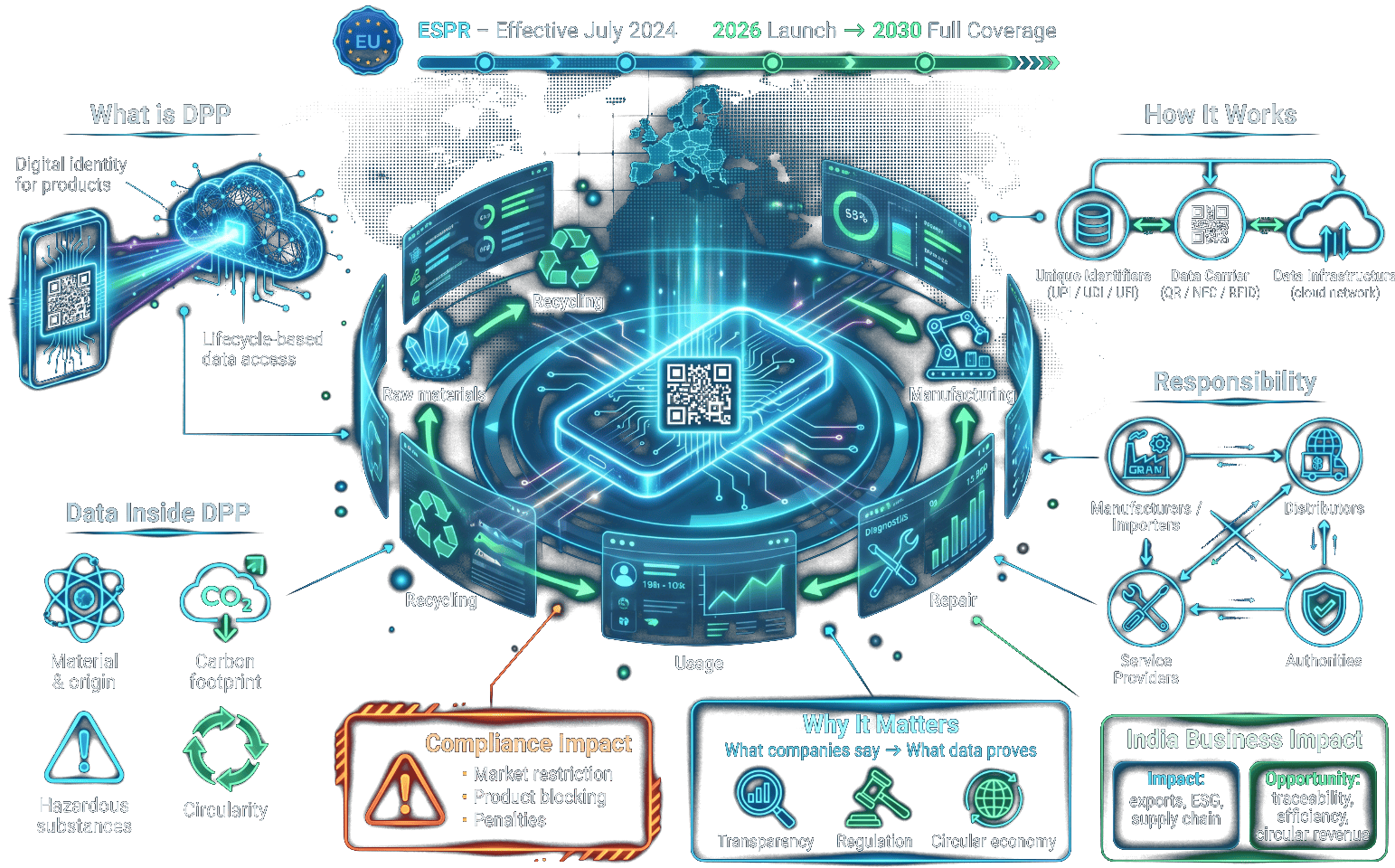
The Ecodesign for Sustainable Products Regulation (ESPR) has been in force since 18 July 2024. Under it, the Digital Product Passport (DPP) becomes a condition of EU market access for each product group that a delegated act covers. Today, that means:
- The Commission’s FAQ says “there is no general obligation for a product to have a DPP”. A product needs one only once a delegated act for its group applies.
- From 18 February 2027, electric vehicle, light means of transport and industrial batteries above 2 kWh need a battery passport.
- Each ESPR delegated act applies at least 18 months after it enters into force. The first act, for iron and steel, is planned for late 2026.
- The EU DPP registry opened on 20 July 2026. The Commission’s user guide of 16 September 2026 says no passport can be registered yet.
- Other laws add passports for detergents from 23 September 2029, toys from 1 August 2030, and cars and vans from 1 September 2032. Construction products follow 18 months after their own delegated act.
What is the Digital Product Passport?
ESPR Article 2(28) defines the DPP as “a set of data specific to a product” that is “accessible via electronic means through a data carrier”. The rest of ESPR adds these points:
- Contents: the information that the product group’s delegated act requires, such as materials, recycled content, substances of concern and repair details.
- Data Carrier: a QR code, a data matrix or an RFID tag, linked to a unique product identifier.
- Readers: customers, repairers, recyclers, market surveillance authorities and customs. Each sees only what its access rights allow.
- Level: a product model, a batch or a single item, as the delegated act decides.
- Availability: at least the product’s expected lifetime, even if the company that created it closes.
What information does a DPP contain?
Each delegated act picks the data for its product group from the list in ESPR Annex III. The fields usually fall into five groups:
- Material & Origin: material composition, recycled content and, where the act asks for it, the origin of raw materials.
- Sustainability Metrics: performance data such as durability, repairability or a carbon footprint, where the act sets one. For batteries, Commission guidance leaves the carbon footprint empty at launch in February 2027.
- Substances of Concern (SoC): each substance’s name, its location in the product and its concentration, plus safe-use information, as ESPR Article 7(5) requires.
- Circular Pathways: information on disassembly, repair, maintenance, reuse, recycling and end of life.
- Identity & Compliance: the unique product identifier, commodity code, declaration of conformity, manuals and safety information, manufacturer and importer details with the EORI number, and who holds the back-up copy.
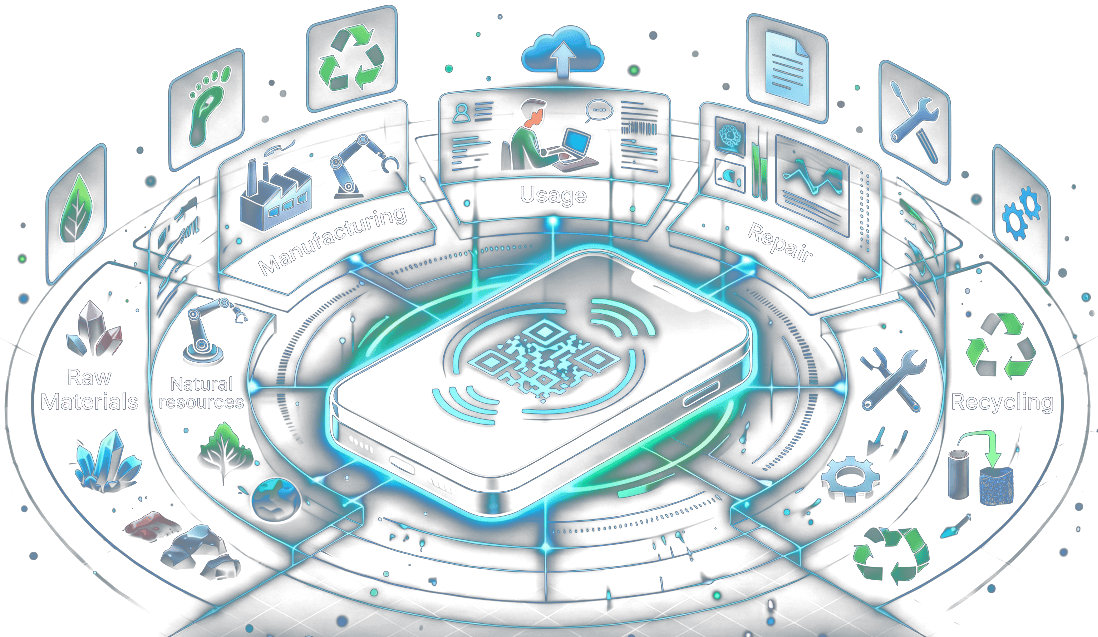
Regulatory Backbone: Ecodesign for Sustainable Products Regulation (ESPR)
The DPP is established by ESPR, Regulation (EU) 2024/1781, which entered into force on 18 July 2024. Articles 9 to 11 set the core requirements every passport must meet:
- Standardised Data Formats: open standards, machine-readable and transferable, without vendor lock-in.
- Persistent Identifier: the passport links through a data carrier to a persistent unique product identifier.
- Digital Accessibility: the data carrier is on the product, its packaging or the documents that come with it.
- Access Rights: each reader sees what the product group’s rules allow, and customer personal data needs explicit consent.
- Back-up & Continuity: an independent DPP service provider holds a back-up copy, and the passport stays available if the company closes.
- Harmonised Standards: six European standards were cited on 15 July 2026, including EN 18219 for identifiers and EN 18220 for data carriers.
Who is responsible?
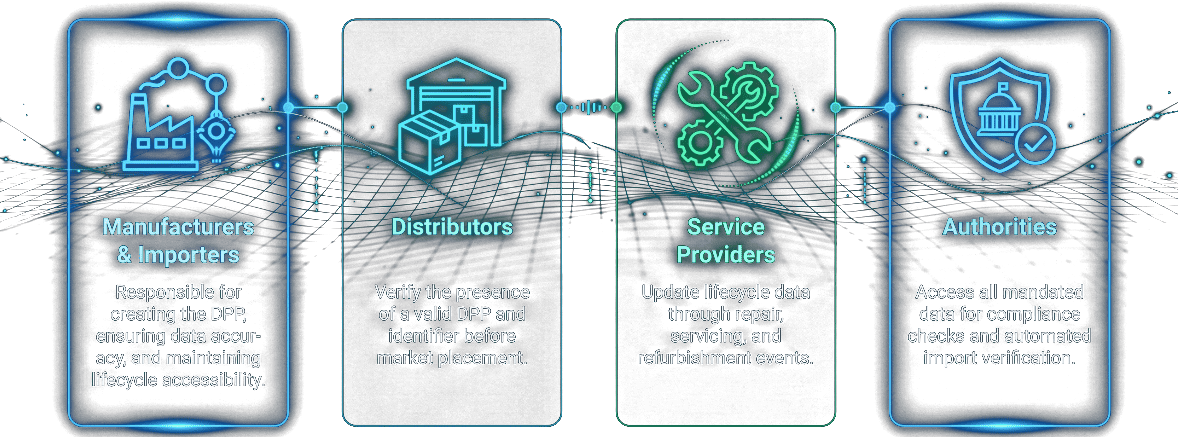
Responsibility lies with the economic operator placing the product on the EU market. ESPR splits the duties this way:
- Manufacturers: make the passport available with a back-up copy, keep its data accurate and up to date, and add their contact details.
- Importers: check that the passport and its back-up exist before placing the goods on the market, and add their own details, including the EORI number.
- Distributors: check that the product is linked to a passport before making it available.
- Dealers & Online Marketplaces: make sure customers can reach the passport easily, in shops and online. The operator placing the product sends them a digital copy of the data carrier within five working days of a request.
- DPP Service Providers: independent third parties that store passport data or the back-up copy for the operator. They may not sell or reuse the data.
An importer or distributor that sells under its own name, or changes the product, takes on the manufacturer’s duties.
How does the DPP system work?
The passport data stays with each operator or its DPP service provider. The system has five parts:
- Unique Identifiers:
1. Unique Product Identifier (UPI): links the specific product to its passport.
2. Unique Operator Identifier (UOI): identifies the businesses in the value chain.
3. Unique Facility Identifier (UFI): identifies manufacturing or treatment sites. - Data Carrier Layer: a QR code, data matrix, NFC or RFID tag connects the physical product to its passport.
- Data Storage: an independent DPP service provider keeps a back-up copy of each passport.
- EU DPP Registry: holds each product’s identifiers and, for imports, the commodity code.
- Customs Link: once the registry connects to the EU customs single window, customs will check the registration identifier and commodity code against it automatically. The connection is due by 6 August 2030.
Significance of the Digital Product Passport
- Circularity and Resource Efficiency: repairers, remanufacturers and recyclers get the technical and disassembly information their work needs.
- Informed Choices: customers and business buyers can compare durability, repairability and substances before they buy.
- Regulatory Compliance: market surveillance and customs authorities can check a product’s identifier against the registry and read its compliance documents.
- Competitiveness: a company that keeps accurate product data for the passport can reuse it to answer EU buyers and authorities. The same data supports repair and product-as-a-service models.
- Data Integrity and Trust: ESPR Article 11 requires data authentication, reliability and integrity, and passports designed so that fraud is avoided. A green claim can then be checked against the passport data.
- Traceability: identifiers link each product to the businesses and sites involved, and substances of concern stay traceable through the product’s life.
- Environmental Goals: the passport is an ESPR tool, and ESPR follows from the European Green Deal. The Green Deal’s Climate Law sets the target of cutting net greenhouse gas emissions by at least 55% by 2030, compared with 1990.
Implementation Timeline
Each date carries a label: Binding for dates fixed in law, Live for systems already running, Planned for Commission plans that can move, and Example for a calculated date.
- 15 July · Binding: six harmonised DPP standards cited in the Official Journal.
- 19 July · Binding: large companies may no longer destroy unsold apparel and footwear.
- 20 July · Live: the EU DPP registry opens with a test environment. Registration is not yet possible.
- Q4 · Planned: the first ESPR delegated act, for iron and steel.
- 18 February · Binding: passports for electric vehicle, light means of transport and industrial batteries above 2 kWh, and QR codes on all batteries.
- Q2 · Planned: the delegated act for construction products. Their passport follows 18 months later.
- 2027 · Planned: delegated acts for textiles, tyres and aluminium.
- September 2028 · Example: the earliest date the steel passport could apply, if its act is adopted in December 2026 and enters into force about three months later.
- 2028 · Planned: the delegated act for furniture.
- 23 September 2029 · Binding: detergent passports, which list every intentionally added substance in each product.
- 2029 · Planned: delegated acts for mattresses and for recycled content in electrical and electronic equipment.
- 1 August · Binding: toy passports, which replace the EU declaration of conformity.
- 6 August · Binding: the latest date for automatic customs checks against the registry.
- 1 September · Binding: a Digital Circularity Vehicle Passport for each new car and van placed on the market.
Related reading on GreenSutra:
- Digital Product Passport guide: the rules in depth, with primary sources.
- EU battery passport: which batteries need one from 18 February 2027.
- Digital Product Passport solutions: how GreenSutra prepares exporters for the passport.
- CBAM solutions: the EU’s carbon border charge on imports such as steel, aluminium and cement.
Primary sources:
