


The EU battery passport is an electronic record that Article 77(1) of the Batteries Regulation (EU) 2023/1542 requires from 18 February 2027. It covers every light means of transport battery, every electric vehicle battery and every industrial battery above 2 kWh. Commission guidance of 15 August 2026 leaves its carbon footprint, responsible sourcing and recycled-content fields empty at that start.
What the EU battery passport is
The battery passport is an electronic record set up by the Batteries Regulation, Regulation (EU) 2023/1542. The Regulation was published in the Official Journal on 28 July 2023 and has applied generally since 18 February 2024. It is reached by scanning a QR code carried on the battery and forms part of the wider Digital Product Passport framework shaped by the Ecodesign for Sustainable Products Regulation (EU) 2024/1781. Readiness for both records is the focus of GreenSutra’s Digital Product Passport readiness service, which maps product data against each obligation before it applies.
Which batteries need one, and from when
Under Article 77(1), the battery passport applies from 18 February 2027. Scope precision matters. The greater-than-2 kWh threshold attaches only to industrial batteries, while all light means of transport (LMT) and all electric vehicle batteries are in scope regardless of capacity. Portable and consumer batteries below those thresholds fall outside the Article 77 passport.
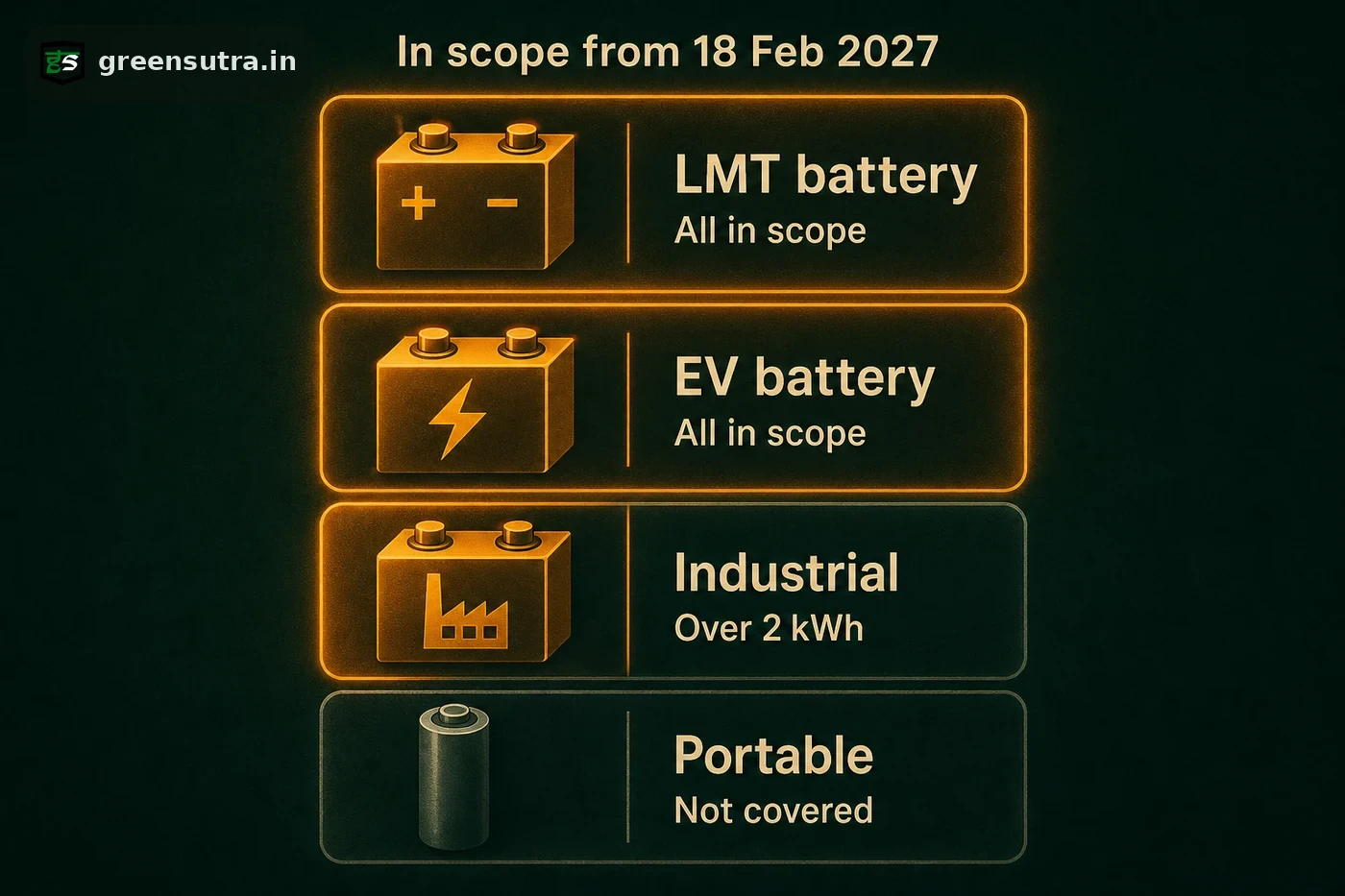
| Battery category | In scope from 18 February 2027 |
|---|---|
| Light means of transport (LMT) | All, regardless of capacity |
| Electric vehicle | All, regardless of capacity |
| Industrial | Only where capacity exceeds 2 kWh |
| Portable or consumer | Not covered by the Article 77 passport |
What the passport must carry
The passport must carry, as set out in Annex XIII:
- a carbon footprint declaration under Article 7;
- recycled-content information under Article 8;
- battery identity, performance and durability data;
- supply-chain due-diligence information.
Three of these four items stay empty when the passport starts on 18 February 2027. The Commission’s battery passport guidance, version 2.0 of 15 August 2026, marks carbon footprint, responsible sourcing and recycled content as not filled at launch. The carbon footprint declaration starts at least 12 months after two Commission acts, on the calculation method and the declaration format, enter into force. Responsible sourcing waits for battery due diligence, which Regulation (EU) 2025/1561 moved to 18 August 2027. All carbon footprint verification is the remit of independent accredited third parties, not of any advisory consultant. Access to the record is tiered under Article 77(2) and Annex XIII: a public subset, a tier for notified bodies, market surveillance authorities and the Commission, and a tier for persons with a legitimate interest such as repairers, remanufacturers and recyclers. Across GreenSutra’s DPP work, battery producers most often underestimate how far up the supply chain the declared data must be gathered. The DPP readiness guide sets out the steps that turn these dates into a practical plan.
Sources: Regulation (EU) 2023/1542 · Regulation (EU) 2024/1781