


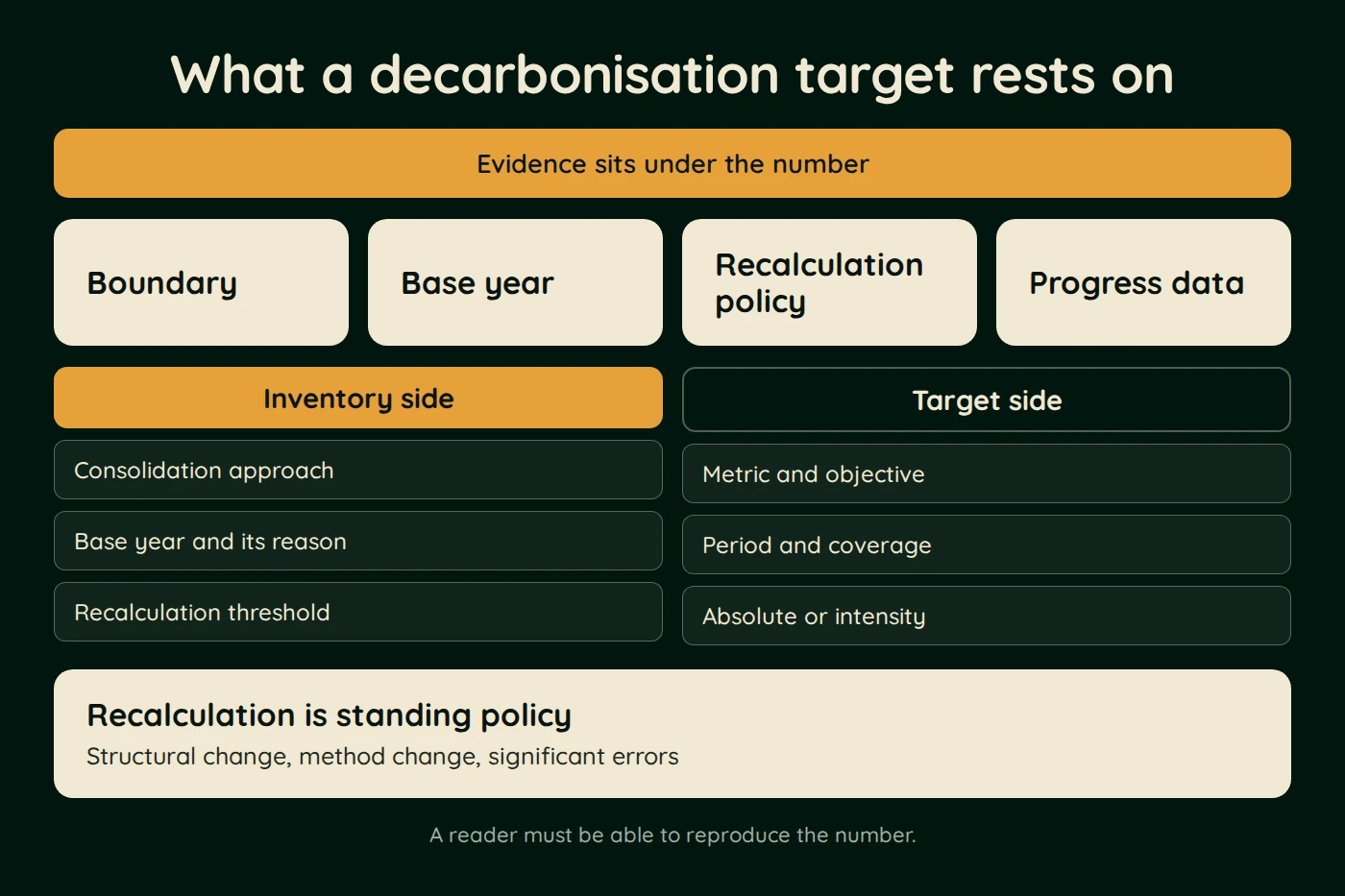
A decarbonisation target is evidenced by the inventory chain behind it, not by the headline percentage: a declared organisational boundary, a base year for which verifiable data exist, a written recalculation policy, and progress reported on that same basis. The GHG Protocol Corporate Standard sets those items. IFRS S2 sets what the target itself must declare.
Two targets stated in identical words can rest on entirely different accounting. The defensible part of a claim is not the percentage, it is the record that lets a reader reproduce the number.
The inventory record a target sits on
The GHG Protocol Corporate Accounting and Reporting Standard fixes the accounting foundation. Boundary comes first: companies shall account for and report consolidated greenhouse gas data on either the equity share or the control approach. The base year is tied to evidence rather than convenience: the Standard requires a year for which verifiable emissions data are available, plus a stated reason for choosing it. Recalculation is a written standing policy, not an ad hoc adjustment.
| Element | What has to be on the record | Where the Standard sets it out |
|---|---|---|
| Organisational boundary | The consolidation approach chosen, equity share or control | Chapter 3 |
| Operational boundary | Which scopes are covered, and if Scope 3 is included, which activity types | Chapter 9 |
| Base year | The year chosen, and the reason it was chosen | Chapter 5 |
| Recalculation policy | The significance threshold applied, and consistent application of it | Chapter 5 |
| Progress data | An emissions profile over time consistent with that recalculation policy | Chapter 9 |
Three cases trigger recalculation: structural change with a significant effect on base year emissions, a methodology change or an accuracy improvement with the same effect, and discovery of significant or cumulatively significant errors. The Standard makes no recommendation on what counts as significant; determining and disclosing that threshold falls to the reporting organisation. It notes only that some greenhouse gas programmes set numerical ones, its worked example being a programme threshold of 10 percent of base year emissions on a cumulative basis.
What the target statement itself declares
IFRS S2 supplies the target-side list. For each climate-related target, an entity discloses:
- the metric used and the objective of the target
- the part of the entity covered and the period the target runs over
- the base period from which progress is measured
- any milestones and interim targets
- whether a quantitative target is absolute or intensity based
- how the latest international agreement on climate change has informed the target
- for emissions targets, the gases and scopes covered, whether the target is gross or net, whether a sectoral decarbonisation approach was used, and any planned reliance on carbon credits
IFRS S2 paragraph 34 then addresses the approach to setting and reviewing each target, including whether the target and its methodology have been validated by a third party. That validation is covered separately in how the SBTi validates a net zero target.
Sources: GHG Protocol Corporate Standard, IFRS S2 Climate-related Disclosures
ESG solutions covers assembling the boundary record, base year documentation and recalculation policy, so the file is ready for the independent accredited provider that alone performs assurance. The ESG guide sets out how one evidence base is built and reused across disclosure formats. The evidence behind a target belongs to the greenhouse gas and energy data area named in the free emissions data readiness register.