


SBTi target validation follows a defined SBTi Services sequence, commit, develop, submit, validate and communicate, in which a company signals intent, builds a base year inventory across Scope 1, Scope 2 and Scope 3, submits targets on the official form, undergoes independent technical review, then publishes the approved targets on the SBTi dashboard.
What SBTi target validation involves
The Science Based Targets initiative (SBTi) sets criteria for corporate emission reduction targets and validates targets against those criteria through its delivery arm, SBTi Services. Validation is carried out by SBTi Services acting as the independent body, so it is not a service a consultancy can perform. A carbon footprint measurement programme prepares the base year inventory and target framing that precede a submission, while the approval itself rests with SBTi.
The validation steps
The pathway follows a defined sequence, from an initial commitment through to public disclosure of the approved targets.
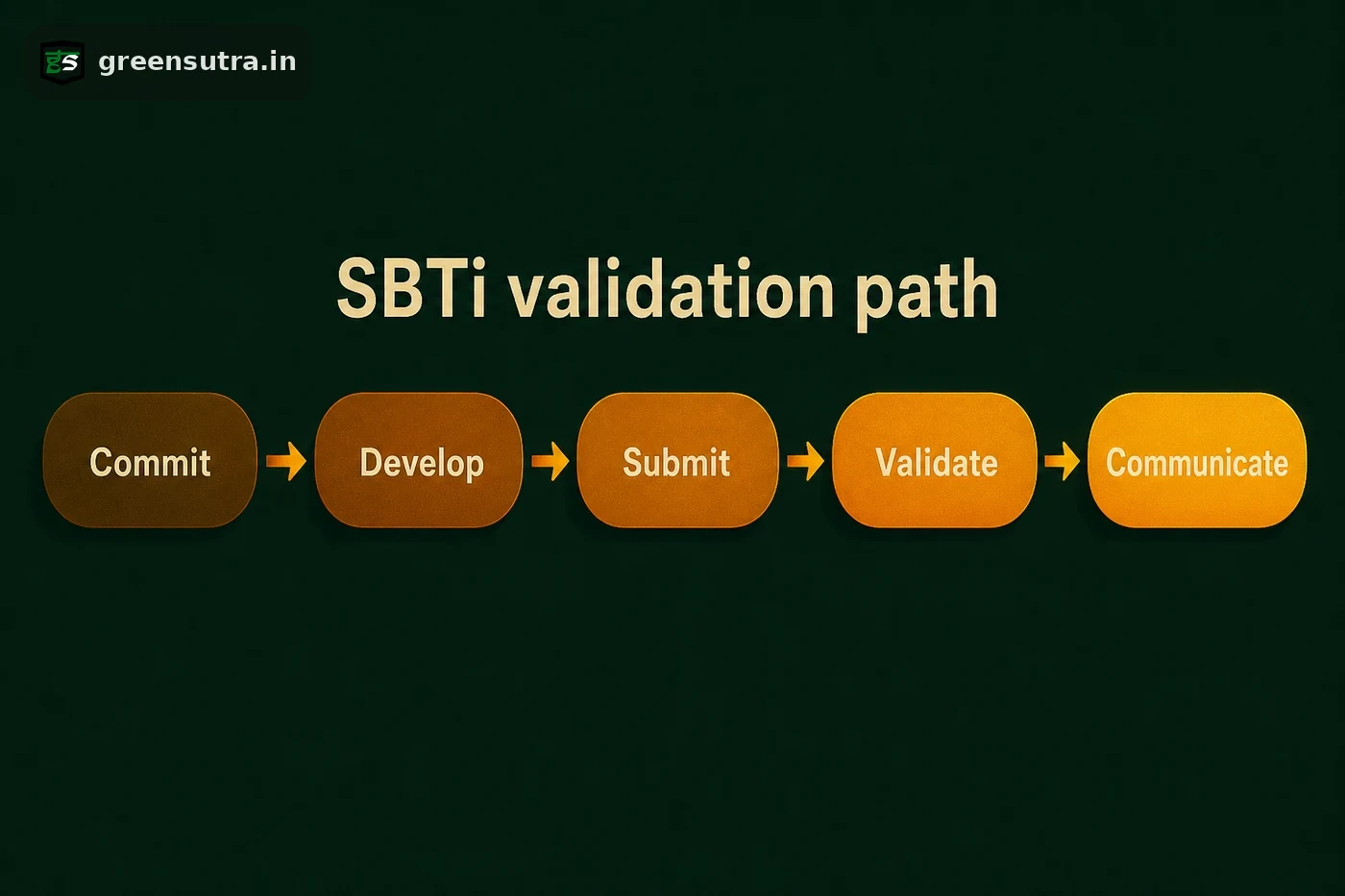
| Step | What happens at this stage |
|---|---|
| Commit | The company signals intent to set a science based target. |
| Develop | A base year inventory is built across Scope 1, Scope 2 and Scope 3, and targets meeting the criteria are drafted. |
| Submit | Targets are submitted on the official form and a validation slot is booked. |
| Validate | SBTi Services conducts a technical review and resolves outstanding questions. |
| Communicate | The approved targets are published on the SBTi target dashboard and disclosed publicly. |
A committed company has a defined window to submit its targets, and a further defined window after validation to communicate them, with the administrative periods set by SBTi Services.
The current standard and where support ends
The current benchmark is the SBTi Corporate Net-Zero Standard Version 2.0, released on 11 June 2026. The previous Version 1.3.1 remains available for use through 31 January 2028, after which Version 2.0 becomes mandatory for all new target submissions from 1 February 2028. The standard pairs:
- Near term targets, covering roughly the next five years.
- A long term target of reaching net zero by 2050 at the latest.
- Residual emissions reduced to approximately ten per cent or less of the base year.
- The remaining residual neutralised through carbon removals rather than avoided emission credits.
Across GreenSutra’s carbon footprint work, the base year inventory is consistently the stage that demands the most groundwork before a credible target can be framed. The carbon footprint guide sets out that inventory method; the target validation and any assurance remain with SBTi and independent accredited bodies.
Sources: SBTi Corporate Net-Zero Standard · SBTi Net-Zero