


Fertilisers carry a flat 1 percent CBAM mark-up on default values, not the escalating 10, 20 and 30 percent applied to cement, steel, aluminium and hydrogen. The Commission set the fertiliser uplift low and flat to limit the cost impact of CBAM on fertiliser prices for EU farmers at launch, not because fertiliser emissions are measured differently.
Fertilisers get the flat 1 percent because the Commission chose to soften how hard CBAM lands on fertiliser prices in the mechanism’s first years. Nitrogen fertiliser is a food-security-sensitive input, and a low, non-escalating uplift keeps the default-value cost from climbing the way it does for other goods. The decision is a policy concession made at the launch of the definitive regime, acknowledged by the fertiliser industry as an effort to address farmers’ concerns, and it is written into Implementing Regulation (EU) 2025/2621. It does not reflect any difference in how fertiliser emissions are measured, because ammonia and urea are assessed under the same embedded-emissions methodology as other covered goods.
What the mark-up is actually for
The mark-up bites only when an exporter relies on a default value instead of verified plant data. A CBAM default value is the country-of-origin emissions figure applied when actual installation data is absent, and the uplift is added on top of it for two reasons: to keep the default conservative for installations whose real emissions sit above their country average, and to give exporters a financial reason to switch to verified actual data. For most goods that uplift escalates each year, so resting on the default grows steadily more expensive. For fertilisers it is held flat.
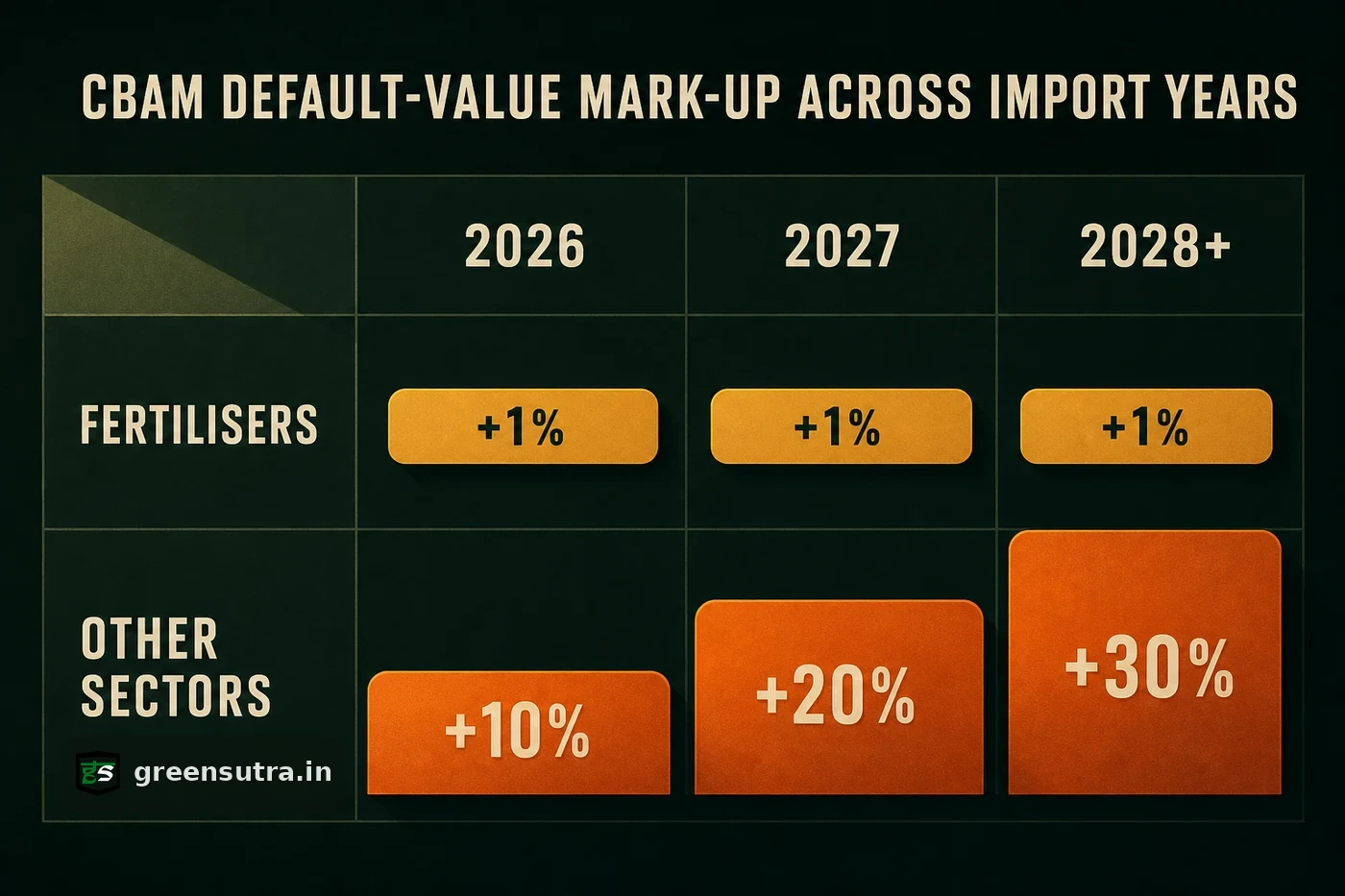
| Sector group | 2026 | 2027 | 2028 onward |
|---|---|---|---|
| Fertilisers | base x1.01 | base x1.01 | base x1.01 |
| Cement, steel, aluminium, hydrogen | base x1.10 | base x1.20 | base x1.30 |
What the flat rate means for a fertiliser exporter
Because the fertiliser uplift stays at 1 percent, the cost penalty for using a default rather than verified data is far smaller than in steel or aluminium, and it does not grow year on year, which lowers the immediate pressure to compile verified figures. Verified installation data still helps, though: a producer whose real emissions sit below the country-of-origin default can declare the lower figure and cut the charge, and that gap is widest for installations cleaner than their national average. CBAM compliance support covers declarant status, embedded-emissions calculation and certificate obligations across the covered goods. A CBAM guide sets out how the mark-up, the default value and the payable share combine into a certificate cost.
Sources: Implementing Regulation (EU) 2025/2621 · Regulation (EU) 2023/956 · European Commission CBAM