


A buyer usually asks for a CDP score, because CDP is opt-in and questionnaire-driven, so a supplier can choose to respond. Commercial ESG ratings are assigned unsolicited from public data. CDP scores run A to D-, with an F awarded for non-response or an incomplete response.
The two look interchangeable on a procurement form and are not. One is a submission a supplier controls; the other is an assessment made about a supplier whether or not it participates.
The structural difference
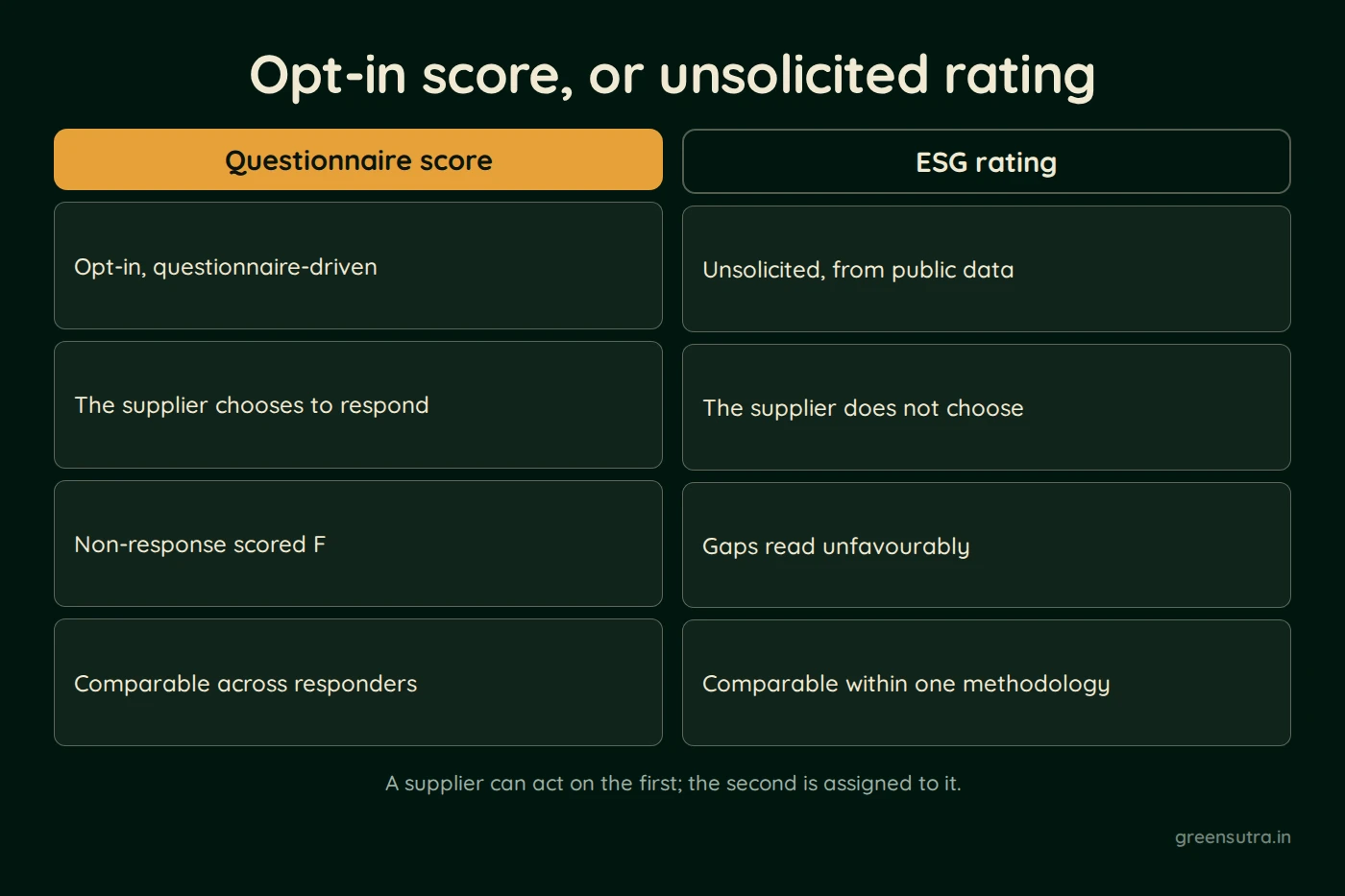
| CDP | ESG ratings | |
|---|---|---|
| Initiation | Opt-in, questionnaire-driven | Unsolicited, from public data |
| Supplier control | The supplier chooses to respond and what to submit | The supplier does not choose to be rated |
| Non-participation | Scored F | Typically rated on available data, with gaps read unfavourably |
| Output | A letter score per questionnaire theme | A rating on the provider’s own scale |
| Comparability | Comparable across responders to the same questionnaire | Comparable within a provider’s methodology only |
How the CDP letter is produced
CDP scoring is a level-based progression rather than a flat percentage. A response climbs four sequential levels, and at each level it must clear both a points threshold and the level’s essential criteria before it can advance:
1. Disclosure, at D, confirming that basic data has been reported properly. 2. Awareness, at C, showing the organisation understands its environmental issues. 3. Management, at B, where policies, targets and action plans are formalised. 4. Leadership, at A, where the strategy is integrated and typically third-party verified.
A company that does not respond, or whose response is judged incomplete, receives an F. That is a scored outcome rather than an absence of one, which is why non-response is visible to a buyer.
Which to prioritise
Where a buyer has named CDP, the answer is settled. Where it has not, CDP generally carries further in a procurement conversation because the supplier can act on it directly within a disclosure cycle, whereas a rating responds only indirectly and slowly to improved public disclosure.
Sources: CDP scoring methodology
Building one evidence set that serves a CDP questionnaire and improves observable disclosure at the same time avoids duplicated work. ESG solutions covers questionnaire response and disclosure structuring, and the ESG guide sets out the underlying data those submissions draw on.