


CEN and CENELEC have published eight European standards for Digital Product Passports, on topics such as identifiers, data carriers and security. Six were cited in the Official Journal on 15 July 2026. A passport that follows those six is presumed to meet Articles 10 and 11 of the Ecodesign for Sustainable Products Regulation (ESPR) on the points they cover.
The eight standards and their status
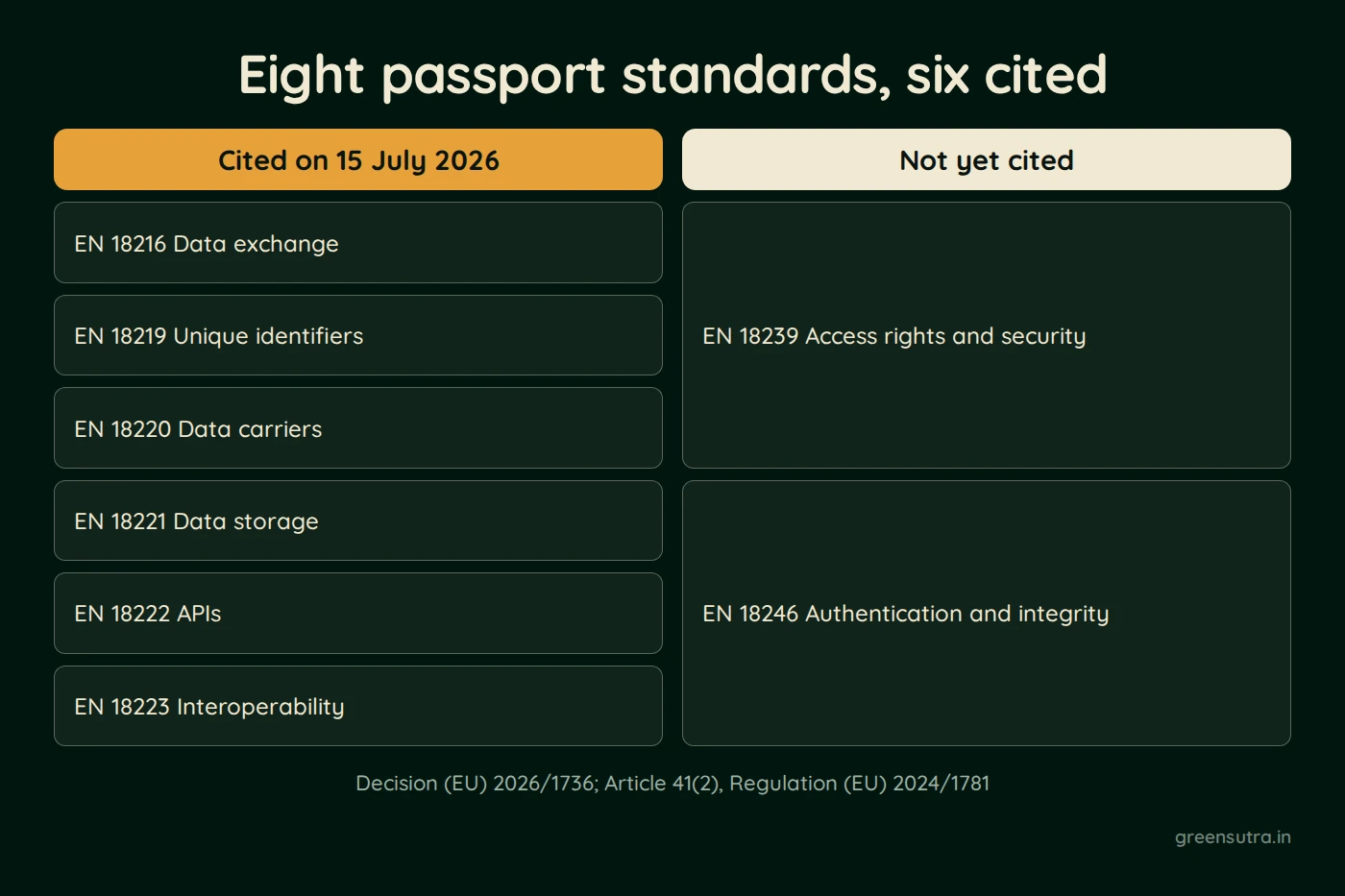
| Standard | Subject | Cited in the Official Journal |
|---|---|---|
| EN 18216 | Data exchange protocols | 15 July 2026 |
| EN 18219 | Unique identifiers | 15 July 2026 |
| EN 18220 | Data carriers | 15 July 2026 |
| EN 18221 | Data storage, archiving and data persistence | 15 July 2026 |
| EN 18222 | APIs for passport lifecycle management and searchability | 15 July 2026 |
| EN 18223 | System interoperability | 15 July 2026 |
| EN 18239 | Access rights management, information system security and business confidentiality | Not yet |
| EN 18246 | Data authentication, reliability and integrity | Not yet |
Who wrote the standards?
The Commission asked for them in standardisation request M/604, Implementing Decision C(2024) 5423 of 31 July 2024, amended in November 2025. CEN and CENELEC’s Joint Technical Committee 24 wrote all eight. CEN-CENELEC lists the first six as published on 27 May 2026 and the last two on 16 September 2026.
Do the standards give a presumption of conformity?
Commission Implementing Decision (EU) 2026/1736 published the references of the first six on 15 July 2026. ESPR Article 41(2) then applies: a passport that conforms to cited standards is presumed to meet Articles 10 and 11 “to the extent” those requirements are covered. Essential requirements for the passport itself, in Article 10, include a data carrier linked to a persistent unique product identifier, open interoperable data and access control. The technical design and operation rules of Article 11 include storage, availability and data integrity.
The standards stay voluntary. Following them is one way to show conformity, and a passport can meet the articles by other means. EN 18239 and EN 18246 give no presumption yet. The Commission’s indicative timeline now places a decision on them in November 2026, after an earlier September date slipped.
How other laws and the registry use them
The toy and detergent regulations require carriers and identifiers to follow the standards that apply under ESPR. The EU passport registry already asks for the unique product identifier as “a URL format compliant with JTC 24 standards”.
ESPR Articles 10(1)(c) and 12(1) tied identifiers and data carriers to the ISO/IEC 15459 series in Annex III, or equivalent standards, only until harmonised standard references were published. The references for EN 18219 and EN 18220 appeared on 15 July 2026. The ISO/IEC 15459 series is still listed in Annex III “where relevant”, so a passport specification should record which standard each identifier and carrier follows.
Sources: Commission Implementing Decision (EU) 2026/1736, Regulation (EU) 2024/1781 (ESPR), DPP Registry user guide, v1.03, CEN/CLC/JTC 24 published standards, European Commission, Digital Product Passport
Standards are sold through national standards bodies, and the DPP guide shows where each one fits. GreenSutra’s Digital Product Passport solutions map a product’s data to these requirements before any software is chosen.