


The EU Digital Product Passport registry is a Commission database that went live on 20 July 2026. It records each passport’s identifiers, the commodity code of imported goods and who registered it and when, while the passport stays with the economic operator or its service provider. Organisations can enrol now, but the Commission’s user guide says no passport can be registered yet.
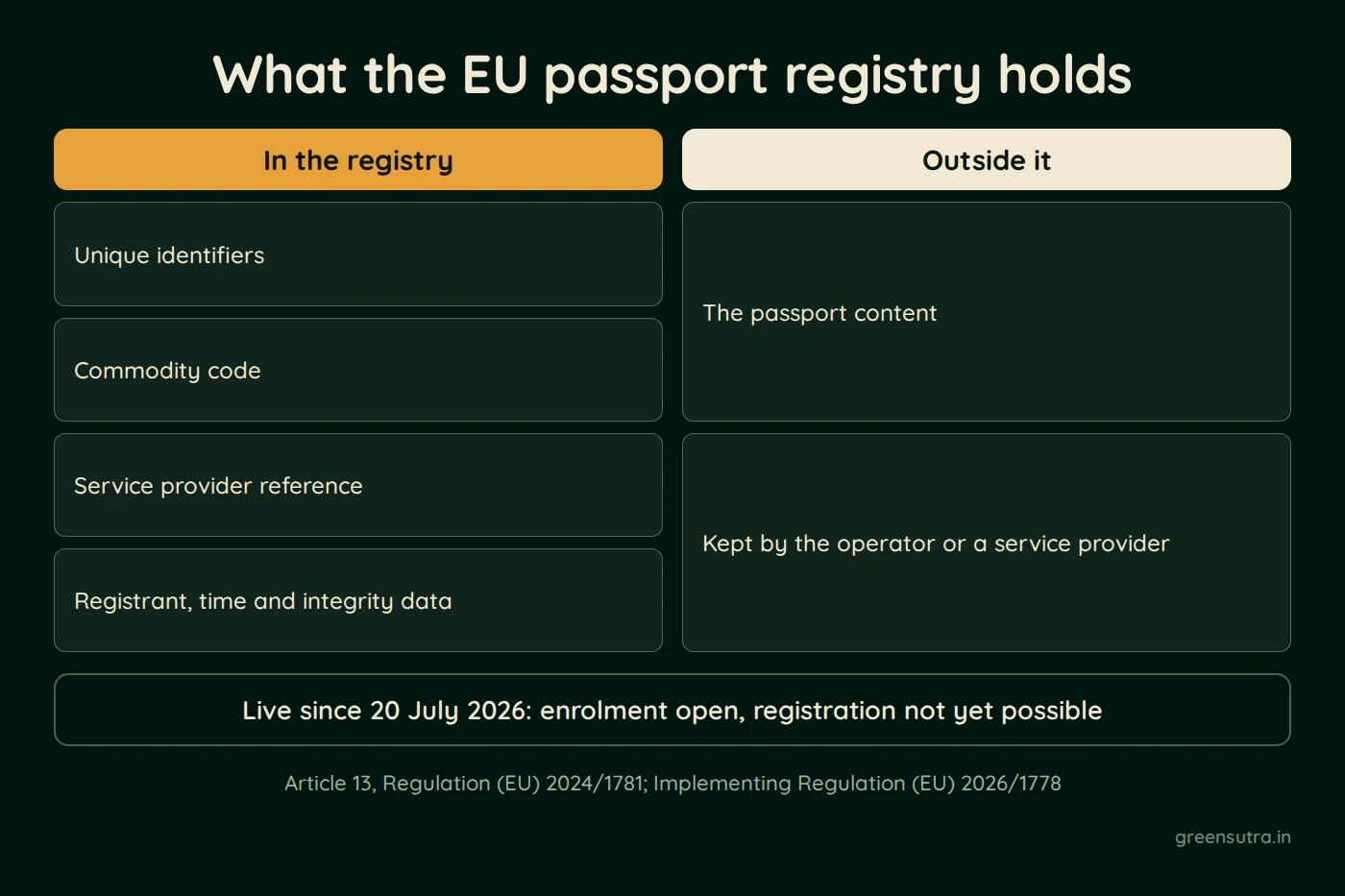
What each registration records
The Ecodesign for Sustainable Products Regulation (ESPR), Regulation (EU) 2024/1781, set a deadline of 19 July 2026 for the registry in Article 13. The Commission launched it on 20 July. Commission Implementing Regulation (EU) 2026/1778, in force since 6 August 2026, gives every registration a persistent registration identifier. Where relevant, each registration also records:
- the unique identifiers
- the commodity code of the product
- a reference to the digital product passport service provider
- the registrant, the date and time of registration and the integrity of the passport
The passport content is not on that list. ESPR Article 11(c) says the operator responsible for the passport, or a service provider, stores it.
Which products does the registry cover?
One registry serves five laws under Article 1 of Regulation 2026/1778: products under ESPR delegated acts, batteries, construction products, toys and detergents. Any other law that requires a passport and its registration joins them. Each law sets whether registration is by model, batch or item. Where two laws differ, the most granular level applies.
Who registers, and how
The upload falls to the economic operator placing the product on the market, under ESPR Article 13(4). A verified third party may also register where Union law provides for it, under Article 8(2) of the implementing regulation. The operator remains fully responsible under Article 19(4).
Identity is proven under the EU electronic identification rules (eIDAS), with a qualified electronic seal or an electronic attestation of attributes. The attestation must be qualified for a company required to be established in the EU. Version 1.03 of the user guide describes one route so far: a Commission-sealed declaration countersigned with a qualified seal. Verified status lasts three years at most. Each upload returns a registration identifier, which ESPR Article 13(5) says is no proof of compliance.
Where things stand on 15 October 2026
Enrolment is open through EU Login, with a separate testing environment. Registration is another matter. “Currently, it is not possible to successfully register DPPs,” says the user guide. No official source gives an opening date. The battery passport, with its upload to the registry under Article 77(10) of the Batteries Regulation, applies from 18 February 2027.
The commodity code matters later at the border, as the customs answer explains, and the toy passport answer shows the registry duty for one product law.
Sources: Regulation (EU) 2024/1781 (ESPR), Commission Implementing Regulation (EU) 2026/1778, DPP Registry user guide for economic operators, v1.03, European Commission, DPP Registry
Which identifiers and data a product needs before registration opens is the first question GreenSutra’s DPP consulting works through. The DPP guide sets out the passport rules law by law.