


An ESG audit trail is the unbroken chain of references that connects a disclosed figure back to the source documents behind it. Every hop, from source record through calculation and aggregation to disclosure, leaves its own reference: the input used, the date, the owner and the version. A trail is complete when a reviewer can walk it without asking a question.
Traceability is a property of the record, not of the number. An ESG metric that cannot be walked back to a dated source document is treated as unsupported, however sound the arithmetic behind it. The trail is built by deciding, before collection begins, what reference each hop will leave behind.
One metric, five hops
Trace a reported figure, purchased electricity at one site, from the utility bill to the printed disclosure. The same five hops apply to any ESG metric. Some hops move the number and some transform it, and every one of them has to leave a reference that outlives the person who did the work.
| Hop | What it produces | Reference that must persist |
|---|---|---|
| Source | Meter reading, invoice, weighbridge slip, payroll extract | Document identifier, issue date, issuing party, storage location |
| Extraction | A value moved into the working file | Field or cell reference, extraction date, name of the person or job that moved it |
| Calculation | Activity data converted to the reported unit | Formula, emission factor, factor publisher and publication year |
| Aggregation | Site figures rolled up to entity or group level | Entity list, consolidation basis, treatment of gaps and estimates |
| Disclosure | The figure printed in the report | Report version, indicator code, approver and approval date |
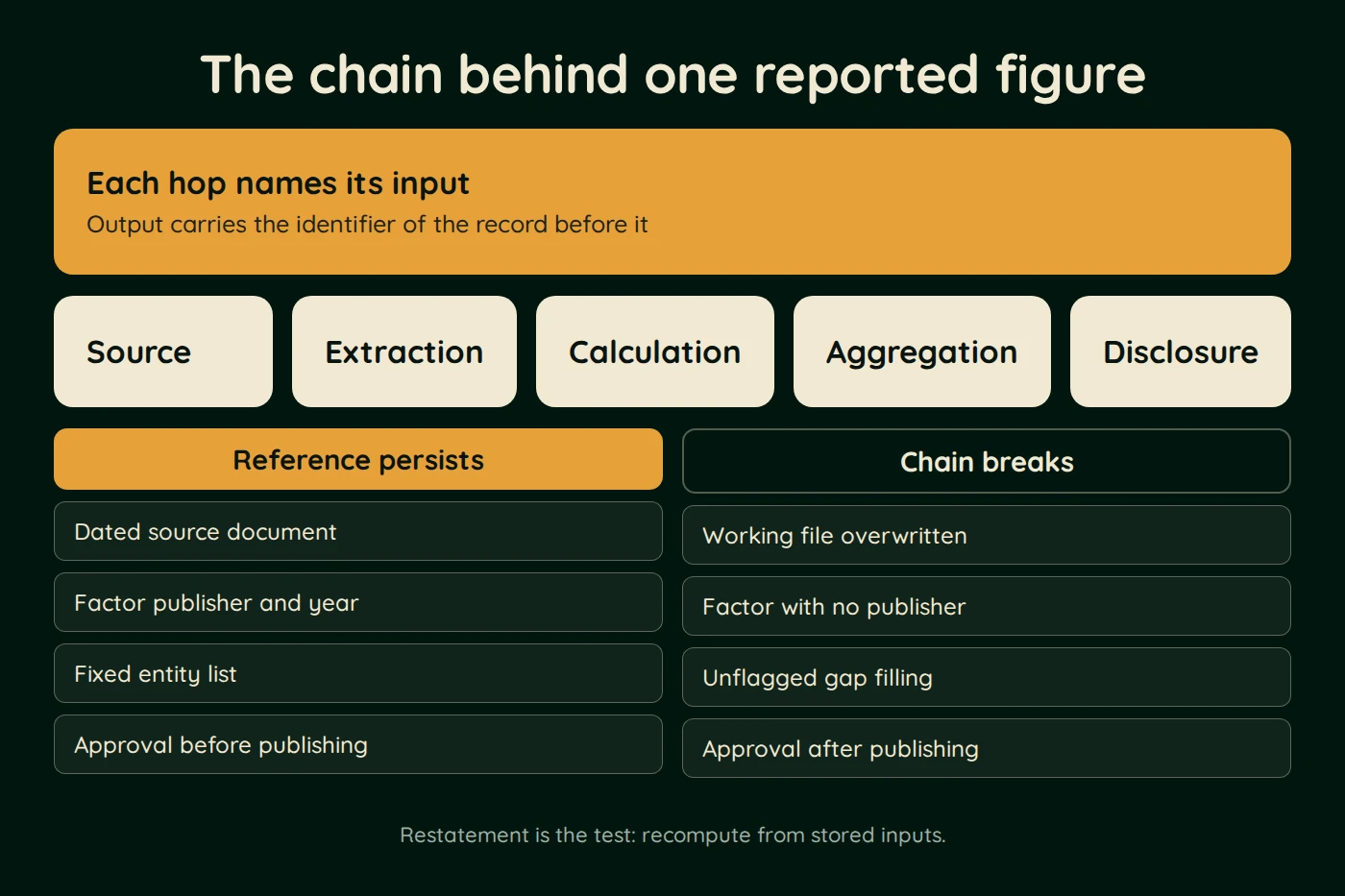
The rule repeats at every hop: the output must name its input. A correctly calculated figure that does not carry the identifier of the record it came from still breaks the chain, because the reviewer cannot close the loop without a conversation.
Where trails break
Most failures are not errors in the metric. They are missing references around it.
- Working files edited in place, so the version that produced last year’s figure no longer exists.
- Emission factors quoted without a publisher and a publication year, which cannot be reproduced.
- Gap filling that is not flagged, so an estimate reads as measured data.
- Roll up totals whose entity list was never fixed, which cannot be reconciled the following year.
- Approval recorded after publication, which cannot evidence review before publication.
Restatement is the honest test. If a factor is revised or a site is divested, a complete trail allows the prior year to be recomputed from stored inputs rather than reconstructed from memory. Structuring that evidence and readying the data file is consulting work. Independent accredited third parties assure the result.
Sources: GRI Standards, GHG Protocol Corporate Standard
The ESG guide sets out the collection and control steps that generate these references. ESG solutions covers evidence structuring and assurance readiness for reported metrics.