


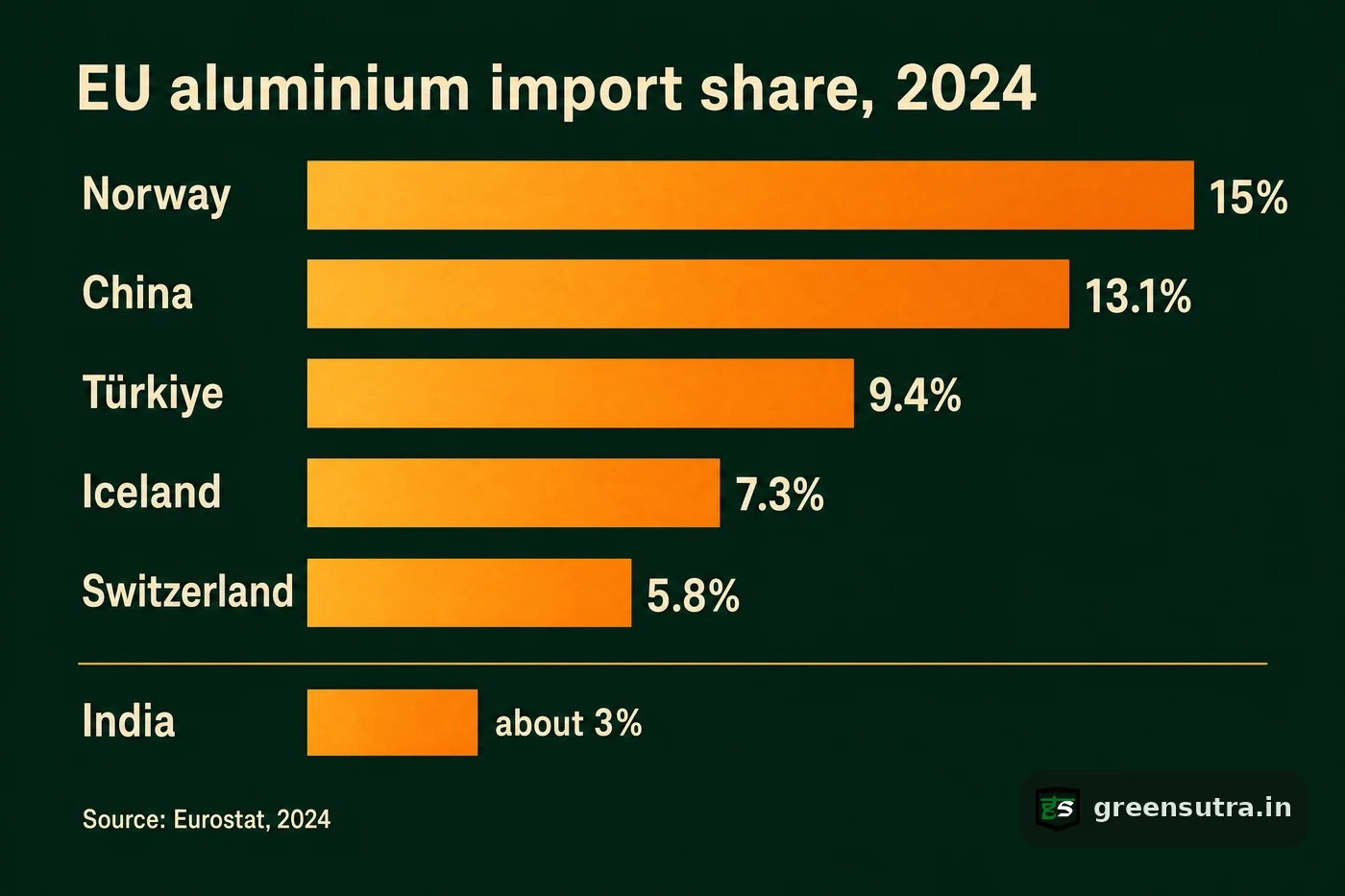
India is a real but mid-tier aluminium supplier to the EU under CBAM: around EUR 0.85 billion in 2024, about 3 percent of imports and outside the top 5. It is home to major primary aluminium producers. India is also the EU’s 5th largest aluminium export destination at EUR 0.8 billion.
India’s position in EU aluminium trade
India ranks as a real but mid-tier aluminium supplier to the European Union. Eurostat data for reference year 2024 puts EU aluminium imports at about EUR 29.6 billion across HS 76, the trade heading that is wider than CBAM’s scope, since it also covers scrap (7602) and household articles (7615). Its share is around EUR 0.85 billion, about 3 percent, outside the top 5, and it is home to major primary aluminium producers. Trade runs both ways: India is the EU’s 5th largest aluminium export destination at EUR 0.8 billion. The full supplier map sits in the sibling answer on top aluminium suppliers to the EU.
| Measure (2024) | Value |
|---|---|
| EU aluminium imports, HS 76 | about EUR 29.6 billion |
| India’s share | around EUR 0.85 billion, about 3 percent |
| India’s rank | mid-tier, outside the top 5 |
| Top 5 suppliers | Norway, China, Türkiye, Iceland, Switzerland |
Source: Eurostat, reference year 2024.
India’s official default sits well below China’s
The official default for Indian unwrought aluminium (CN 7601) in Implementing Regulation (EU) 2025/2621 is 1.87 tCO2e per tonne, against 3.00 for China, before the mark-up. A default is a country average, so an individual smelter’s actual figure can sit above or below it. Aluminium is an Annex II good, so the definitive regime that began on 1 January 2026 prices direct embedded emissions only; the coal-heavy grid behind Indian smelters adds nothing to the certificate obligation unless the scope is later extended to indirect emissions.
The verified-data case for Indian producers
Verified installation data is the strongest lever for Indian exporters. On the default path the unwrought base of 1.87 carries a 10 percent mark-up in 2026, to 2.06. Where a producer’s actual direct intensity is below that marked-up default, its verified figure lowers the cost. The gap widens as the mark-up rises to 30 percent from 2028. Either way, certificates are due for the embedded emissions minus the free allocation adjustment. That deduction shrinks each year: the CBAM factor is 97.5 percent in 2026, and from 2034 nothing is deducted for free allocation. In 2026, 2.5 percent of the benchmark is no longer deducted. That figure is not 2.5 percent of the embedded emissions. An importer may declare actual data or the marked-up default, and actual figures must be verified by an accredited verifier. The first annual declaration falls due on 30 September 2027. Product-level figures sit in the sibling answer on default values for Indian aluminium; exporters can map their exposure through the CBAM discovery intake and engage a CBAM solutions consulting service to prepare installation data for verification.
Sources: Regulation (EU) 2023/956 · Implementing Regulation (EU) 2025/2621 · European Commission, Carbon Border Adjustment Mechanism