


A returned supplier ESG questionnaire is scored by weighting evidence, not intent: each theme is assessed on policies, actions and results, and an unevidenced policy claim earns close to zero rather than partial credit. Weightings are fixed and disclosed before responses arrive. Thresholds set a floor for every supplier; rankings order suppliers against each other.
Scoring is the buyer’s half of the exchange. The supplier decides what to send. The buyer decides what the return is worth, and that judgement has to hold up in front of procurement, an auditor and the supplier that lost the contract.
Why an unevidenced policy scores near zero
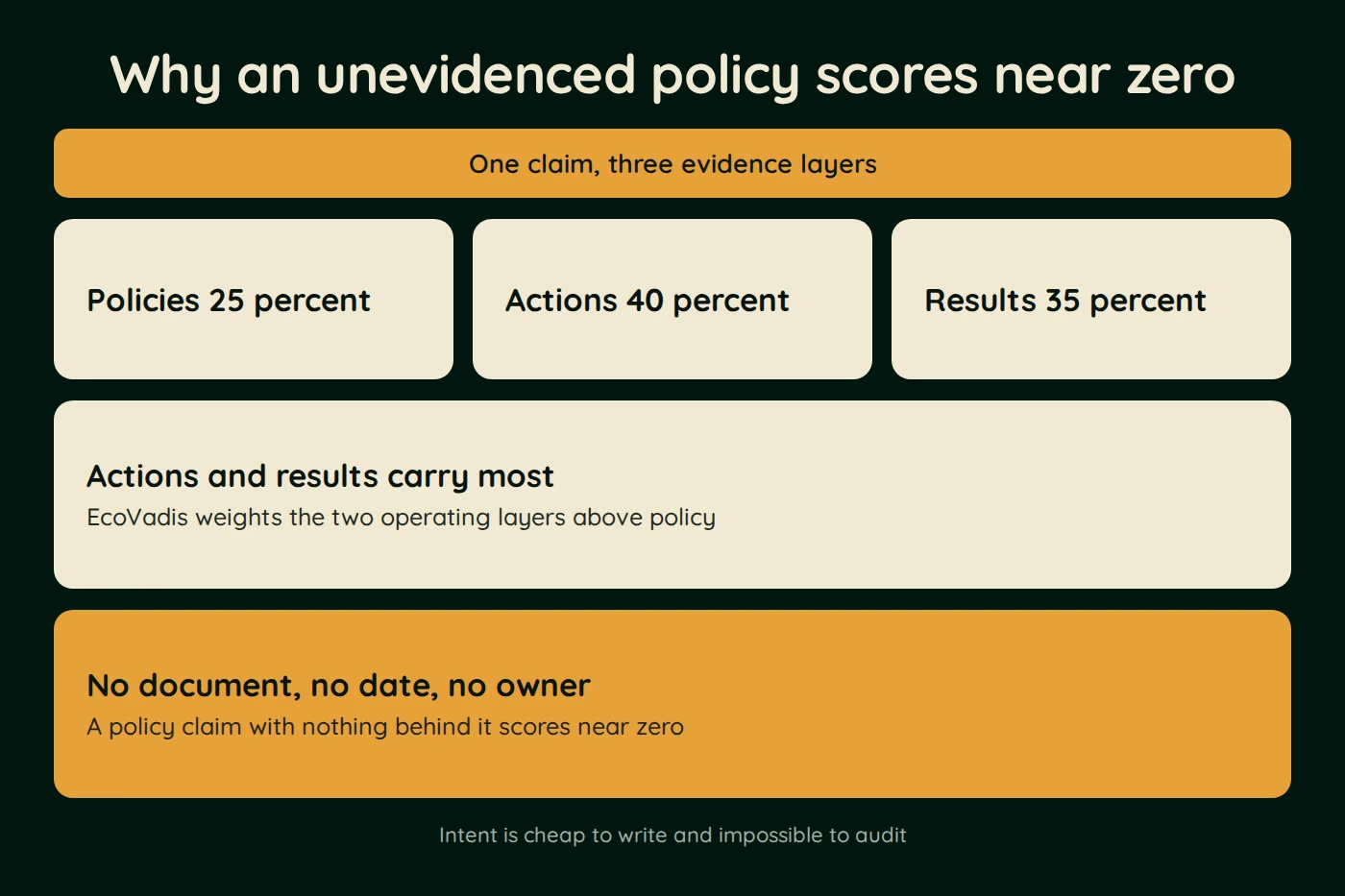
Every claim splits into three layers, and that split is the whole scoring engine. EcoVadis assesses four themes, Environment, Labour and Human Rights, Ethics and Sustainable Procurement, on policies, actions and results across 21 criteria on a 0 to 100 scorecard.
| Evidence layer | EcoVadis weighting | What the layer proves |
|---|---|---|
| Policies | 25 percent | A written commitment exists, with scope and ownership |
| Actions | 40 percent | The commitment operates: procedures, training, audits, contract clauses |
| Results | 35 percent | A measured, dated number moved |
The asymmetry is deliberate. Actions and results together carry most of the theme score, so a supplier with an immaculate policy library and nothing operating behind it sits low on the scale. A buyer scoring rule built on the same shape gives a policy answer carrying no document, no date and no named owner a score near zero rather than partial credit. Intent is cheap to write and impossible to audit.
Thresholds and rankings answer different questions
A weighted score is a number. What the programme does with it is a separate decision, and the two common designs are not interchangeable.
1. A threshold is absolute. Every supplier is measured against a fixed floor, the floor holds while the cohort changes, and year on year movement means something. 2. A ranking is relative. Suppliers are ordered against each other, so a score can fall while a position rises, and remediation targets shift under the supplier’s feet.
Mature programmes use both. EcoVadis medals have been percentile based since 2024, with Platinum at the top 1 percent, Gold the top 5 percent, Silver the top 15 percent and Bronze the top 35 percent of companies assessed, and no individual theme scoring below 30. The percentile decides recognition while the fixed floor stops one failed theme hiding inside a strong average. CDP uses a different design again, scoring its corporate questionnaire across four sequential levels, Disclosure, Awareness, Management and Leadership, so a response that discloses but cannot demonstrate management does not climb.
Sources: EcoVadis ratings methodology, CDP scoring levels
ESG solutions covers assembling and structuring the evidence base a scoring rule of this shape looks for, so a returned questionnaire carries documents rather than adjectives. The ESG guide sets out which records each theme calls for. The platform scores, and independent accredited third parties assure. Where a scored questionnaire is not wanted, the free unscored exposure register names the areas and the gaps without producing a number.