


Biogenic carbon is the carbon a bio based material takes up from the atmosphere as it grows. Under EN 15804 as amended by the A2 revision, an Environmental Product Declaration reports global warming potential split into fossil, biogenic and land use change. Biogenic carbon counts as a removal when the product takes it up and an emission when released.
What biogenic carbon is
Biogenic carbon is the carbon a bio based material, such as timber, draws from the atmosphere as it grows and stores in the product. Fossil carbon, by contrast, comes from oxidising fossil fuels or fossil based materials. A life cycle assessment and the Environmental Product Declaration built on it separate the two, because a product that stores biogenic carbon and one that emits fossil carbon affect the climate differently.
How EN 15804 splits and signs it
EN 15804, the European standard for construction product Environmental Product Declarations, was amended by its A2 revision to report global warming potential not as one number but as separate sub indicators.
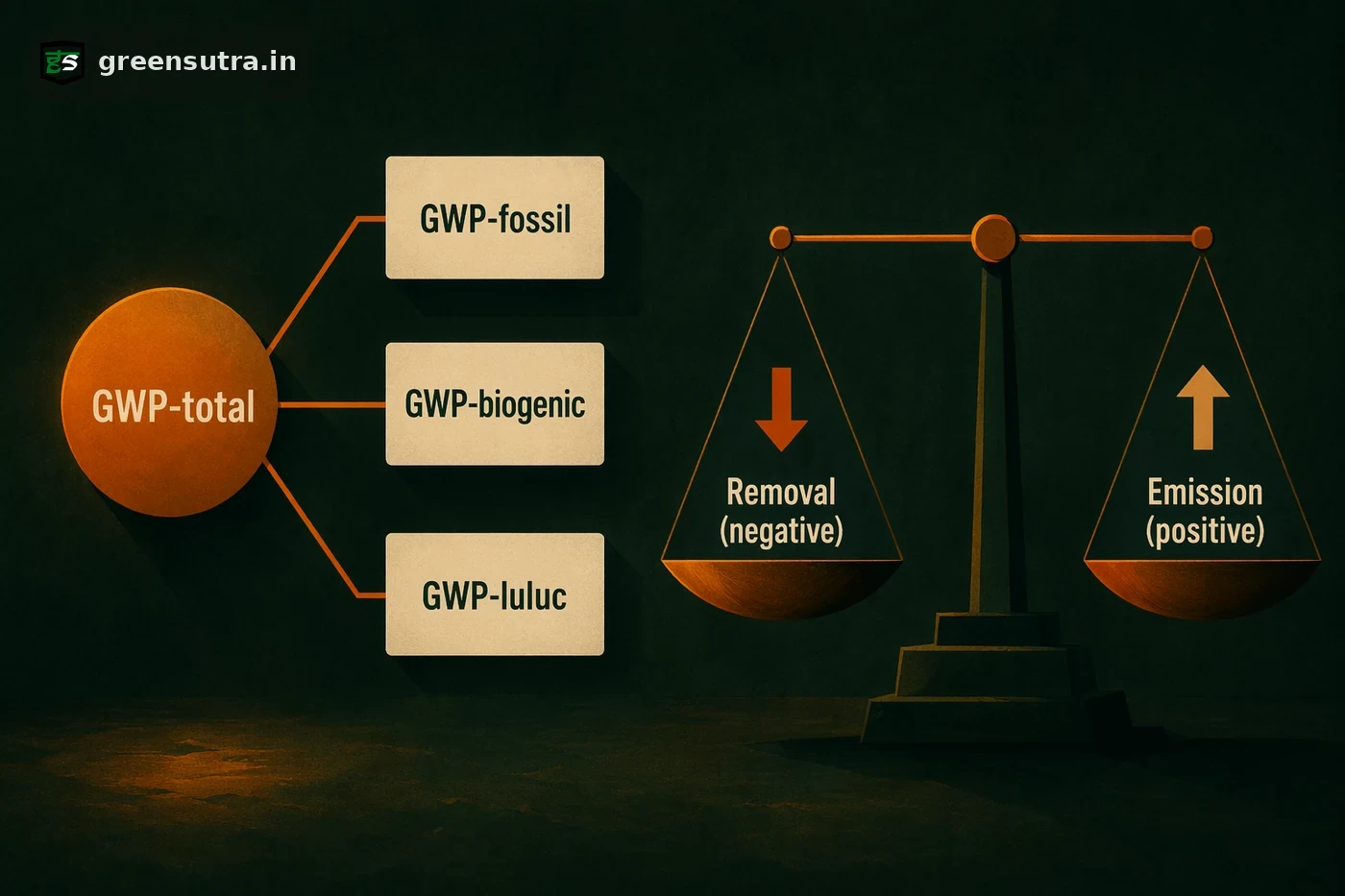
| Indicator | What it covers |
|---|---|
| GWP-total | The sum of the sub indicators below |
| GWP-fossil | Emissions and removals from fossil fuels and fossil based materials |
| GWP-biogenic | Emissions and removals of biogenic carbon dioxide, including carbon stored in the product |
| GWP-luluc | Emissions and removals from land use and land use change |
The sign follows where the carbon flows. When biogenic carbon enters the product in the product stage, as the plant material takes it up, it is recorded as a removal, a negative entry. When that carbon is later released, for example at end of life, it is recorded as an emission, a positive entry. For carbon that is taken up and then released, the two net out across the full life cycle. This is an accounting convention for tracking carbon, not a claim that a product is climate positive.
Traceability, content and where credits sit
The A2 revision requires the whole life of biogenic carbon to be traceable across the life cycle stages, and requires the biogenic carbon content of the product, and separately of its packaging, to be declared. It also follows a modularity and polluter pays principle: emissions and removals are assigned to the stage where they physically occur, and any benefit from future reuse, recovery or recycling is reported separately in Module D rather than folded into the product result. The life cycle assessment service builds the study to ISO 14040 and ISO 14044 and prepares the EPD to ISO 14025 and EN 15804, while an independent programme operator verifies it. The LCA guide sets out how an EPD is declared, and a LCA discovery session scopes the study.
Sources: ISO 14025 · EN 15804 environmental indicators (EPD International) · ISO 14067