Bulk Waste Generator Registration and Compliance

Any site that meets one of three tests under the Solid Waste Management Rules, 2026 is a bulk waste generator and must register on CPCB's portal. GreenSutra handles that registration for the site, then sets up its waste records and files its returns.

Reviewed by Team GreenSutra · Updated 8 November 2026

On recordGoverning rulesSolid Waste Management Rules, 2026Who countsAny one of three testsRegisters onCPCB's SWM portalWaste streamsWet, dry, sanitary, special care
01

What GreenSutra does for a bulk waste generator

For offices, campuses, hospitals, hotels, malls, factories and housing societies that meet one of three tests.

The Ministry of Environment, Forest and Climate Change notified the Solid Waste Management Rules, 2026 on 27 January 2026, and they took effect on 1 April 2026. A site counts as a bulk waste generator if it meets one of three tests. It has 20,000 sq m or more of floor area, uses 40,000 litres of water a day, or produces 100 kg of waste a day. These sites must register on CPCB's portal, keep four waste streams apart, deal with wet waste and file returns.

On site, the staff keep sorting and weighing the waste. GreenSutra turns those weights into returns and keeps the records ready for any check.

Bulk waste generators in 2026, explained

02

The four waste streams a bulk waste generator keeps apart

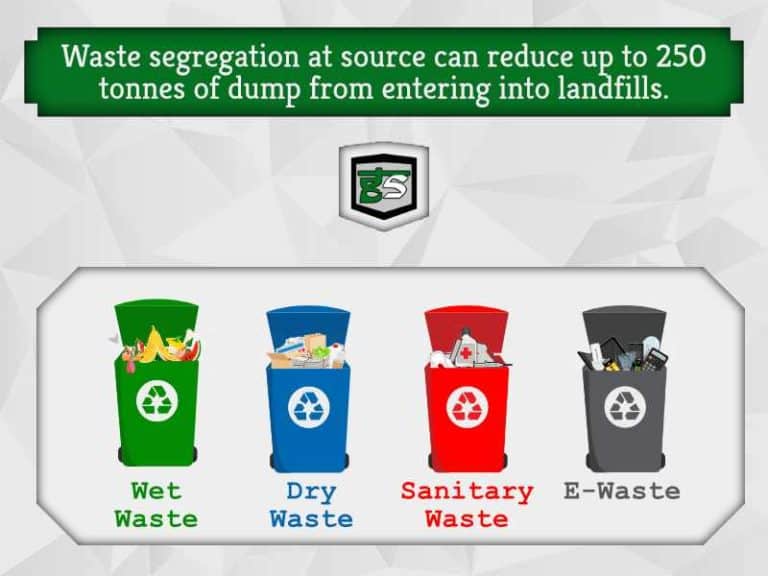
The rules ask every bulk waste generator to keep these four apart.

Wet waste

Kitchen, food, vegetable, meat, fruit and flower waste, and other biodegradable waste.

Dry waste

Paper, plastic, glass, metal and anything else that is not wet, sanitary or special care waste.

Sanitary waste

Used diapers, sanitary napkins, tampons, condoms and incontinence sheets.

Special care waste

Paint drums, pesticide cans, tube lights and CFLs, expired medicines, mercury thermometers, waste batteries, and used needles and syringes.

Sorting starts where the waste is made. GreenSutra reviews how the site sorts today and what has to change.

03

How bulk waste generator registration and compliance runs

Five steps, from the first call to a site that files on time.

Facility manager and consultant check floor area, water use and daily waste against the bulk waste generator tests
01

Check the three tests

A first call covers floor area, water use and daily waste. GreenSutra checks them against the three tests and tells the site whether it must register.

Consultant files a bulk waste generator registration on CPCB's SWM portal while the facility head hands over documents
02

Register on CPCB's portal

GreenSutra prepares the documents and files the application as the site's authorised representative. The site checks and signs the declaration, and the fee is paid at the Pay & Submit step.

Staff weigh segregated waste on a floor scale beside four colour-coded bins and log the daily weight for returns
03

Set up weighing and records

GreenSutra writes a simple weighing routine. The site's staff weigh each of the four streams and log the figures every day.

Kitchen waste goes into an on-site composting machine at a housing society, the wet waste route under SWM Rules 2026
04

Sort out wet waste

A new site processes its wet waste on the premises. An existing site may ask the local body for an exemption instead. GreenSutra compares the options and vendors; the vendor installs and the site runs the plant.

A periodic return is filed on CPCB's portal beside the records binder and EBWGR certificates
05

File returns and keep records

GreenSutra checks the logs and files each return on the portal's schedule, plus the annual return. It also keeps one file ready for the local body, the SPCB or a Special Cell.

04

How EBWGR certificates work

EBWGR stands for Extended Bulk Waste Generator Responsibility. It covers the waste a site does not process itself: all dry, sanitary and special care waste, plus any wet waste not processed on site.

Each EBWGR certificate stands for 1 kg of that waste. Only the site's own local body generates certificates, and each one stays valid for three years. How EBWGR differs from EPR for producers →

Example: a site logging 600 kg a day, half of it wet waste composted on site, sends about 1,09,500 kg a year beyond its own composter. At 1 kg a certificate, that points to about 1,09,500 certificates a year, before CPCB's norms set the final count.

Example only. One certificate stands for 1 kg; CPCB's norms will set the final count.

1122334455667788AABBCCDDEEFFRULESSWM RULES 2026CPCB SWM PORTALCPCB FEE GUIDELINES 2026KEYWETDRYSANITARYSPECIAL CAREWEIGHLOG · FOUR STREAMS01COUNT1 CERT = 1 KG02BUYFROM THE LOCAL BODY03FILEWITH THE ANNUAL RETURN04KEEPVALID 3 YEARS05KG A YEAR0KG NEEDING CERTIFICATES1 CERT = 1 KG0COSTNOT YET NOTIFIEDNOV 2026CERTIFICATES A YEAR0VALID 3 YEARS123ADRAWINGEBWGR CERTIFICATE FLOWSTATUSDWG NOGS·BWG·02REVADATE2026·11
01Weigh

The site logs its waste through the year.

02Count

One certificate covers 1 kg of that waste.

03Buy

Only the site's own local body generates certificates, at a cost it notifies.

04File

The certificates go with the annual return.

05Keep

Each certificate stays valid for three years.

As of November 2026 no local body had notified a cost, so certificates could not be bought yet. GreenSutra buys them for the site once the cost is notified.

05

Bulk waste generator self-check: the three tests

Three steps: the site's figures, the kind of site, then the result with the fee.

Q·01The site's figures
20,000
sq m
40,00000000
litres
100000
kg

No test met yet. Move a gauge or type a figure.

Answers stay in this browser until the form is sent.

06

What the site gets

What the site has in hand once GreenSutra runs the compliance work.

B·01

A registration filed right

The application goes in under the right group and type, with a supporting document the portal accepts.

B·02

A log that fits any schedule

One daily format for the four streams, which turns into each return the portal asks for.

B·03

Returns filed on time

Each periodic return by its due date, and the annual return by 30 June.

B·04

One file for every check

The certificate, logs, receipts, returns and partner registrations, kept together.

Facility team reviews bulk waste generator compliance records, with segregated bins and a composter outside the window
A registered site, its four streams sorted and its records in order
07

Why GreenSutra for bulk waste generator compliance

R·01

Built on CPCB's own material

The work follows the 2026 rules, CPCB's portal FAQ and its seven role manuals.

R·02

One team, start to finish

One team handles the check, the registration, every return and the records. A site can also take the registration on its own.

R·03

Ready for schedule changes

The portal decides how often returns are due. The weighing log works for any period it sets.

R·04

Mumbai based, across India

GreenSutra works with sites across India from a Mumbai base.

08

Built for every kind of site

Any site that meets one of the three tests, in the three groups CPCB's portal uses.

Institutional

Offices and campuses

Government, PSU and company offices, and schools, colleges and universities.

Commercial

Hospitals and hotels

Hospitals and nursing homes, hotels and hostels.

Commercial

Malls, markets and factories

Malls, multiplexes and markets, industrial units, stadiums and banquet halls.

Residential

Housing societies

Residential societies that meet one of the three tests.

Each site registers on its own, with its own local body. An organisation with many sites gets one method across all of them. Segregation design and recycling routes for the same sites →

09

Bulk waste generator questions, answered

Q·01Who is a bulk waste generator under the SWM Rules 2026?
Under the Solid Waste Management Rules, 2026, a site is a bulk waste generator if it meets any one of three tests. The tests are 20,000 sq m or more of floor area, 40,000 litres of water a day, or 100 kg of waste a day. Example: an office complex of 25,000 sq m that produces only 60 kg of waste a day still counts, because one test is enough.One test is enough →
Q·02How does a bulk waste generator register on CPCB's portal?
Registration runs on CPCB's portal, swmp.cpcb.gov.in. The eligibility check comes first, before any account. Then come the account, the application and Pay & Submit, where the fee is paid. CPCB's FAQ says an account takes a few minutes, and approval time depends on the review by the local body or District Panchayat, which may verify details on site.
Q·03What documents does bulk waste generator registration need?
CPCB's FAQ asks for the site's daily waste, floor area and daily water use. It also asks for any one supporting document: a property tax record, a building approval plan, a water bill, a GSTIN document or an agreement with an authorised waste processor. Each user also needs a mobile number and email not already used on the portal.
Q·04When is the bulk waste generator annual return due?
The annual return is due by 30 June each year under the Solid Waste Management Rules, 2026. CPCB's portal also asks for periodic returns. As of November 2026 its home page sets them monthly, due by the 15th of the next month.
Q·05What is the bulk waste generator registration fee?
CPCB's user fee guidelines of September 2026 set a one-time fee of ₹1,000 to ₹10,000, by group and daily waste. A site then pays 25% of it each year with the annual return, and ₹250 for each type of amendment. Example: a hotel logging 600 kg a day pays ₹5,000 to register, then ₹1,250 a year.
One-time registration fee by daily waste, CPCB's user fee guidelines, September 2026
Under 500 kg a day500 to 2,000 kg a dayAbove 2,000 kg a day
Residential₹1,000₹2,500₹5,000
Institutional₹1,500₹3,750₹7,500
Commercial₹2,000₹5,000₹10,000

Then 25% of it each year with the annual return, and ₹250 for each type of amendment.

The fee by group →
Q·06What is the full form of EBWGR?
EBWGR is the Extended Bulk Waste Generator Responsibility under the Solid Waste Management Rules, 2026. Its certificates cover a site's dry, sanitary and special care waste, plus any wet waste the site does not process.How many certificates a site needs →
Q·07How long is an EBWGR certificate valid?
An EBWGR certificate stays valid for three years, and one certificate stands for 1 kg. Only the local body generates them. As of November 2026 no local body had notified a cost, so none could be bought yet.
Q·08What happens if a bulk waste generator does not comply?
Under the Supreme Court's order of 5 May 2026, a District Collector's Special Cell can order a non-compliant bulk waste generator's water or electricity cut. The cut stays until the site submits a compliance certificate. As of November 2026, guidelines on environmental compensation were still being drafted.
Q·09Does each site of a company register separately?
Yes. CPCB's FAQ says registration is specific to the organisation and to the local body. Each site that meets a test registers on its own, with its own local body, and pays its own fee.
Q·10Does GreenSutra collect or process the waste?
No. Collection and processing stay with the local body, registered collectors and processors, and the site itself. A vendor installs any wet waste plant, and the site runs it.
11

Asked at the Expert's Corner

Real waste, recycling and compliance questions from the community, answered by the GreenSutra team.

Q · 01Waste

Is a building over 20,000 sq m a bulk waste generator if it makes under 100 kg of waste a day?

A building with 20,000 sq m or more of floor area is a bulk waste generator under India's Solid Waste Management Rules, 2026. That…

Answered by the GreenSutra team
Q · 02Waste

Is a housing society a bulk waste generator under the SWM Rules 2026?

A housing society is a bulk waste generator under the Solid Waste Management Rules, 2026 once it crosses any one of three tests. The…

Answered by the GreenSutra team
Q · 03Waste

Are factories bulk waste generators under the SWM Rules 2026?

Yes, once a factory crosses one of three tests, because rule 3(1)(i) of the Solid Waste Management Rules, 2026 lists industrial units. The tests…

Answered by the GreenSutra team
Q · 04Waste

How many EBWGR certificates does a bulk waste generator need?

A bulk waste generator needs one EBWGR certificate for every kilogram of its calculated solid waste that it does not process itself. Under rules…

Answered by the GreenSutra team
Q · 05Waste

How is EBWGR different from EPR for producers?

Extended Bulk Waste Generator Responsibility (EBWGR) puts the duty on the site that generates the waste, and only that site's local body can generate…

Answered by the GreenSutra team
Q · 06Waste

What is the bulk waste generator registration fee on the CPCB portal?

The one-time fee for registering a bulk waste generator on the CPCB portal runs from ₹1,000 to ₹10,000 under CPCB's fee guidelines of September…

Answered by the GreenSutra team
Q · 07Waste

Can a District Collector cut water or electricity to a bulk waste generator?

A District Collector can direct that a non-compliant bulk waste generator's water or electricity be cut until it submits a compliance certificate. The power…

Answered by the GreenSutra team

Solution deck · 23 slides · PDF by email

Download the Bulk Waste Generator Compliance deck

23 slides on the 2026 rules and how the work runs, from the three tests to a filed annual return.
  • Who counts, and the three tests
  • Registration on CPCB's portal, step by step
  • Periodic and annual returns, and the fees
  • How the work runs and what the site keeps
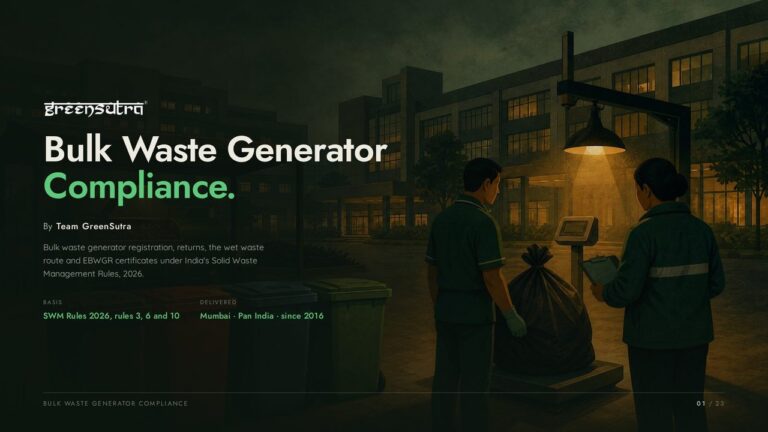
Cover of the Bulk Waste Generator Compliance deck, 23 slides on registration, returns and EBWGR under SWM Rules 2026Get the deck by email
Bulk Waste Generator Compliance Deck - Lead Magnet

The PDF is attached to a confirmation email. There is no public download link.

12

Request a bulk waste generator check

A short call about the site's floor area, water use and daily waste is enough to start. Book a call, or send a written brief.

01Schedule a call

Pick the service and a slot; a practitioner takes the call.

02Write a brief
Service enquiry
Preferred reply channel
Replies within one business day, Monday to Saturday, 10:00 to 18:30 IST.

Bulk waste generators registered, filed and kept ready for checks, across IndiaCheck the three tests →