


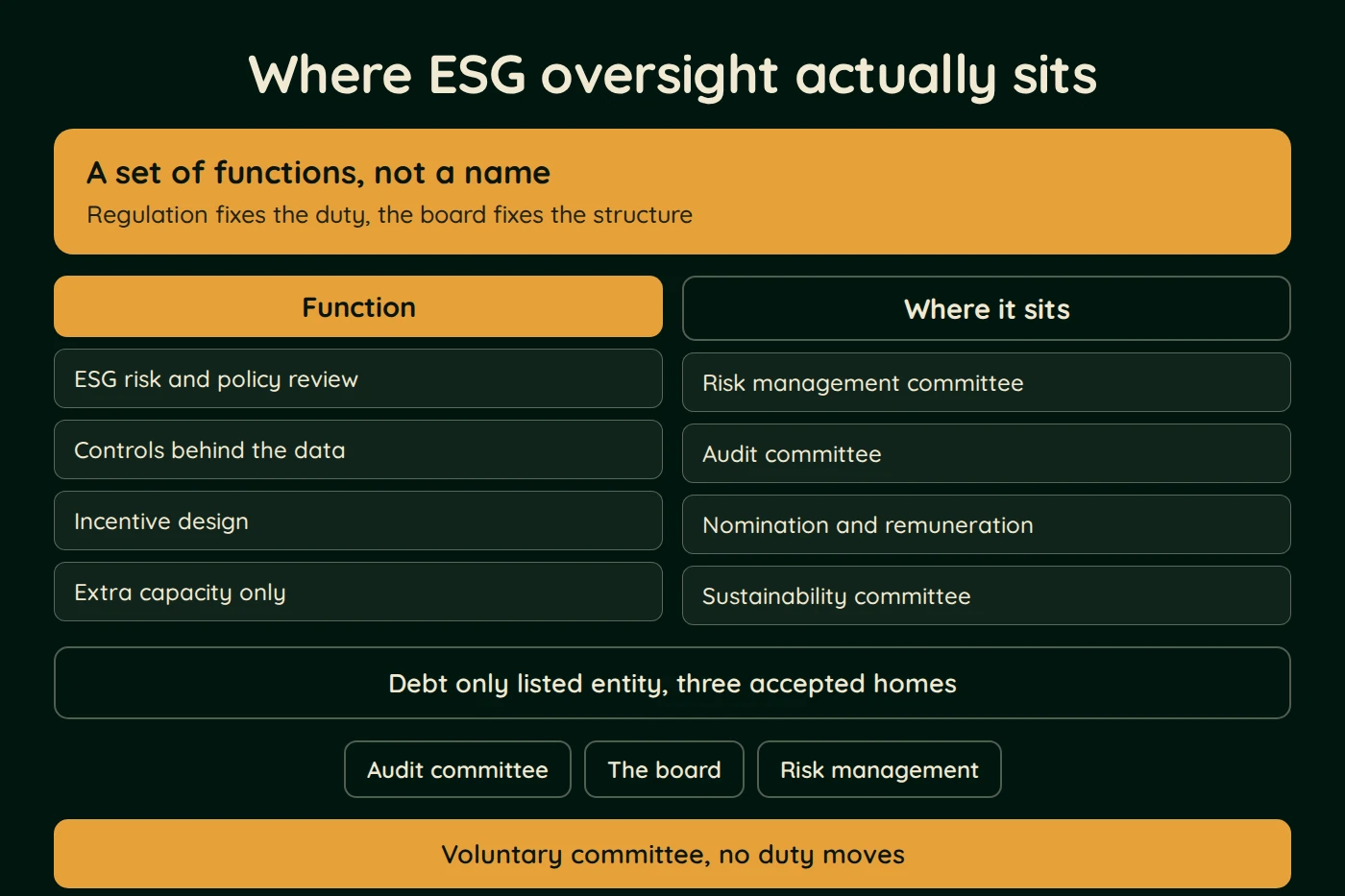
Indian law mandates no dedicated ESG or sustainability committee, and the only committee mandate that names ESG risk is the Risk Management Committee’s terms of reference under SEBI listing rules. The audit committee reaches the controls behind the data. A debt only listed entity may place those functions with the board. A voluntary sustainability committee adds capacity without discharging the statutory duty.
Only one board committee mandate in the Indian listing regulations names ESG risk, so the legal answer and the design answer are different questions. The law fixes where ESG risk has to be identified and leaves the rest of the structure to the board, which then discloses what it chose.
Four candidate homes compared
| Option | Delegation it implies | Reporting cadence | Minute trail |
|---|---|---|---|
| Full board | No delegation. The mandate stays with every director | At least four meetings a year, not more than 120 days apart | Minutes signed and kept within 30 days, the rule that also covers every committee |
| Risk management committee | Statutory delegation. Its mandatory functions expressly cover sustainability, particularly ESG related risks | At least twice a financial year, not more than 210 days apart | Minutes, plus terms of reference, composition and attendance in the corporate governance report |
| Audit committee | Delegation of control, not of subject. The hook is internal financial controls and risk management systems | At least four times a financial year, not more than 120 days apart | Minutes, plus the same three corporate governance report items |
| Dedicated sustainability committee | Voluntary delegation. No statutory function moves to it | Whatever the board fixes. Nothing is prescribed | Minutes, plus the BRSR answer describing the committee |
The risk management committee obligation does not reach every listed entity: it applies to the top 1000 listed entities and to a high value debt listed entity. For a debt only listed entity inside the separate chapter, SEBI accepts three homes for the identical functions: the audit committee, the board, or a risk management committee. The mandate is a set of functions, not a committee name.
Does Indian law mandate an ESG committee
It does not. The committees the listing regulations compel are the audit, nomination and remuneration, stakeholders relationship and risk management committees, the last of those only for the entities just described, alongside a corporate social responsibility committee under the Companies Act where its thresholds are met. None of them is a sustainability committee. SEBI’s format confirms the point by asking rather than commanding: the BRSR takes a yes or no answer on whether a specified committee of the board or director is responsible for decision making on sustainability issues.
A workable default follows:
- ESG risk identification, mitigation and policy review belong to the risk management committee, because the regulation puts them there.
- Controls over the data reaching a disclosure sit with the audit committee.
- Incentive design sits with the nomination and remuneration committee.
- A sustainability committee, if constituted, adds capacity. It discharges no part of the risk management committee’s duty.
Sources: SEBI LODR Regulations 2015, Companies Act 2013
The ESG guide sets out the governance disclosures a board mandate has to answer. ESG advisory services covers committee terms of reference and the evidence file behind the disclosure. Board oversight of sustainability is one of six areas in the free oversight and data register, which names the specific governance gap inside each.