


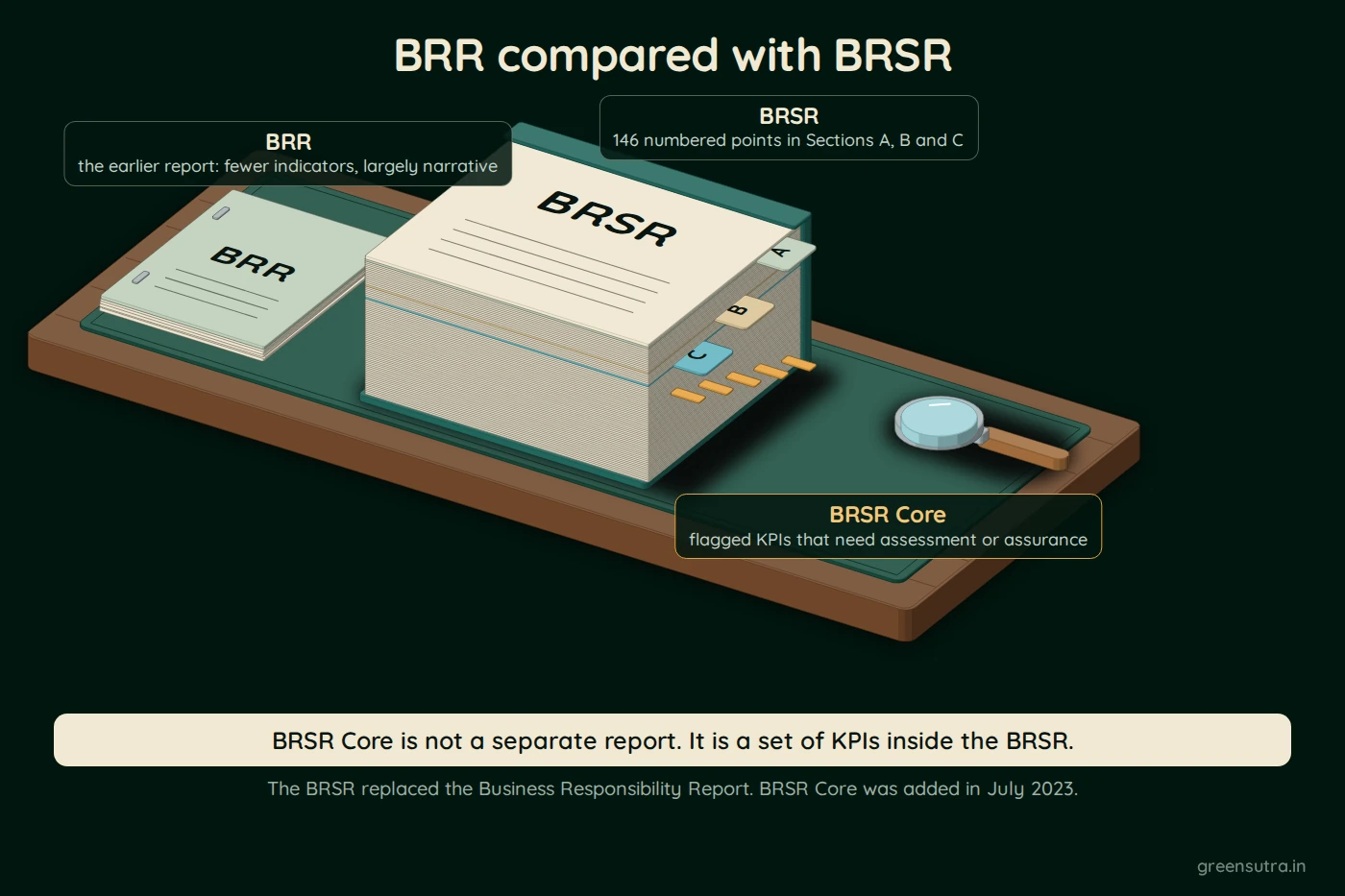
The Business Responsibility Report was the earlier and narrower disclosure; the Business Responsibility and Sustainability Report replaced it. The BRSR carries a far larger indicator set, is structured around the nine NGRBC principles across three sections, and later gained BRSR Core, an assurable subset the older format never had.
Guidance written before the transition still refers to the Business Responsibility Report, and the two are not interchangeable. An entity working from older material can end up preparing the wrong indicator set.
What changed
| Aspect | Business Responsibility Report | Business Responsibility and Sustainability Report |
|---|---|---|
| Scale | A narrow disclosure with far fewer indicators | 146 numbered points in the current format, of which 68 are essential and 40 are leadership indicators |
| Structure | A shorter reporting format | Three sections: general disclosures, management and process, principle-wise performance |
| Assurance | No assurable subset | BRSR Core, a defined subset requiring assessment or assurance |
| Data shape | Largely narrative | Substantially quantitative, including intensity ratios |
BRSR vs BRSR Core: is the Core a separate report?
BRSR Core is not a separate report. It is the set of KPIs inside the BRSR, grouped under nine ESG attributes, that must be independently assessed or assured. The rest of the BRSR carries no such check. The BRSR guide shows the year each group of listed entities reaches that requirement.
Why the replacement happened
The older format established the idea of principle-based responsibility reporting but produced disclosure that was difficult to compare between entities and difficult to test. The BRSR addressed both problems: it standardised the indicator set so filings could be compared, and it made the data quantitative enough that a defined subset could later be assured.
The practical consequence
Because BRSR Core indicators must withstand assessment or assurance, the preparation discipline is different in kind. A narrative statement that was acceptable under the older format is not sufficient where a measured figure, a stated boundary and a reconcilable source are now expected. Entities moving from legacy processes usually find the gap is in data lineage rather than in writing.
Sources: SEBI BRSR framework circular
The BRSR guide explains the current format in full. BRSR reporting services covers the move from legacy reporting to an assurance-ready file.
Related questions
- What does Section C of the BRSR cover?
- What does Section B of the BRSR cover?
- What does Section A of the BRSR cover?
Reviewed by Team GreenSutra on 15 November 2026.