

CBAM adds no fixed euro figure to urea or ammonia; the cost is a formula. The declarant surrenders certificates for the embedded emissions in the tonnes shipped, minus the free allocation adjustment. Any carbon price deduction also comes off, and the total never falls below zero. Embedded emissions come from verified actual data or the India default, which carries a flat 1 percent fertiliser mark-up. Each certificate is priced off EU ETS auctions.
The fertiliser cost formula
CBAM does not add a single per tonne charge to urea or ammonia. The cost for an import year is built from cited components:
certificates = tonnes shipped x embedded emissions per tonne, minus the free allocation adjustment, minus any carbon price deduction, never below zero.
On default values: free allocation adjustment = tonnes shipped x CBAM benchmark x CBAM factor for the year x cross-sectoral correction factor.
certificate cost = certificates x CBAM certificate price.
Embedded emissions are either verified actual installation data or the country of origin default value from Implementing Regulation (EU) 2025/2621. Fertilisers count direct plus indirect emissions. Natural gas is the feedstock and the main source. In 2026 the certificate price is the average EU ETS auction price for the quarter of import. The free allocation adjustment mirrors the free allocation EU producers of the same good still receive. The deduction shrinks each year. The CBAM factor is 97.5 percent in 2026, 95 percent in 2027, 90 percent in 2028 and 77.5 percent in 2029. It falls to 51.5 percent in 2030, 39 percent in 2031, 26.5 percent in 2032 and 14 percent in 2033. From 2034 nothing is deducted for free allocation. In 2026, 2.5 percent of the benchmark is no longer deducted. That figure is not 2.5 percent of the embedded emissions.
India default values for urea and ammonia
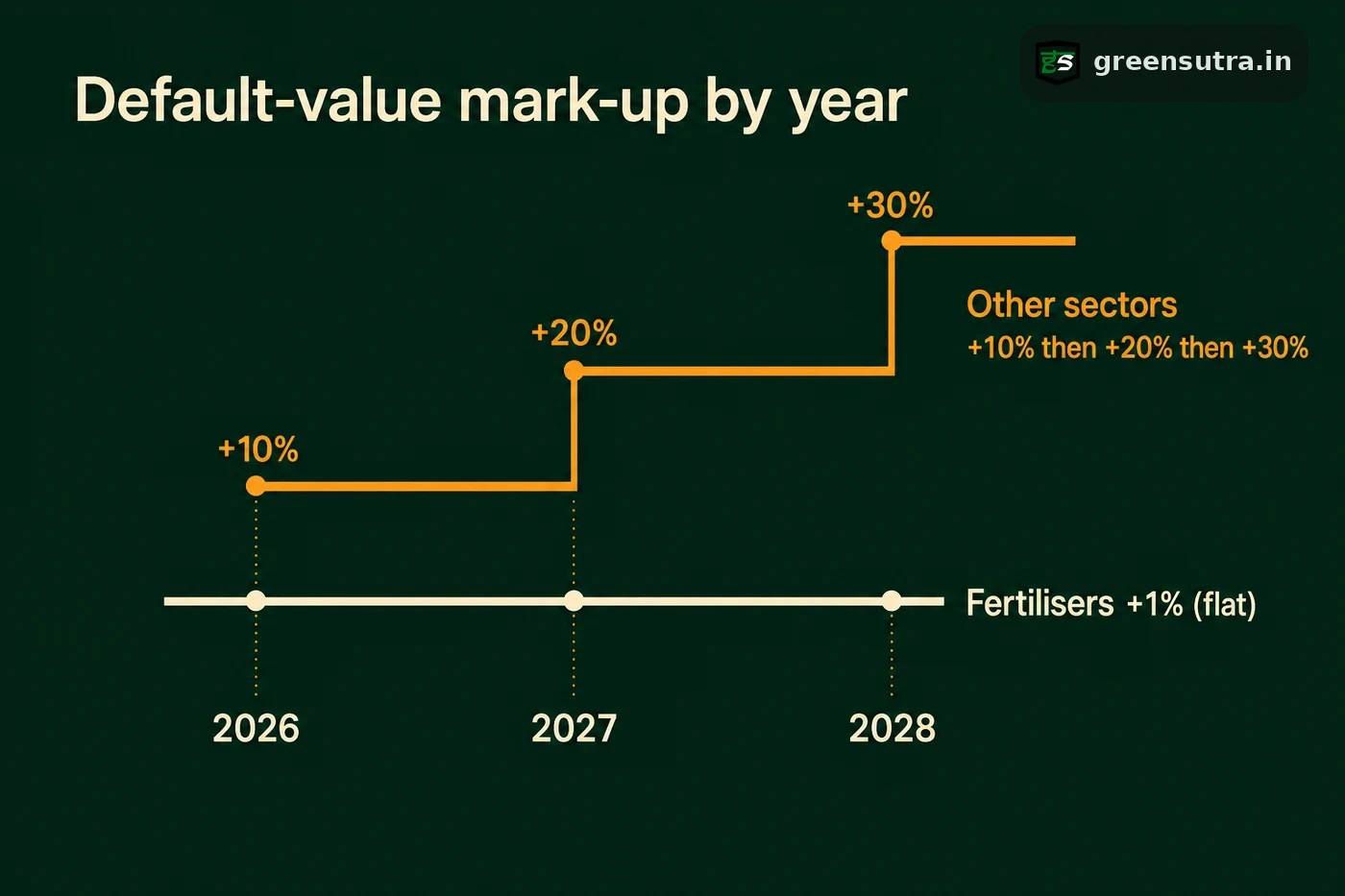
Annex I of Implementing Regulation (EU) 2025/2621, as corrected by Implementing Regulation (EU) 2026/1740, sets a flat 1 percent mark-up on fertiliser default values. It stays at 1 percent from 2026 onwards. This is the fertiliser exception: cement, steel, aluminium and hydrogen ramp at 10, 20 and 30 percent, while ammonia and urea stay at base times 1.01 throughout.
| Product | CN code | Base (tCO2e/t) | Direct + indirect | 2026 marked up (x1.01) |
|---|---|---|---|---|
| Urea | CN 3102 10 19 (over 45 percent nitrogen) | 2.22 | 2.05 + 0.17 | 2.24 |
| Anhydrous ammonia | CN 2814 10 00 | 3.28 | 3.06 + 0.22 | 3.31 |
Straight nitrogen products carry the most embedded carbon, driven by the gas feedstock. Values are India totals, specific to the country of origin, so the set differs elsewhere.
Example: one tonne of Indian anhydrous ammonia (CN 2814 10 00) imported in the third quarter of 2026 on default values. The default of 3.28, with the 1 percent mark-up, gives 3.313. The free allocation adjustment is 0.975 x 1.00 x 1.522, or 1.484. The declarant surrenders 3.313 minus 1.484, or 1.829 certificates, about EUR 151 at the third-quarter 2026 price of EUR 82.32.
Where to size the actual figure
Verified actual data lowers the bill by replacing the marked up default, a deliberately conservative estimate, with the plant’s real and usually lower emissions. With verified actual emissions, a carbon price effectively paid in a third country can be deducted, net of any rebate, if an independent person certifies the records. The EU does not have to recognise India’s Carbon Credit Trading Scheme. On the India default values, a deduction needs a yearly default carbon price, and none had been published by 15 October 2026.
A single euro per tonne figure depends on product, volume, year and data basis, so no headline number applies. The CBAM cost calculator estimates a specific product, volume and year; the CBAM guide sets out the mechanism; and a CBAM consulting service prepares installation data for verification by an accredited verifier.
Sources: Implementing Regulation (EU) 2025/2621 · Regulation (EU) 2023/956 · European Commission CBAM