


A CBAM verifier applies a materiality level of 5% of the total specific embedded emissions for each tonne of each good, identified by its CN code. The same 5% applies to the specific embedded free allocation. Article 5 of Implementing Regulation (EU) 2025/2546 sets both levels. The verifier also judges smaller errors by their nature.
How the 5% is applied
- The level applies per tonne of each good, by CN code, not to the installation’s total emissions.
- The Commission’s verification guidance of 24 August 2026 lets a verifier use one level for all goods from a single production process.
- For electricity produced as a CBAM good, the level is read per MWh.
- For every other parameter, and for errors below 5% that matter by their nature, the verifier uses expert judgement under Article 5(2).
An error early in the data flow, such as one fuel’s consumption, can carry through into precursor and final figures. Verifiers often calculate how far it spreads before deciding whether it is material.
Not a tolerance band
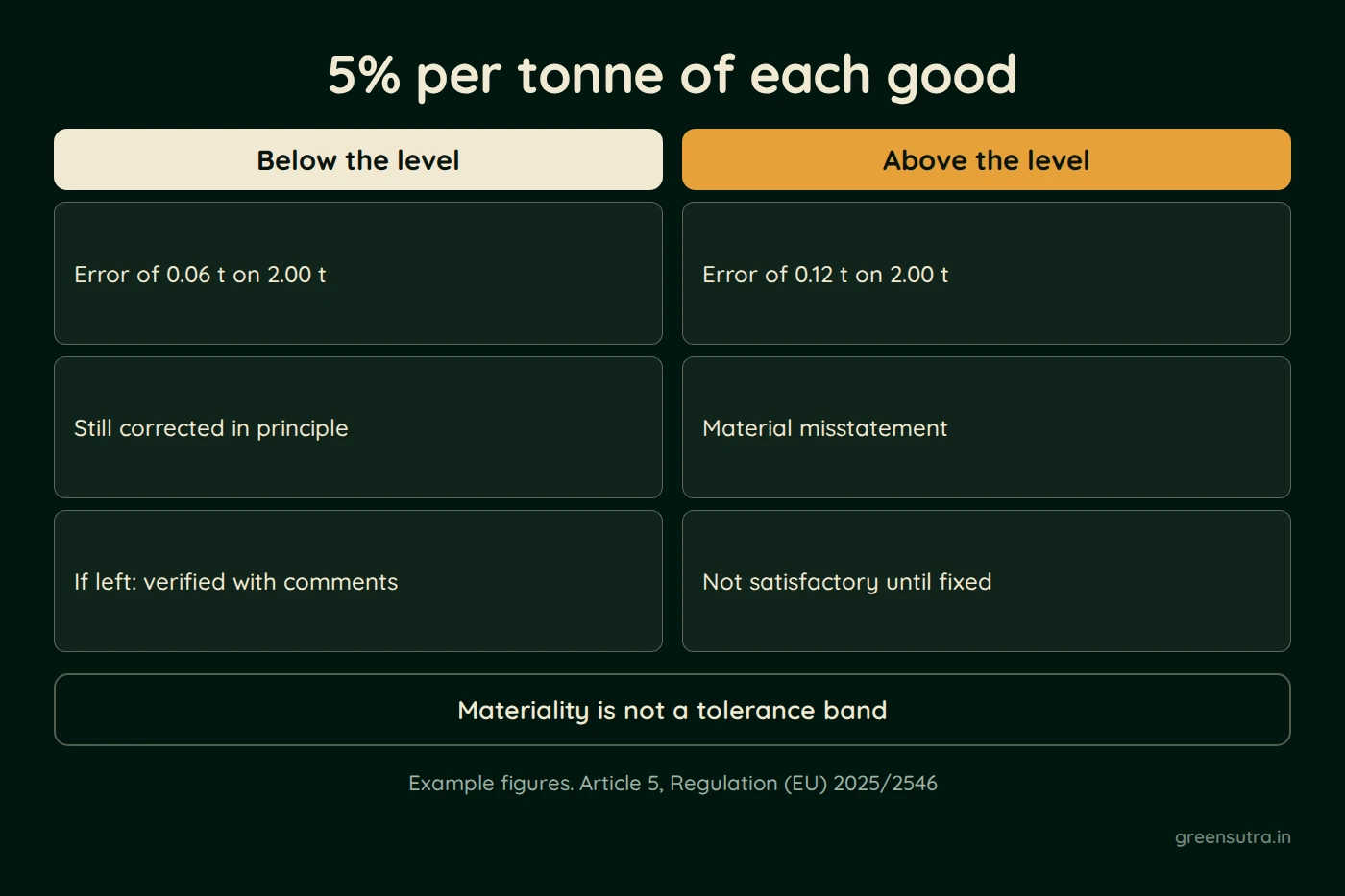
The guidance states that materiality “is not a tolerance band”. Every misstatement found should in principle be corrected before the verification ends. Delegated Regulation (EU) 2025/2551 then sets one satisfactory and three unsatisfactory opinions, and the guidance splits the satisfactory one in two.
| Statement | When it applies |
|---|---|
| Verified as satisfactory, without comments | No misstatements or non-conformities |
| Verified as satisfactory, with comments | Only issues without material effect remain, such as non-material misstatements or recommendations |
| Unsatisfactory | Material misstatements or non-conformities were not corrected before the report was issued |
| Unsatisfactory | Non-conformities leave too little clarity for reasonable assurance |
| Unsatisfactory, scope too limited | Data are missing, the monitoring plan lacks scope or clarity, or the operator has not provided enough information |
Example: one coil product
Example. Hot-rolled coil carries specific embedded emissions of 2.00 t CO2e per tonne. The materiality level is 5%, or 0.10 t CO2e per tonne. A gas meter error that overstates the figure by 0.06 t is below the level. It should still be corrected, and if it stays, the report can be verified with comments. An error of 0.12 t is material, and the report cannot be verified as satisfactory until it is fixed. Several small errors that together pass 0.10 t count as material too.
Sources: Commission Implementing Regulation (EU) 2025/2546, Guidance on CBAM verification and accreditation, 24 August 2026, Commission Delegated Regulation (EU) 2025/2551
How the verifier uses the monitoring plan is covered in CBAM Monitoring Plan in 2026 and the CBAM compliance guide. GreenSutra’s CBAM solutions prepare the emissions report for an accredited verifier.