


ESG data is assurance ready when every figure carries a defined boundary, a traceable source record, a documented calculation and a retained evidence file an independent practitioner can test. Readiness is graded, not binary. Limited assurance tests a narrower sample; reasonable assurance demands deeper evidence. A consultant readies the file; an accredited practitioner assures it.
Assurance readiness is a property of the record, not of the report. An independent practitioner tests whether a stated figure can be rebuilt from evidence the organisation already holds. Where that trail breaks, the practitioner narrows scope, qualifies the conclusion or drops the item entirely.
Evidence depth follows the assurance level
The level sought sets how deep the evidence has to go. ISAE 3000 (Revised) is the IAASB umbrella standard for assurance engagements other than audits of historical financial information, and it separates the two levels by procedure and by the form of the conclusion. ISSA 5000, the dedicated sustainability assurance standard, marks its requirements L for limited and R for reasonable, and is effective for engagements covering periods beginning on or after 15 December 2026.
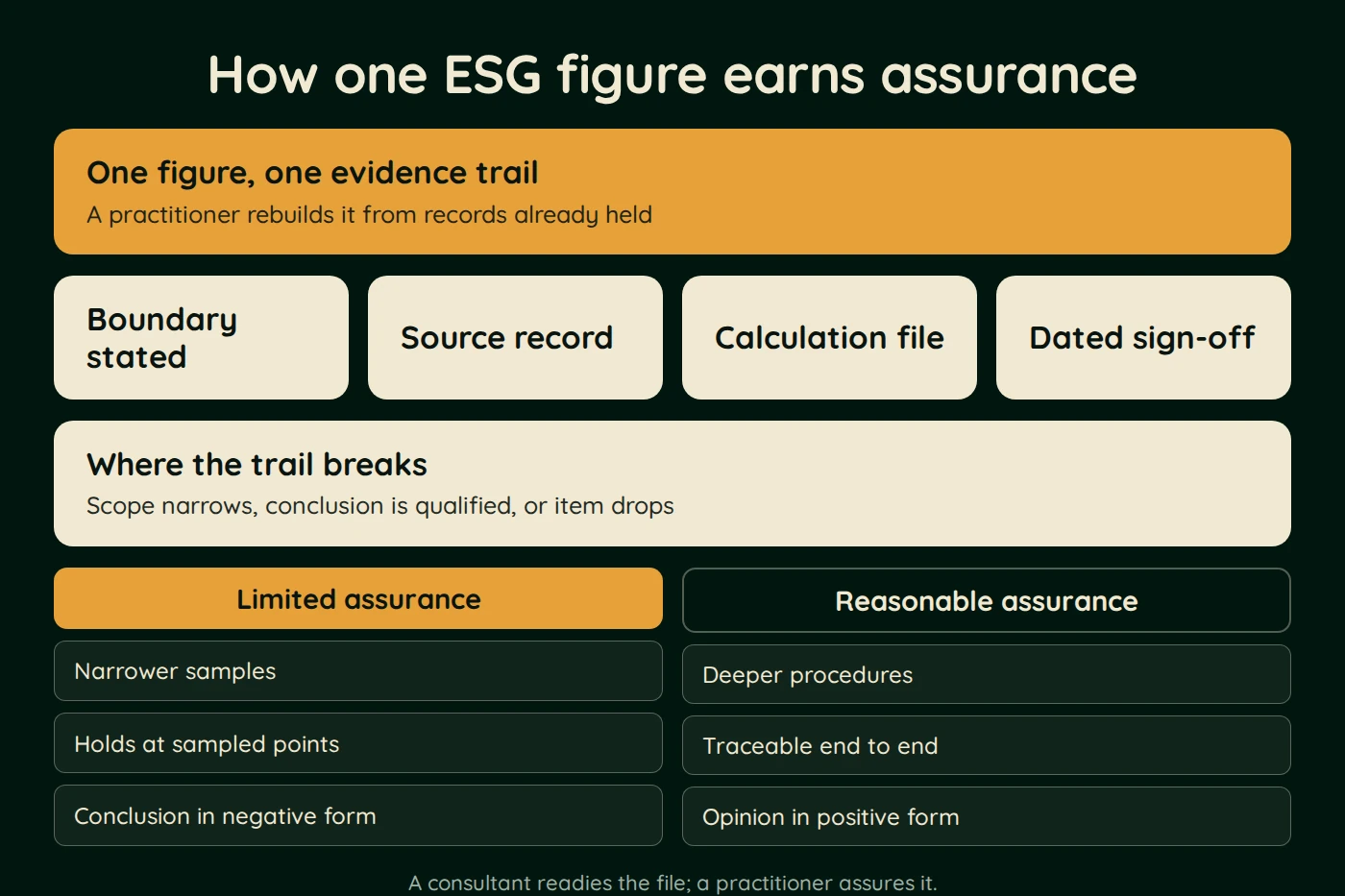
| Dimension | Limited assurance | Reasonable assurance |
|---|---|---|
| Procedures | Fewer or narrower procedures, smaller samples | Procedures deep enough to reduce engagement risk to an acceptably low level |
| Conclusion | Negative form: nothing has come to the practitioner’s attention suggesting material misstatement | Positive form: an opinion that the information is prepared, in all material respects, in accordance with the criteria |
| Readiness implication | Method and controls must hold at the sampled points | Every material figure must be traceable end to end |
Under the CSRD the requirement begins at limited assurance and stays there, the planned escalation to reasonable assurance having been removed by Directive (EU) 2026/470.
What a ready file contains
Readiness can be checked before an engagement begins. Six items decide it.
- Scope and boundary stated once in writing, naming every entity, site and period covered, with each exclusion justified.
- A source record behind each figure, such as a meter reading, invoice, payroll extract or supplier statement, retained in original form.
- A calculation file showing the method, the conversion or emission factor, the factor version and the date applied.
- A named owner and a dated sign-off per disclosure, so a query reaches the person who produced the number.
- A restatement policy recording what changed, why, and which prior period figures move.
- Estimates and proxies labelled as such, with the basis of estimation written down rather than reconstructed under questioning.
Two roles stay separate throughout. A consultant prepares and structures the evidence and readies the data file. An independent accredited third party runs the engagement and issues the conclusion.
Sources: IAASB, ISAE 3000 (Revised), IAASB, ISSA 5000, EUR-Lex, Directive (EU) 2026/470
The ESG guide sets out the disclosure chain that produces these records. ESG advisory services covers readiness reviews, evidence structuring and gap closure ahead of a third party engagement. Readiness gaps ahead of an assurer can be named with the free assurance readiness register.