

EU buyers of Indian coffee need the location of every plot it grew on and the harvest dates, under the EU Deforestation Regulation (EUDR). India is classified as low risk, so the buyer can use simplified due diligence, without the formal risk assessment and mitigation. The plot data is still required, and only the exporter and its growers can supply it.
Which coffee products are covered?
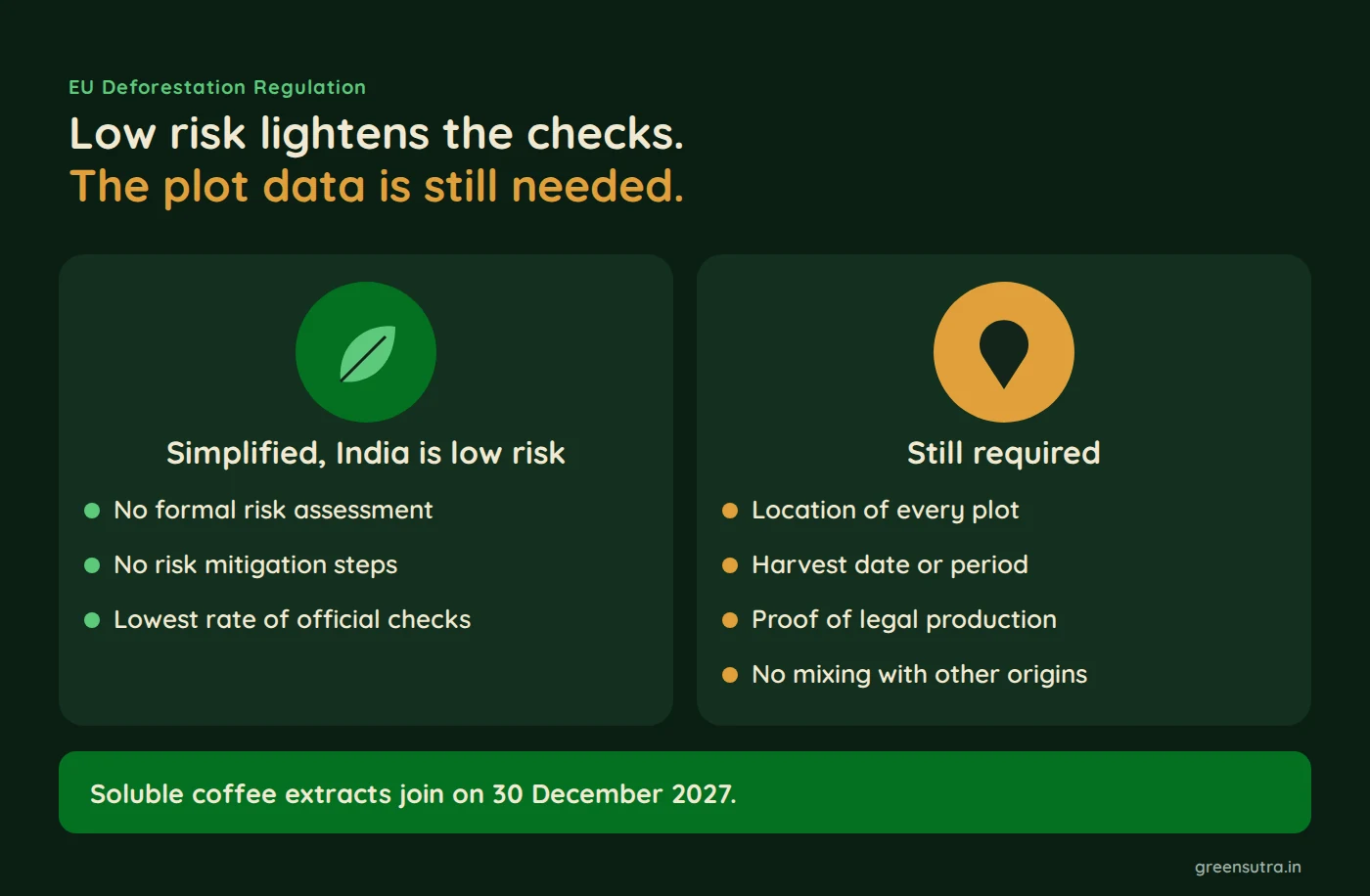
Coffee under heading 0901: roasted or not, decaffeinated or not, along with coffee husks and skins and any coffee substitute that contains coffee. Soluble coffee extracts and concentrates join from 30 December 2027. Coffee harvested before 29 June 2023 is outside the regulation, and so are used grounds discarded as café waste.
What does India’s low-risk status change?
The EU classified India as low risk in May 2025. For coffee grown only in India, the operator, usually the EU importer, can skip the formal risk assessment and mitigation. It still holds the full information set. That means the geolocation of every plot, the harvest date or period, the supplier chain and evidence that the coffee was produced legally under Indian law. That only holds while the coffee is not mixed with coffee of unknown origin or from standard- or high-risk countries. Low-risk origin also means the lowest minimum rate of official checks, at least 1% of the businesses concerned each year.
Example: single-origin and blended lots
Example. An importer in Italy buys green coffee grown only in India. It uses simplified due diligence and holds the plot coordinates and harvest dates for every lot. A second lot is blended with beans from a country the EU has not classified, which counts as standard risk. For that product, the full risk assessment and mitigation apply.
Who files the statement?
Usually the EU importer, as set out in whether EUDR applies to non-EU exporters. An Indian grower can use the one-time simplified declaration only in one case. It must itself be an individual or a micro or small business, judged on its coffee business, that grows the coffee and sells it into the EU in its own name, with an EORI number.
What can an Indian exporter prepare now?
For every lot: plot coordinates to six decimal places, with polygons for plots over four hectares, the harvest date or period, the grower’s identity and land records. The geolocation answer sets out the format. Keep lots from different origins apart.
Where this comes from: Regulation (EU) 2023/1115, Articles 1(2), 2(15a), 9, 13 and 16 and Annex I; Implementing Regulation (EU) 2025/1093, Annex; Delegated Regulation (EU) 2026/2102, Annex; Commission guidance, OJ C/2026/3896, section 4.
More on this: EUDR guide · EUDR compliance
Reviewed by Team GreenSutra on 26 October 2026.