


LCA impact categories extend well beyond carbon, since a full life cycle impact assessment measures acidification, eutrophication, water use, land use, resource depletion, toxicity and ozone depletion alongside global warming, most often through the European Commission Environmental Footprint method, which defines a common set of sixteen categories so environmental trade offs stay visible.
Why carbon alone is not a full LCA
Carbon is a single environmental issue, so a product carbon footprint to ISO 14067 quantifies climate change alone and sits inside a full life cycle assessment rather than replacing it. A full life cycle assessment measures many environmental impacts together. The life cycle impact assessment phase converts the inventory into results across categories such as global warming, acidification, eutrophication and water use, so a carbon-only figure omits most of the picture and hides the trade offs a full study is built to reveal. Treating a carbon number as an LCA is the most common misreading of the method.
The impact categories the EF method measures
The European Commission Environmental Footprint method defines a common set of 16 impact categories for the life cycle environmental performance of products and organisations. The current version is EF 3.1, released by the Joint Research Centre in July 2022; EPD International has required EF 3.1 characterisation factors for new EPDs since 1 September 2024. Water use, land use and mineral and fossil resource depletion each carry a separate indicator, so scarcity and pollution are scored apart from warming.
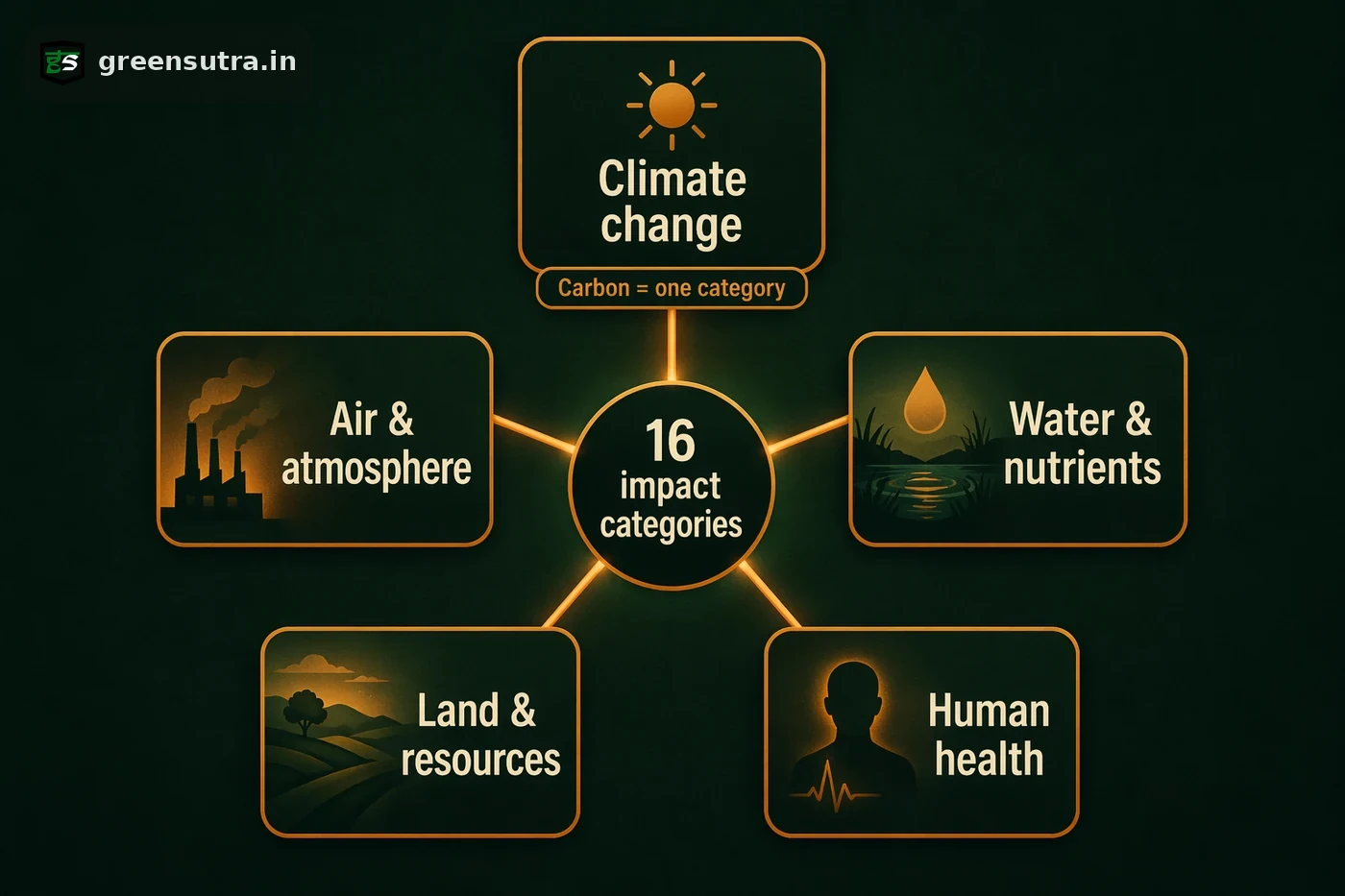
| Theme | Environmental Footprint impact categories |
|---|---|
| Climate | Climate change (fossil, biogenic, land use sub-indicators) |
| Air and atmosphere | Ozone depletion, particulate matter, photochemical ozone formation, ionising radiation |
| Water and nutrients | Acidification, eutrophication terrestrial, eutrophication freshwater, eutrophication marine, ecotoxicity freshwater, water use |
| Land and resources | Land use, resource use minerals and metals, resource use fossils |
| Human health | Human toxicity cancer, human toxicity non-cancer |
Climate change is one category among sixteen, so a carbon-only result leaves fifteen impacts unmeasured.
Carbon footprint or full LCA
A product carbon footprint answers a narrow climate question and is the right output where only greenhouse gas performance is needed. A full LCA is the multi-impact study a company commissions to see the trade offs between climate, water, land, resources and pollution before making a claim. The lca guide sets out how the two relate. GreenSutra’s consultants often see a product that looks strong on carbon carry a heavier burden on water use or acidification, a trade off that only surfaces once every impact category is measured.
Sources: Recommendation (EU) 2021/2279 · JRC Environmental Footprint 3.1 · ISO 14067:2018