


In a product carbon footprint (PCF), primary versus secondary data sets the accuracy hierarchy: ISO 14067:2018 expects site-specific primary data for processes under an organisation’s control and for the most significant unit processes, allowing documented secondary data from databases and default factors only where primary data proves impracticable.
The activity-data hierarchy
A product carbon footprint is built from activity data multiplied by emission factors, and ISO 14067:2018 imposes an order of preference on where that activity data comes from. Primary data is gathered from the specific processes and suppliers in the product system, while secondary data is drawn from databases, published literature and default factors where primary data is not available. GreenSutra’s carbon footprint solutions apply the same primary-first principle across the value chain, because the split between measured and generic data shapes how far the final result can be trusted.
Primary versus secondary data at a glance
Site-specific primary data shall be collected for processes under an organisation’s financial or operational control, and should also be used for the unit processes that are most significant even where they lie outside that control. Secondary data is permitted where primary data is not practicable to obtain, or for processes of minor influence, provided the choice is justified and documented. The GHG Protocol Product Standard applies the same rule.
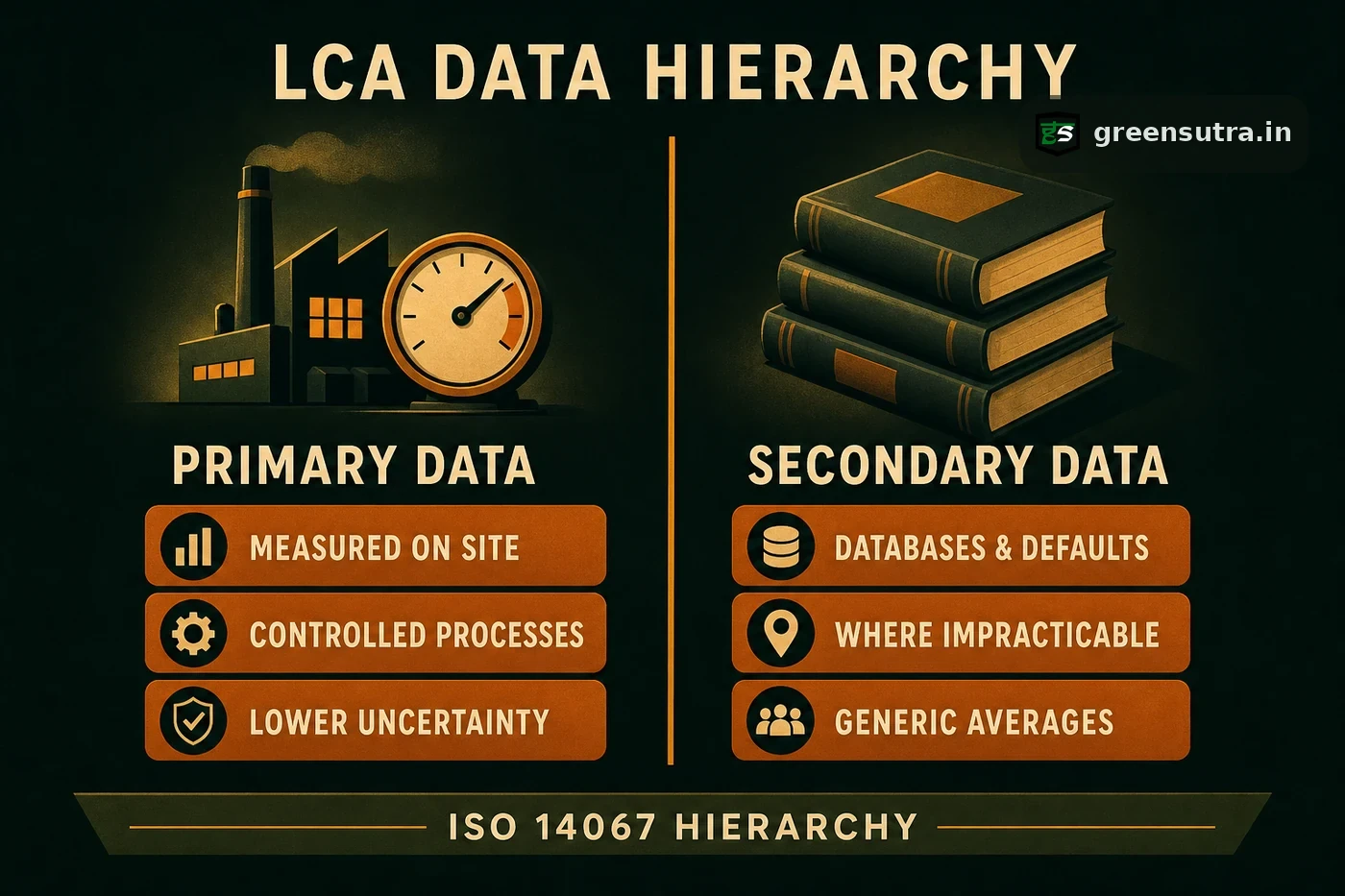
| Aspect | Primary data | Secondary data |
|---|---|---|
| Source | Measured from the specific processes and suppliers in the product system | Databases, published literature and default emission factors |
| ISO 14067 expectation | Required for controlled processes; recommended for the most significant unit processes | Allowed where primary data is impracticable or the process is of minor influence |
| Effect on result | Lowers uncertainty, improves comparability and credibility | Provides generic averages that can mask supplier-level differences |
Why data quality drives credibility
ISO 14067 sets data quality requirements that the study documents and assesses:
- time-related, geographical and technology coverage
- precision, completeness and representativeness
- consistency and reproducibility
The standard fixes no minimum numeric threshold, so the assessment stays qualitative and must be disclosed. Stronger primary-data coverage lowers uncertainty, which is why value-chain data exchange now reports a primary data share, the proportion of the final footprint resting on measured data rather than generic factors. In GreenSutra engagements, product teams often find that a few material processes hinge entirely on whether a supplier can provide primary data rather than an average. The carbon footprint guide shows how activity data feeds a full inventory; any independent critical review or verification is carried out by a separate competent third party to ISO 14064-3, never by the consultant that prepared the assessment.
Sources: ISO 14067:2018 · GHG Protocol Product Standard