


Article 7 of the PPWR, Regulation (EU) 2025/40, sets minimum post-consumer recycled content for the plastic parts of packaging, averaged per plant and year. From 1 January 2030, or three years after the Commission’s calculation act if later, the minimums are 30% for contact-sensitive PET and 10% for other contact-sensitive plastics. Single-use plastic beverage bottles need 30% and all other plastic packaging 35%, with higher targets from 2040.
How PPWR sets recycled content
Article 7 of Regulation (EU) 2025/40 requires a minimum share of recycled plastic in the plastic part of packaging placed on the EU market. The recycled content is measured as post-consumer plastic waste, averaged per manufacturing plant and per year. Targets apply from 1 January 2030, or three years after the Commission’s calculation act enters into force if that is later, and step up from 1 January 2040. Article 7(6) of the PPWR puts the proof on the manufacturer or importer, in the technical documentation. When the packaging carries a non-EU company’s name or trademark, that company is the manufacturer and holds the proof, and the EU importer checks it. GreenSutra’s PPWR consulting work maps the packaging to these categories and helps compile the supplier and recycler evidence for that documentation.
Minimum recycled content by category
The 2030 and 2040 figures differ by packaging category.
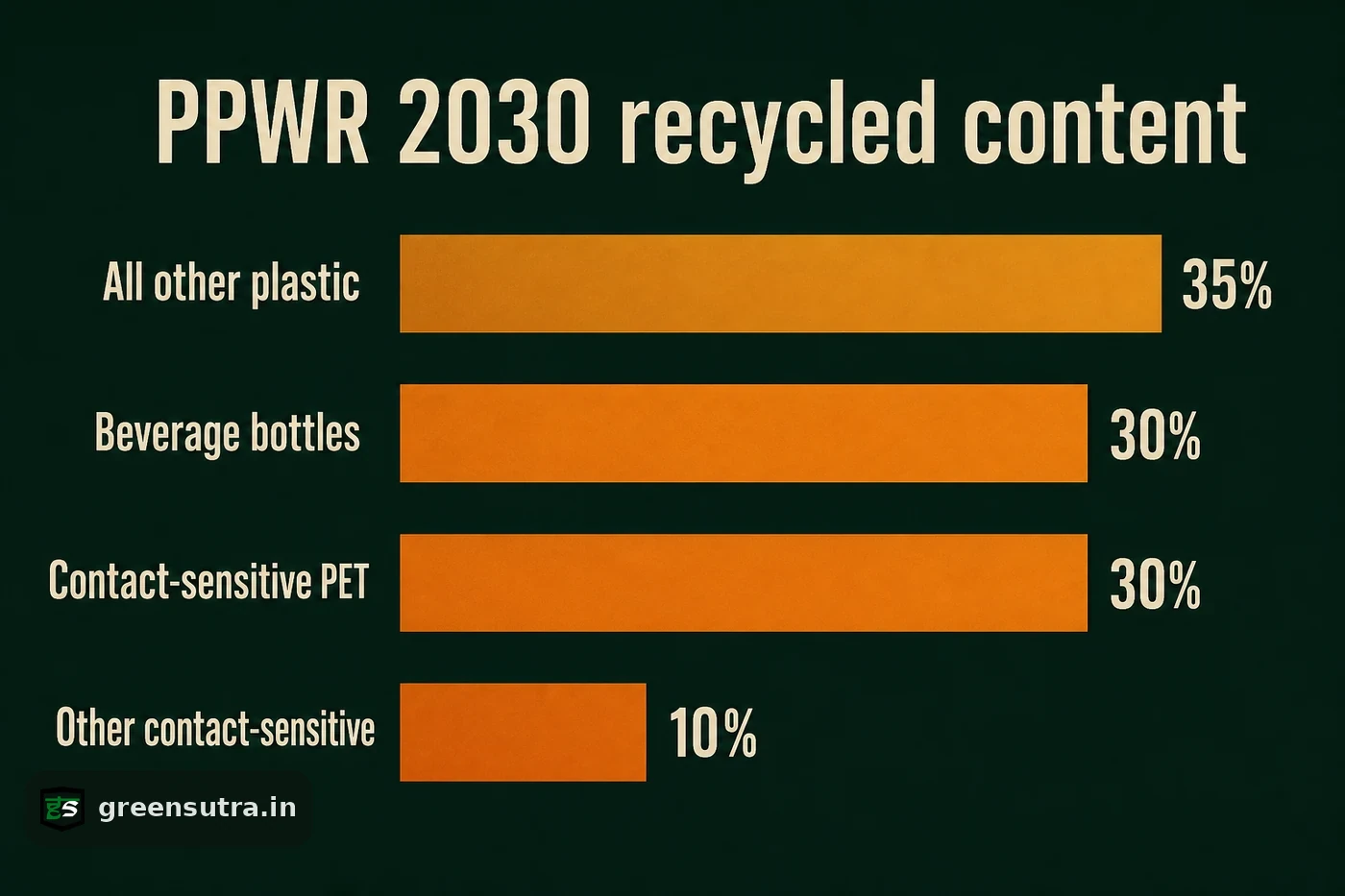
| Packaging category | From 2030 | From 2040 |
|---|---|---|
| Contact-sensitive PET, other than single-use beverage bottles | 30% | 50% |
| Contact-sensitive packaging in other plastics (non-PET), other than single-use beverage bottles | 10% | 25% |
| Single-use plastic beverage bottles | 30% | 65% |
| All other plastic packaging | 35% | 65% |
Only post-consumer recyclate counts toward these figures. The start date depends on the Commission’s calculation act, due by 31 December 2026 and still in preparation in September 2026. Recycled plastic from outside the EU counts only if it was collected to standards equivalent to the EU’s and, where they would apply, recycled under equivalent emissions rules, under Article 7(3) of the PPWR.
Exemptions and readiness
Several packaging types sit outside the targets. Article 7(4) and (5) exempt, among others:
- plastic parts below 5% of the total packaging-unit weight;
- compostable plastic packaging;
- immediate packaging of medicinal products and contact-sensitive plastic packaging for food for infants and young children;
- contact-sensitive plastic packaging of medical devices, and packaging for the transport of dangerous goods.
For a brand owner outside the EU, preparing that proof is its own task as manufacturer, and the EU importer checks it before selling. The EU PPWR guide sets out the wider readiness steps. Recycled content works better as a design decision taken early than as a late purchasing task. The manufacturer carries out the conformity assessment itself or has it carried out on its behalf, and the PPWR does not require an accredited body. The recycled-content implementing acts, due by 31 December 2026, may still add independent third-party audits.
Sources: Regulation (EU) 2025/40 (EUR-Lex) · European Commission, Packaging waste