

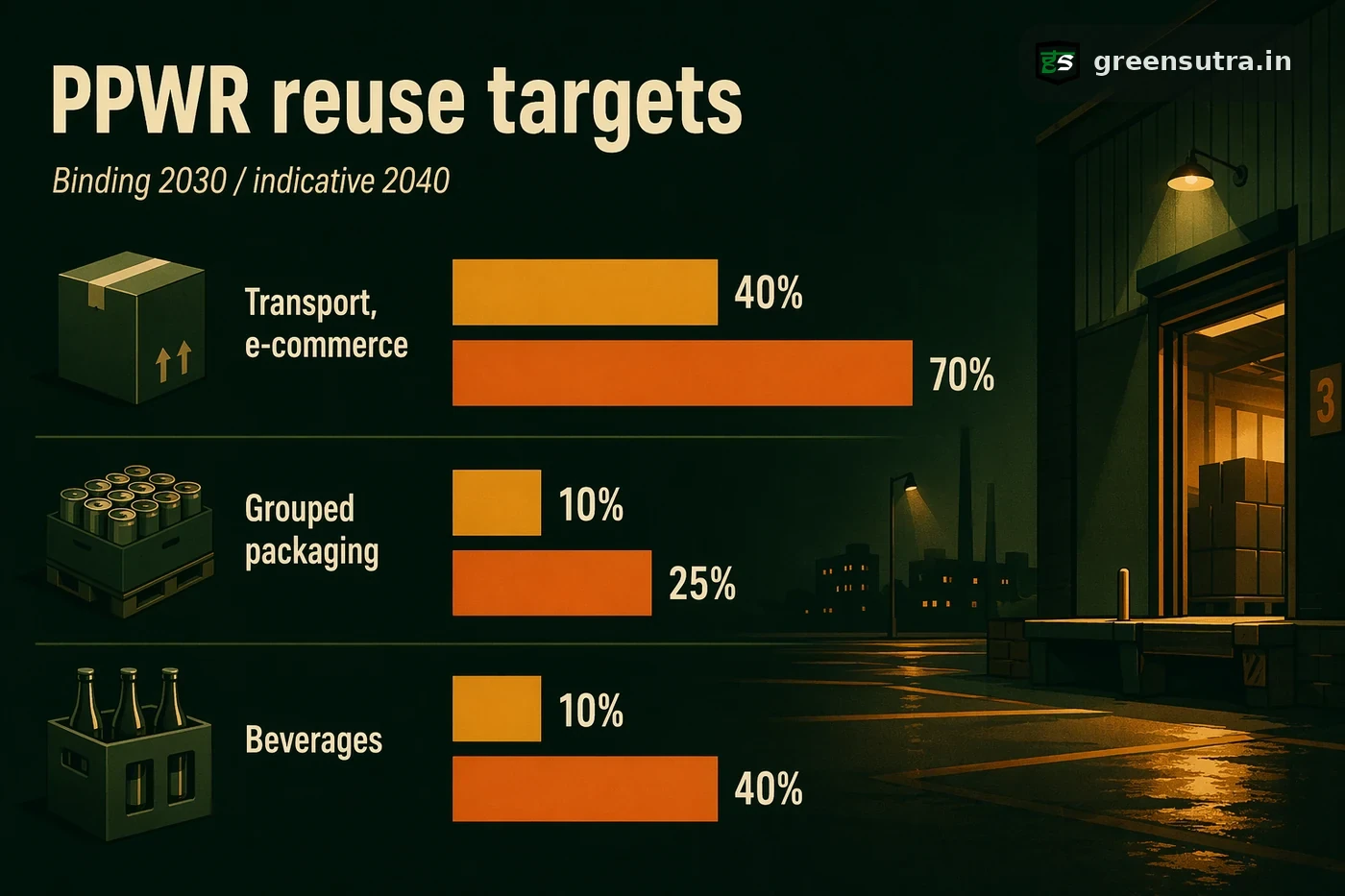
From 1 January 2030, the PPWR, Regulation (EU) 2025/40, requires at least 40% of transport and e-commerce packaging to be reusable, cardboard boxes excepted. It also requires 10% of grouping boxes other than cardboard to be reusable, and 10% of beverages sold by final distributors to consumers to come in reusable packaging. For 2040 the law sets best-effort targets of 70%, 25% and 40%. Refill rules for take-away food and drink start earlier, on 12 February 2027.
What the PPWR reuse and refill regime covers
The Packaging and Packaging Waste Regulation, Regulation (EU) 2025/40, has applied since 12 August 2026. Its reuse targets sit in Article 29, its refill rules in Articles 28 and 32 and its take-away reuse offer in Article 33. Cafés, restaurants and other HORECA businesses selling take-away drinks or ready meals must let customers bring their own container from 12 February 2027. From 12 February 2028 they must also offer reusable packaging, unless they are micro-enterprises, and from 2030 they should aim to offer 10% of products in it. A PPWR reuse target is a binding share of a packaging format that must go round a reuse system instead of being used once and thrown away. The refill rules serve the same purpose. GreenSutra’s EU PPWR solutions work maps these duties for each business.
Reuse targets by sector for 2030 and 2040
The obligations apply to specific formats: transport and e-commerce packaging, grouped packaging, and beverages made available by final distributors, each measured as a share circulating within a reuse system. Binding targets apply from 1 January 2030, but the duty to demonstrate them starts on that date or 18 months after the Article 30(3) calculation act enters into force, whichever is later. The 2040 figures are higher. Article 29 treats the 2040 figures as best-effort targets. The Commission must report on them by 1 January 2034 and may propose changes then.
| Packaging sector | Binding from 2030 | Best-effort target from 2040 |
|---|---|---|
| Transport and e-commerce packaging such as pallets, plastic crates and boxes, except cardboard boxes | at least 40% reusable | at least 70% |
| Grouped packaging in boxes, except cardboard | at least 10% reusable | at least 25% |
| Beverages via final distributors (alcoholic and non-alcoholic) | at least 10% reusable | at least 40% |
From 1 January 2030, Article 29(2) and (3) require transport packaging to be reusable within a re-use system when it moves between sites of the same or linked operators. The same applies when it is delivered to another operator in the same Member State. Commission Delegated Decision (EU) 2026/429 exempts pallet wrappings and straps used to stabilise loads on pallets from both rules.
Main exemptions and how to prepare
Several categories sit outside some reuse or deposit-return duties. For beverages:
- Highly perishable beverages, which Article 29(7) leaves out of the beverage reuse targets.
- Fruit wines and other fermented beverages under CN code 2206 00, which Articles 29(7) and 50(4) leave out of both the beverage reuse targets and deposit return systems.
- Wine, aromatised wine products and spirit drinks.
- Milk products, which fall outside certain reuse or deposit-return duties.
Reuse is more than a packaging swap, because a working reuse system needs return logistics and pooling. The EU PPWR guide sets out the readiness steps sector by sector and separates the binding 2030 shares from the 2040 figures, which depend on the Commission’s review. Operators calculate their reuse shares under Article 30 and report them to the competent authority under Article 31.
Sources: Regulation (EU) 2025/40 · EUR-Lex summary