


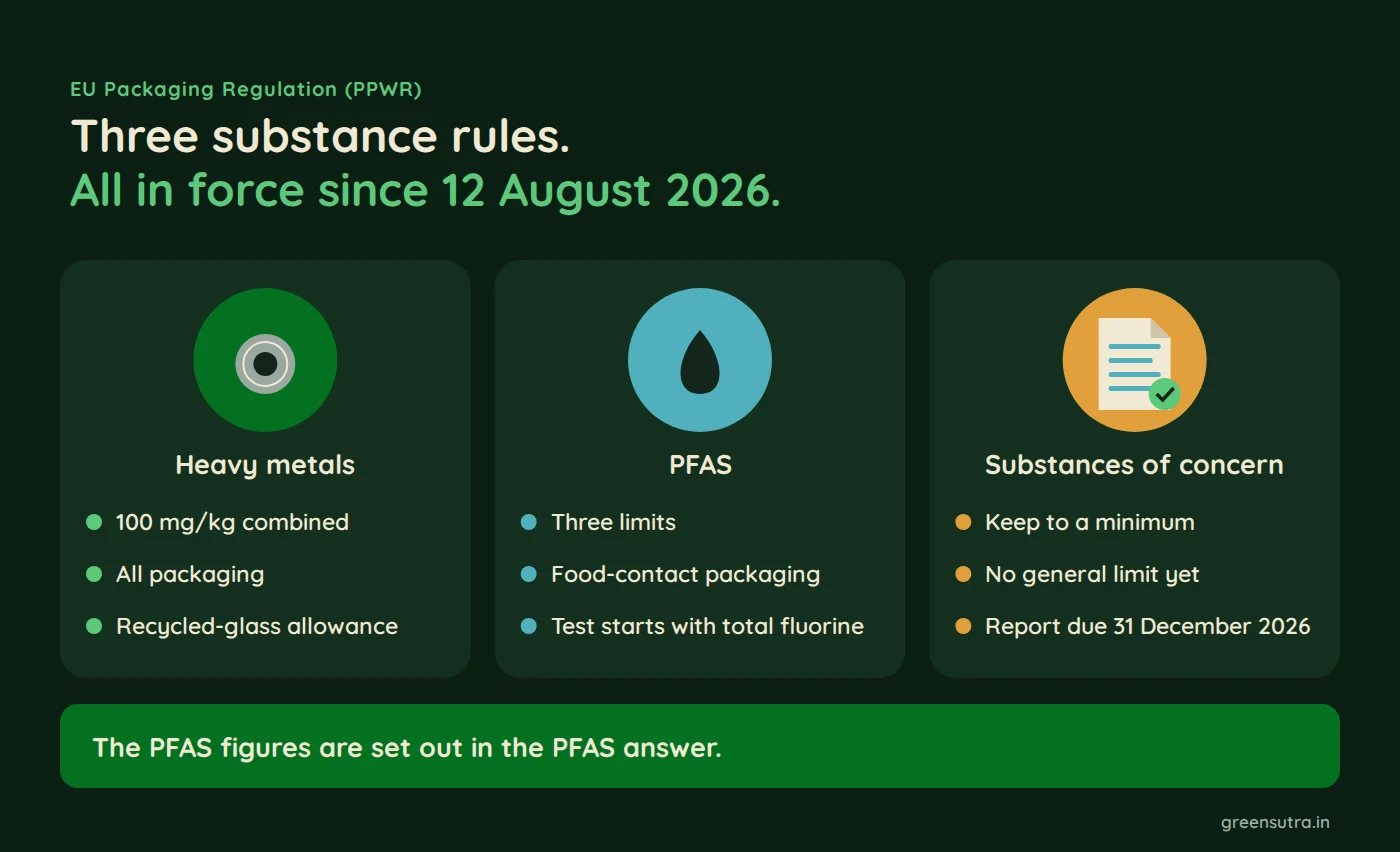
Three substance rules apply to packaging under the EU packaging regulation (PPWR), all since 12 August 2026. Every packaging item must keep lead, cadmium, mercury and hexavalent chromium together at or below 100 mg/kg. Food-contact packaging must also stay under three PFAS limits. And all packaging must keep substances of concern to a minimum, though no general number exists for them yet.
Which limit applies to all packaging?
The heavy-metal cap: 100 mg/kg for the four metals combined, in the packaging and in each of its components. The limit is not new, since the old packaging directive set the same figure, but it now sits in a regulation that applies directly. Two allowances carry over. Glass may exceed it when the excess comes only from recycled glass, and plastic crates and pallets have a similar allowance.
What does the PFAS rule add?
The PFAS answer sets out the three figures. Three points from the Commission’s guidance are easy to miss. The limits cover the whole unit, coatings and glues included. Packaging placed on the market before 12 August 2026 may stay on sale. Anything placed after that date must comply, with no run-down period and no allowance for recycled material. And the suggested first test is total fluorine.
What are substances of concern, and what is required?
They are substances defined in the EU’s ecodesign rules, such as those that are hazardous or that hamper recycling. Packaging has to be made so that their presence is minimised, but the regulation sets no general concentration limit. A Commission report with the European Chemicals Agency is on the way, and new limits may follow. Until an updated standard exists, the existing European standard EN 13428:2004 can still be used to document the minimisation.
Example: a paper food wrap
Example. A bakery supplier tests a paper food wrap for total fluorine. Under the Commission’s suggested method, a result below 50 mg/kg means the wrap could be considered compliant without further tests. Above that, a second test checks whether the fluorine is organic. Only if organic fluorine is also above 50 mg/kg does a third analysis test the individual PFAS limits. Either way, the results go into the technical file.
What is still open?
| Point | Status on 26 October 2026 |
|---|---|
| Commission report on substances of concern | Due by 31 December 2026; any new limits later, no date set |
| Review of the PFAS limits | Due by 12 August 2030 |
| Harmonised EU test method for PFAS | In preparation, no date given |
Where this comes from: Regulation (EU) 2025/40, Articles 5(1), 5(2), 5(4), 5(5), 5(6) and 70(3); Commission guidance, OJ C/2026/3084, section 5; PPWR FAQ, 2nd edition, sections III.6 to III.19.
More on this: EU PPWR guide · EU PPWR compliance
Reviewed by Team GreenSutra on 26 October 2026.