Cement
CN 2523 · 2507Cement clinker, white and grey Portland cement, aluminous cement, other hydraulic cements and calcined kaolinic clays.
Within the 50 tonne de minimis

CBAM GUIDE
The Carbon Border Adjustment Mechanism (CBAM) is the European Union framework that prices the carbon emissions embedded in imported goods. This guide sets out what CBAM is, how the transitional period differs from the definitive regime, how embedded emissions are calculated and verified, the deadlines and phase-in costs, the six covered goods and their combined nomenclature codes, and the questions exporters and EU importers ask most.
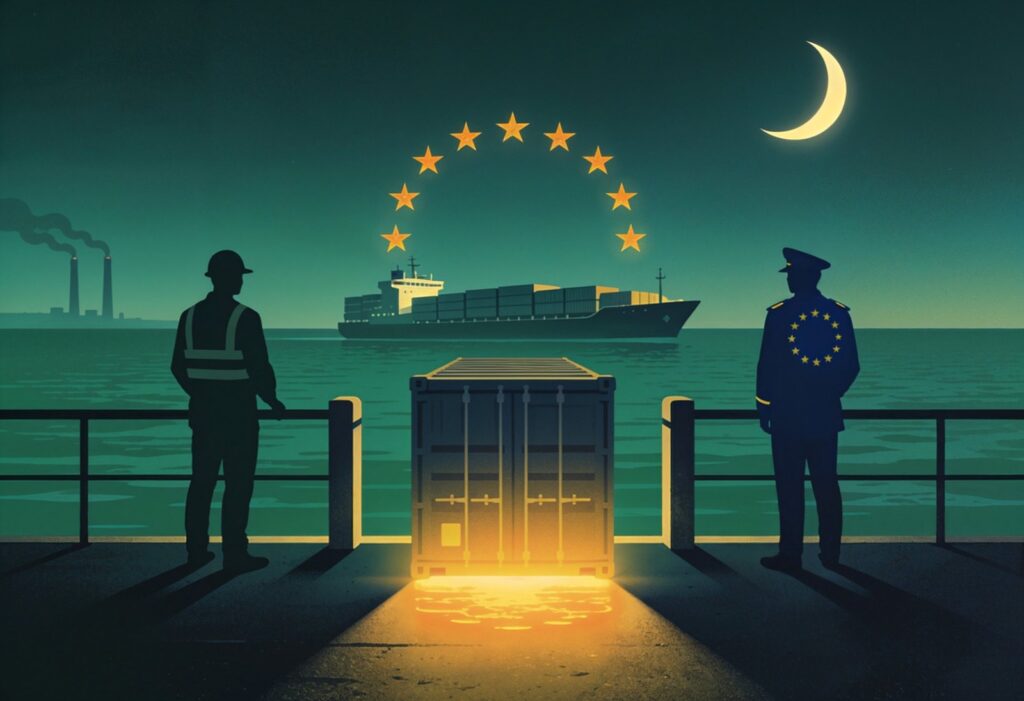
The definitive CBAM regime has applied since 1 January 2026, covering six product groups under Regulation (EU) 2023/956.
The Carbon Border Adjustment Mechanism (CBAM) is the European Union framework that prices the carbon emissions embedded in imported goods, so the climate ambition of European industry is not undercut by carbon leakage.
The Carbon Border Adjustment Mechanism (CBAM), sometimes referred to as a carbon border tax, is the European Union framework that prices the carbon emissions embedded in imported goods. CBAM is not a tax in the legal sense; it operates as a certificate obligation tied to the EU Emissions Trading System rather than a customs duty.
Its purpose is to put a carbon cost on imports equivalent to the cost that production inside the European Union carries under the EU Emissions Trading System (EU ETS), so that the climate ambition of European industry is not undercut by carbon leakage to regions with weaker carbon pricing. Transitional reporting ran from October 2023 to December 2025, and the definitive regime has applied since 1 January 2026. CBAM covers six product groups: cement, iron and steel, aluminium, fertilisers, electricity and hydrogen, listed by combined nomenclature code in Annex I of Regulation (EU) 2023/956.
The transitional period and the definitive regime differ in kind, not only in degree.
An installation in India may register voluntarily in the CBAM registry through the operator module and share its verified embedded emissions data centrally, so the European importer or authorised declarant can rely on it. EU ETS free allocation phases out between 2026 and 2034, and CBAM covers 100 percent of embedded emissions by 2034. The lean overview and the conversion path sit on the CBAM consultants for exporters and EU importers page; this guide holds the detail.
Under CBAM, embedded emissions are measured at the installation, verified and shared through the central CBAM registry, then declared at the European border by an authorised declarant who surrenders certificates priced off the EU ETS.
A carbon price paid in the country of origin is deductible where the European Union recognises it.
Embedded emissions under CBAM are determined through monitoring, reporting and verification (MRV): the direct embedded emissions of a covered good are determined using either a calculation-based approach or a measurement-based approach, and the calculation-based approach includes a mass-balance method.
Embedded emissions under CBAM are determined through the monitoring, reporting and verification methods set out in the EU rules. These are the official terms, set out in Implementing Regulation (EU) 2025/2547 with the framework methodology in Annex IV of Regulation (EU) 2023/956. The direct and indirect emission categories behind this work sit within the wider greenhouse gas scopes set out on the carbon footprint solutions page, where Scope 1, Scope 2 and Scope 3 emissions are explained in full.
Whichever approach applies, the determined emissions are verified and shared so the EU importer or authorised declarant can rely on them. A readiness review fixes the monitoring approach before any data work begins.
A one-page branded checklist sets out the six CBAM readiness steps: identify covered goods, map embedded emissions, choose the MRV method, track the key dates, appoint or authorise the declarant, and file the declaration.
The checklist PDF is attached to the confirmation email sent on submit, and the team is notified.
CBAM phases in between 1 January 2026 and 2034: the definitive regime applies from 1 January 2026, certificate sales open on 1 February 2027, the first annual declaration falls on 30 September 2027, and full coverage is reached in 2034.
The mechanism phases in between 1 January 2026 and 2034. Certificate money moves for the first time in 2027: sales open on 1 February 2027 and the first annual declaration and surrender, covering 2026 imports, falls on 30 September 2027.
| Year | 2026 | 2027 | 2028 | 2029 | 2030 | 2031 | 2032 | 2033 | 2034 |
|---|---|---|---|---|---|---|---|---|---|
| Payable share | 2.5% | 5% | 10% | 22.5% | 48.5% | 61% | 73.5% | 86% | 100% |
Certificate exposure on any specific product and volume, on default values against verified data, is estimated year by year in the CBAM cost calculator.
CBAM applies to the goods listed in Annex I of Regulation (EU) 2023/956, grouped into six product groups, with coverage following the combined nomenclature (CN) code of each good rather than its trade name.
Coverage follows the combined nomenclature (CN) code of each good rather than its trade name, so the chapters and headings below act as the guide. The product lines name representative goods in each group rather than every covered code.
Cement clinker, white and grey Portland cement, aluminous cement, other hydraulic cements and calcined kaolinic clays.
Within the 50 tonne de minimisPig iron, crude and semi finished steel, flat rolled products, bars and rods, tubes and pipes, screws, bolts and nuts, and steel structures.
Within the 50 tonne de minimisUnwrought aluminium, bars, rods and wire, plates, sheets and strip, foil, tubes and pipes, aluminium structures, containers and stranded wire.
Within the 50 tonne de minimisNitric acid, ammonia, potassium nitrates, urea and other nitrogenous fertilisers, and multi nutrient fertilisers containing nitrogen.
Within the 50 tonne de minimisElectrical energy imported into the European Union.
No de minimis exemptionHydrogen, a single combined nomenclature code covering the pure product.
No de minimis exemptionA precise check of each product against the Annex I code list is the first step of every CBAM readiness review.
For Indian exporters of covered goods, CBAM compliance turns on measuring the embedded emissions of each product at the installation, verifying that data and sharing it so the EU importer or authorised declarant can file an accurate annual declaration.
For Indian exporters of covered goods, CBAM compliance turns on measuring the embedded emissions of each product at the installation, verifying that data and sharing it so the EU importer or authorised declarant can file an accurate annual declaration. The India and European Union free trade agreement provides no exemption from CBAM, so the discipline below applies to material exporters in each covered group. A first step for any Indian exporter is a structured CBAM discovery brief, after which exposure feeds the CBAM cost calculator.
Fertiliser, electricity and hydrogen exporters follow the same measure, verify and report discipline; electricity and hydrogen sit outside the 50 tonne de minimis and stay in scope at any volume.
Common questions on CBAM scope, data, certificate pricing, deadlines, penalties and verification, answered for exporters and EU importers.
CBAM solutions help exporters of covered goods in India and worldwide, and the EU importers who declare them, comply with the European Union Carbon Border Adjustment Mechanism. The work covers exposure assessment, measurement of embedded emissions, verification, reporting through the CBAM registry and management of certificate obligations under the definitive regime that has applied since 1 January 2026.
CBAM covers six product groups: cement, iron and steel, aluminium, fertilisers, electricity and hydrogen. A proposal published in December 2025 would extend the mechanism to a wider set of downstream products from 2028, but that extension has not been adopted.
The Omnibus simplification introduced a de minimis threshold of 50 tonnes per importer each year for cement, iron and steel, aluminium and fertilisers. Electricity and hydrogen are excluded from this exemption. Around 90 percent of importers fall below the threshold, yet close to 99 percent of embedded emissions remain covered, so material exporters are still affected.
The importer or authorised declarant needs the verified embedded emissions of the goods supplied. An Indian installation can register voluntarily in the CBAM registry and share this verified data centrally, so the declarant can file an accurate annual declaration.
Default values carry a regulatory markup, so they tend to overstate emissions. Actual verified installation data, confirmed by an accredited verifier, usually produces a lower and more accurate figure, which reduces the certificate obligation that the European importer faces.
The price tracks EU ETS auction closing prices: certificates covering 2026 imports are priced on the quarterly average of the quarter of importation, and the standing price from 2027 is the weekly average. The first official price, for the first quarter of 2026, is 75.36 EUR per tonne of CO2e, published by the European Commission on 7 April 2026.
A carbon price paid in the country of origin is deductible against the certificate obligation where the European Union recognises it. As of June 2026 India's Carbon Credit Trading Scheme is not yet recognised by the European Union, although the India and European Union trade agreement opens a technical dialogue on carbon price recognition.
Importers above the threshold must hold authorised CBAM declarant status; the application window closed on 31 March 2026. Certificate sales begin on 1 February 2027, and the first annual CBAM declaration, covering 2026 imports, is due by 30 September 2027.
Embedded emissions are the greenhouse gas emissions released in producing a good. Under CBAM they are calculated from actual verified installation data where available, or from default values that carry a regulatory markup of 10 percent in 2026, 20 percent in 2027 and 30 percent from 2028.
The iron and steel group covers most of combined nomenclature chapter 72 and listed headings of chapter 73, from pig iron and semi finished steel through flat rolled products, bars, rods, tubes and pipes, to finished articles such as screws, bolts and nuts and steel structures. Coverage follows the CN code of each good, so Annex I of Regulation (EU) 2023/956 is the reference for any specific product.
The definitive regime covers the six Annex I product groups: cement, iron and steel, aluminium, fertilisers, electricity and hydrogen, including finished articles that Annex I lists, such as iron or steel screws, bolts and structures. A proposal published in December 2025 would extend the mechanism to a wider set of downstream products from 2028, but that extension is a proposal only and has not been adopted.
Only a share of embedded emissions needs certificates while EU ETS free allocation phases out. The payable share is 2.5 percent for 2026 imports, then 5, 10, 22.5, 48.5, 61, 73.5 and 86 percent through 2033, reaching 100 percent in 2034. A shipment that costs little in 2026 carries nearly twenty times that certificate cost by 2030 on the same emissions, so verified low emission data compounds in value across the phase-in.
Each certificate missing at the 30 September surrender costs the EU ETS excess emissions penalty of 100 EUR per tonne of CO2e, indexed to European consumer prices since 2013, so the effective rate sits above that figure today. Importing covered goods above the 50 tonne threshold without authorised declarant status carries three to five times that rate under Article 26.
Yes. Annex I of Regulation (EU) 2023/956 lists the covered goods by combined nomenclature (CN) code, grouped into six product groups. Whether a good is in scope follows from its CN classification rather than from its trade name, so classifying the product correctly is the first step of any CBAM exposure assessment.
Embedded emissions are determined using the methods set out in the EU monitoring rules, principally a calculation based approach and a measurement based, or continuous monitoring, approach, with a mass balance option as a calculation sub method. The sequence runs as follows. First, the system boundary of the installation and the production process is defined. Second, production and activity data are gathered, covering fuels, raw materials, electricity and the relevant process emissions. Third, the calculation based or measurement based approach is applied to those data. Fourth, the result is converted into tonnes of carbon dioxide equivalent, the unit CBAM uses for embedded emissions. Fifth, the figure is reported, verified and shared so the EU importer or authorised declarant can rely on it. Default values published by the European Commission could be used where actual data was unavailable only until 31 July 2024; from 1 August 2024 reporting based on actual emissions was required, with a limited tolerance allowing up to 20 percent of a complex good's embedded emissions to rely on default or estimated values. The direct and indirect emission categories behind this work map onto the wider greenhouse gas scopes covered on the carbon footprint solutions page.
An accredited verifier in India supports the data work but does not, by itself, replace EU CBAM verification. NABCB, the National Accreditation Board for Certification Bodies under the Quality Council of India, accredits validation and verification bodies in India to ISO 14065 and ISO/IEC 17029 for greenhouse gas verification, which supports preparing and assuring the emissions data behind a covered good. The final EU CBAM declaration, however, must be verified by a verifier accredited under the EU CBAM accreditation rules set out in Commission Delegated Regulation (EU) 2025/2551, so an India accredited body supports and prepares the data while EU CBAM verification remains a separate step.
No. The India and European Union free trade agreement does not provide any exemption from the Carbon Border Adjustment Mechanism. CBAM remains fully applicable to imports from India, and the agreement instead establishes a technical dialogue on CBAM implementation. Indian exporters of CBAM covered goods to the European market stay subject to the mechanism, which is why a CBAM consultant in India works from the regulation as it stands rather than on any expected carve out.
The CBAM rules cited in this guide come from the European Union legal texts and the European Commission.
This guide sets out the rules; a readiness review applies them to a specific trade. The CBAM solutions page sets out the engagement, the CBAM cost calculator estimates certificate exposure year by year, and the CBAM discovery brief opens a structured first step.
Reviewed June 2026