


The employee wellbeing and safety attribute covers spending on wellbeing measures as a percentage of total revenue, the Lost Time Injury Frequency Rate, and the number of fatalities. It cross-references to Principle 3 of the essential indicators, and is the first non-environmental attribute in BRSR Core.
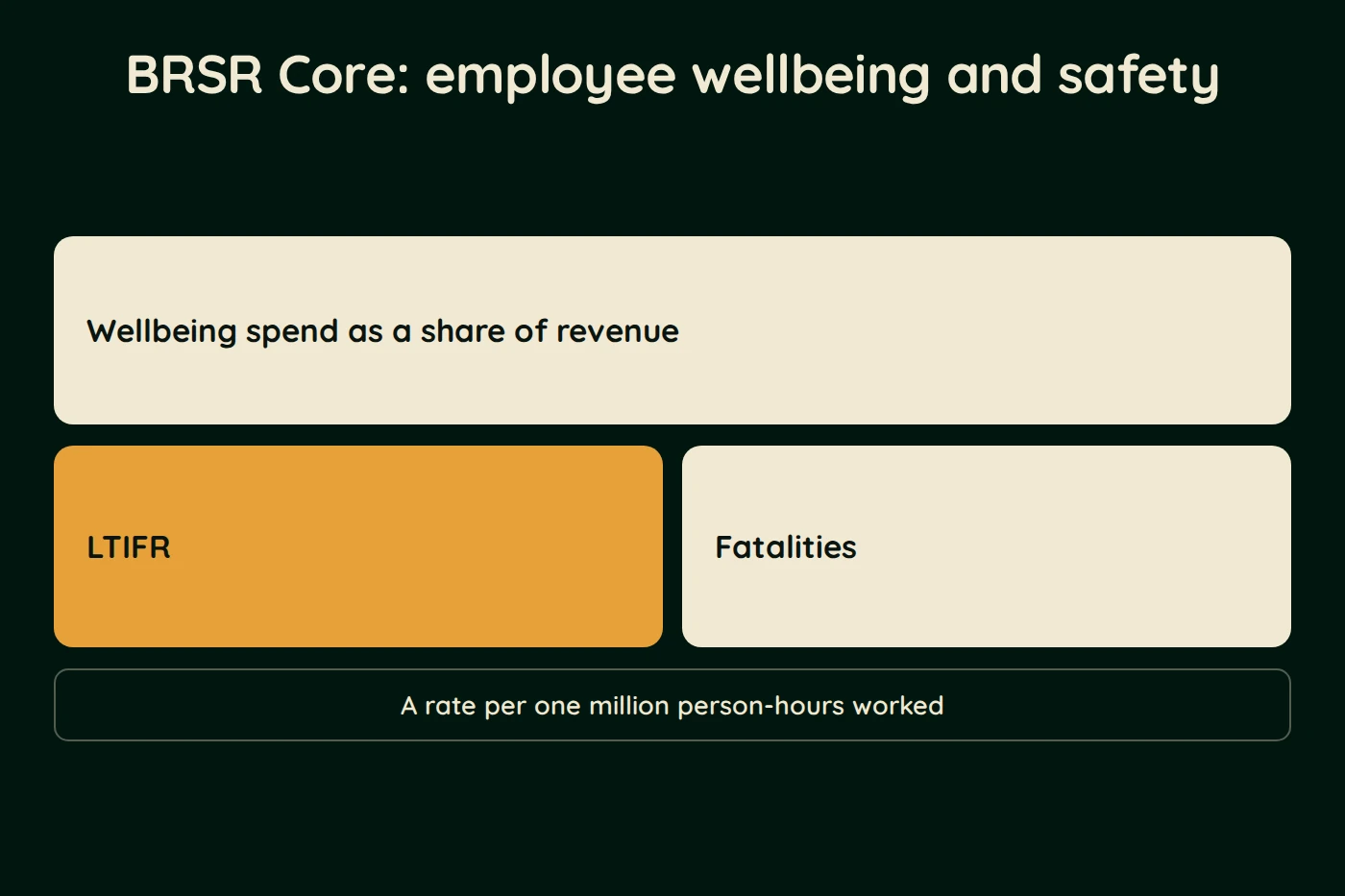
This is the fifth of the nine BRSR Core attributes, and the point at which the assurable set moves beyond environmental data.
The three measures
- Spending on employee wellbeing measures, expressed as a percentage of total revenue
- The Lost Time Injury Frequency Rate, abbreviated LTIFR
- The number of fatalities
How LTIFR is computed
The Lost Time Injury Frequency Rate is computed as the total number of lost time injuries multiplied by one million, divided by the total number of hours worked. It is therefore a rate per one million person-hours worked, not a count and not a percentage. Reporting a raw injury count in the LTIFR field is a straightforward error that changes the figure by orders of magnitude.
Why the denominator is the hard part
The injury numerator is usually available from incident records. The hours-worked denominator often is not, particularly where contract labour is engaged through third parties, where shift patterns vary, or where sites record attendance rather than hours. Since the whole rate is driven by that denominator, an entity cannot assure its LTIFR without a defensible hours-worked basis covering the same population as the injury data.
Population consistency
The employee and worker counts disclosed in Section A of the BRSR should be consistent with the population underlying this attribute. Mismatches between the two are a recurring assurance finding, and they usually originate in contract workers being inside one count and outside the other.
Sources: SEBI Annexure I, Format of BRSR Core
The BRSR guide maps each attribute to its principle. BRSR reporting services covers safety data preparation for assurance.