


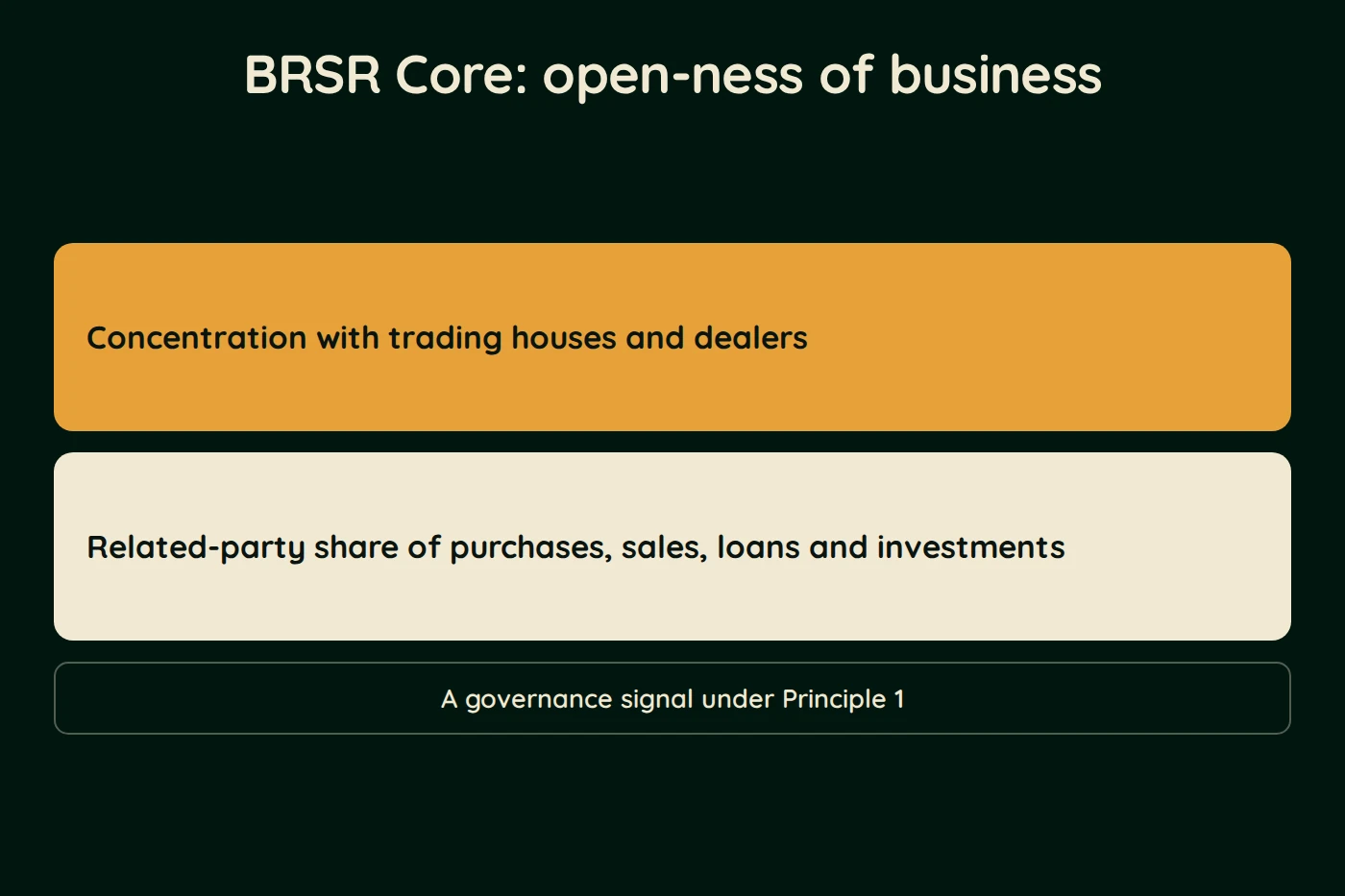
Open-ness of business measures how concentrated an entity trade is with connected counterparties. It covers the concentration of purchases and sales with trading houses, dealers and related parties, and the share of related-party transactions in purchases, sales, loans and advances and investments. It cross-references to Principle 1.
Open-ness of business is the ninth and last of the BRSR Core attributes, and the least familiar to anyone approaching from an international reporting background.
What is measured
- Concentration of purchases and sales with trading houses, dealers and related parties
- The share of related-party transactions across purchases, sales, loans and advances, and investments
Why this sits in a sustainability report
The attribute belongs to Principle 1, which concerns ethics, integrity, transparency and accountability. Highly concentrated dealing with connected parties is a governance risk indicator: it can signal that value is being routed through related entities, that procurement is not genuinely competitive, or that reported margins depend on transactions not struck at arm’s length. Disclosing the concentration lets a reader judge that risk rather than assume it.
Why it is distinctly Indian in framing
International sustainability frameworks rarely ask for related-party concentration as an environmental, social and governance indicator, treating it instead as a financial reporting matter. Its presence in BRSR Core reflects a governance concern specific to the Indian market context, alongside the other emerging-market indicators in the set such as job creation in smaller towns.
Where the data comes from
Related-party information is already prepared for the financial statements, so the underlying data exists. The work is recasting it into the concentration ratios the attribute asks for, and ensuring the counterparty classification used matches the one in the audited accounts.
Sources: SEBI Annexure I, Format of BRSR Core
The BRSR guide sets out all nine attributes and their principles. BRSR reporting services covers governance disclosure preparation.