

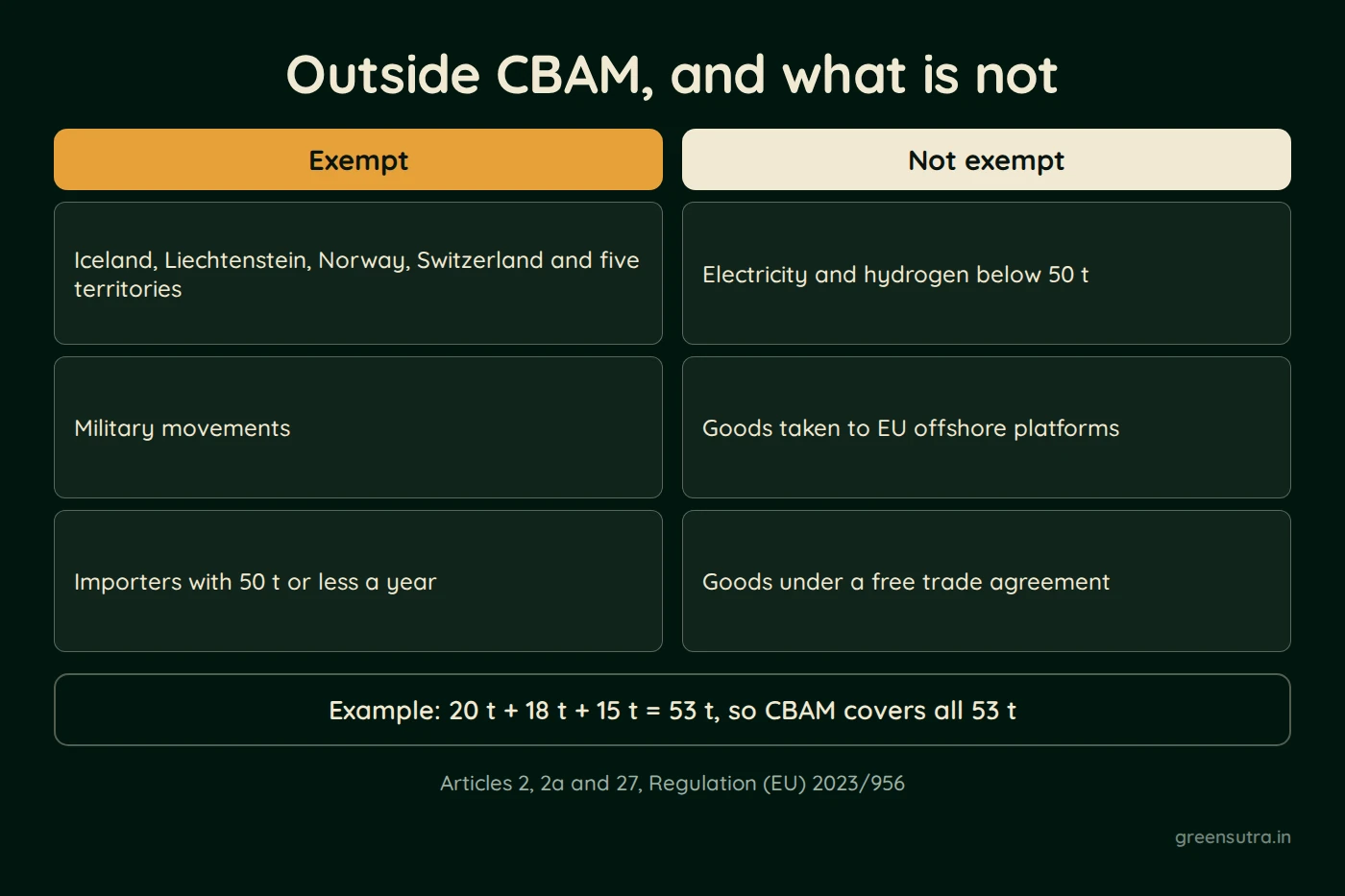
The Carbon Border Adjustment Mechanism (CBAM) exempts goods originating in Iceland, Liechtenstein, Norway, Switzerland and five listed territories, military movements, and importers with 50 tonnes or less a year. That threshold never covers electricity or hydrogen. The old EUR 150 per consignment and personal luggage exemptions ended with Regulation (EU) 2025/2083.
The exemptions at a glance
| Exemption | Legal basis | How firm it is |
|---|---|---|
| Goods originating in Iceland, Liechtenstein, Norway, Switzerland, Büsingen, Heligoland, Livigno, Ceuta and Melilla | Article 2(4), Annex III | Conditional on carbon pricing; the Commission can amend the list by delegated act |
| Goods moved or used in military activities | Article 2(3) | Standing |
| Electricity and hydrogen produced offshore in EU or Annex III waters | Article 2(3a) | Standing |
| Importers whose CBAM goods total 50 t net mass or less in a calendar year | Article 2a, Annex VII | Checked every year; never for electricity or hydrogen |
| Goods not released for free circulation | Article 3(4) | Until release |
How does the 50-tonne threshold work?
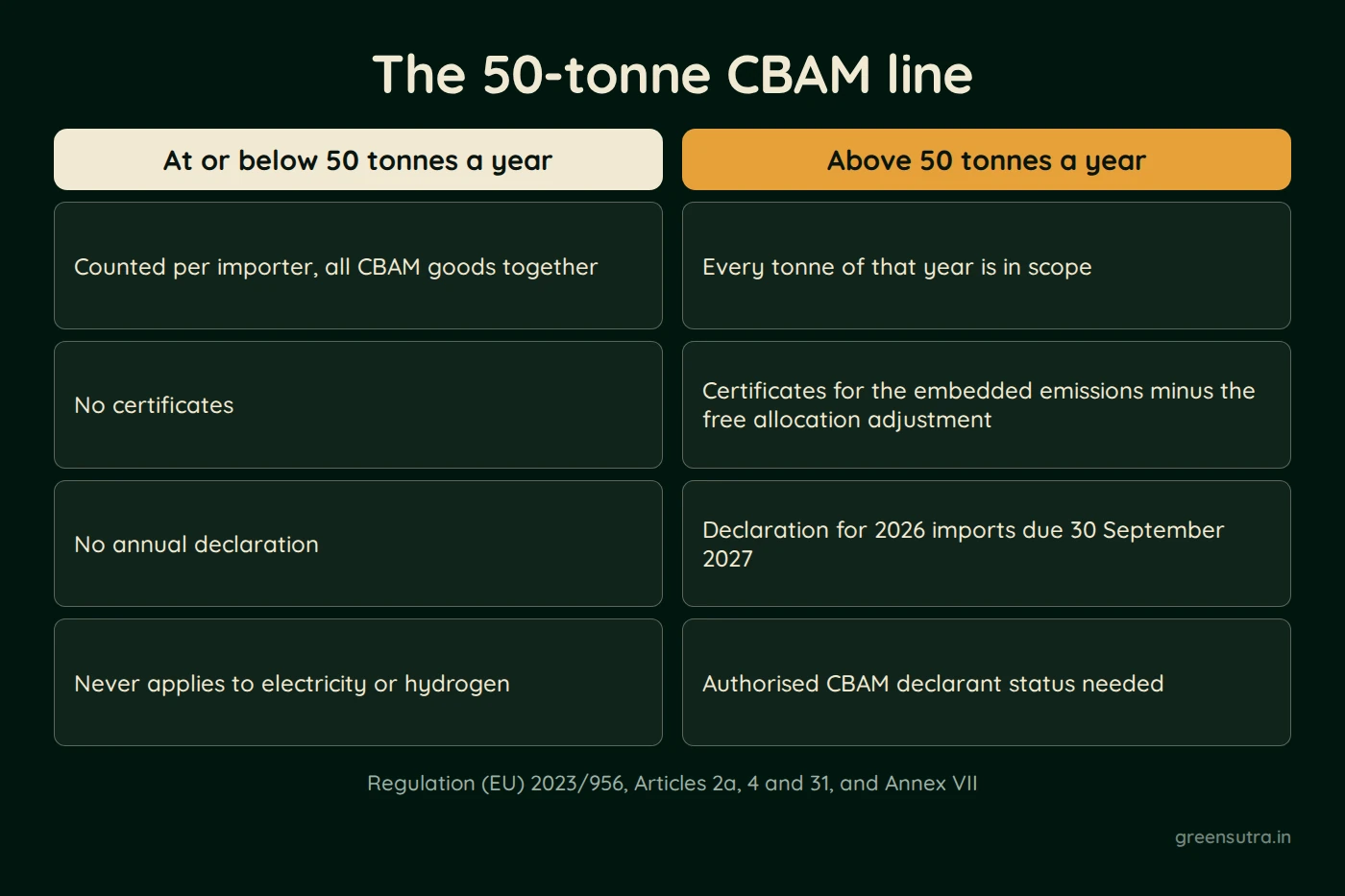
The threshold counts the net mass of all CBAM goods, across every Combined Nomenclature (CN) code, per importer and per calendar year, under Article 2a. Exactly 50 t is still exempt. Crossing it brings every import of that year into CBAM, not just the excess.
Above the line the full obligation applies: declarant status, the annual declaration and certificates, as the figure sets out.
Example, with illustrative shipments: an importer brings in 20 t, 18 t and 15 t of steel products in one year. The shipments mix hot-rolled coil (CN 7208) and bars (CN 7214). The total of 53 t exceeds 50 t, so CBAM applies to all 53 t. The steel CN codes that count are listed in which iron and steel products CBAM covers. Artificially splitting imports to stay below counts as circumvention under Article 27(2)(b).
Each importer counts all its CBAM goods from every supplier, so an exporter cannot see that total in its own sales. An exporter with many small EU buyers asks each one whether it expects to pass 50 t, and readies emissions data for those that will.
The Commission’s assessment of 30 September 2026, on imports from April 2025 to March 2026, found the threshold would exempt 0.87% of embedded emissions, below the 1% limit. No act changing it had been adopted by 15 October 2026.
What the exemptions do not cover
The Commission’s Q&A reads the military exemption narrowly: it covers movements between armed forces, while goods sold by a company to an army are covered. Goods brought to a platform in an EU exclusive economic zone are in scope under Article 2(2). No exemption covers goods traded under a free trade agreement, and the Q&A says a tariff suspension has no effect on CBAM obligations.
Goods in transit or under a suspensive customs procedure trigger CBAM only when released for free circulation. Returned goods of non-EU origin under Article 203 of the Union Customs Code are declared with zero emissions but still count toward the 50 t. The Q&A says Norway and Iceland aim to bring CBAM into the European Economic Area (EEA) Agreement from 1 January 2027. They would then apply it at their own borders, while goods originating there stay exempt. The Norway and Iceland answer covers their aluminium today.
Importing without authorisation once over the threshold carries the penalties set out in Article 26.
Sources: Regulation (EU) 2023/956, consolidated, Regulation (EU) 2025/2083, CBAM Questions and Answers, 15 October 2026, CBAM de minimis threshold assessment
Scope by sector is in the CBAM guide. GreenSutra’s CBAM solutions can run the 50-tonne count on a year of import records and flag the shipments no exemption covers.