


From 2026, an authorised Carbon Border Adjustment Mechanism (CBAM) declarant short of certificates on 30 September pays the EU Emissions Trading System (ETS) excess emissions penalty for each missing certificate. That penalty starts from EUR 100 per tonne and rises yearly with European consumer prices, and the certificates are still owed. Importing above the 50 tonne yearly threshold without authorisation costs three to five times as much.
What are the three CBAM penalty cases?
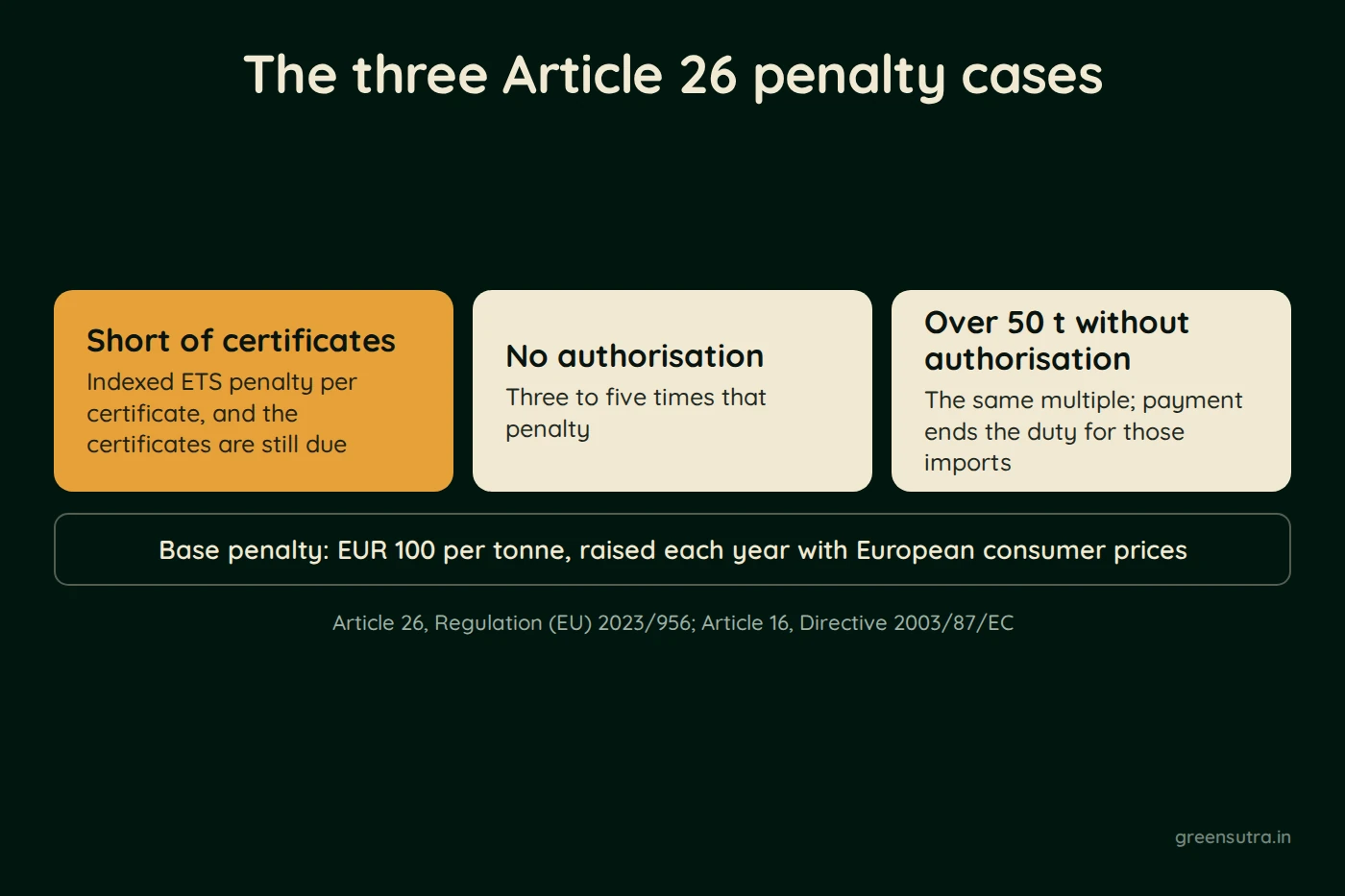
| Situation | Penalty | Article |
|---|---|---|
| Authorised declarant short of certificates on 30 September | The ETS excess emissions penalty applicable in the year of import, for each missing certificate; the certificates must still be surrendered | 26(1), 26(3) |
| Goods brought in by someone without authorised declarant status | Three to five times that penalty for each certificate not surrendered, set by duration, gravity, scope, intent, repetition and cooperation | 26(2) |
| Importer that crosses 50 t without authorisation | The same multiple, on all of that year’s embedded emissions; paying it ends the declaration and surrender duty for those imports | 26(2a) |
How much is the penalty per missing certificate?
The CBAM penalty is the EU ETS excess emissions penalty, tied by Article 26(1) to Article 16(3) and (4) of Directive 2003/87/EC. The base is EUR 100 per tonne of CO2e, and it increases in line with the European index of consumer prices. Because of that indexation the 2026 amount is above EUR 100, although neither the Commission’s CBAM Q&A of 15 October 2026 nor its ETS page states the figure.
In all three cases the authority works out the missing certificates from net mass and default values, after the free allocation adjustment, under Article 26(4a).
A competent authority may reduce the penalty where the shortfall came from wrong information from an operator, a verifier or the person certifying a carbon price. For an importer that crossed 50 t, it may cut the multiple where the excess was 10% of the threshold or less, or a 31 March 2026 application was refused. That reduction cannot go below the Article 26(1) penalty.
What does a 100-certificate shortfall cost?
Example: a declarant finds on 30 September 2027 that it is 100 certificates short for its 2026 imports. It owes 100 times the indexed ETS penalty applicable in 2026, and it must still surrender the 100 certificates. Without authorisation, the same shortfall would cost three to five times the indexed penalty per certificate.
What else follows a missed surrender?
From 2027, a quarterly holding shortfall leads to a one-month deadline to top up under Article 22(3). After a serious or repeated breach of the surrender or holding duty, the authority must revoke authorised declarant status under Article 17(8). A non-genuine arrangement set up to stay under 50 t is a serious infringement under Article 25a(4); the exemptions answer covers the 50 t count.
Implementing Regulation (EU) 2023/1773 set a band of EUR 10 to EUR 50 per tonne for quarterly reports not submitted or corrected in the transitional period. That period ended on 31 December 2025, and the band does not apply to 2026 imports.
Sources: Regulation (EU) 2023/956, consolidated, Directive 2003/87/EC (EU ETS), consolidated, CBAM Questions and Answers, 15 October 2026
GreenSutra’s CBAM solutions build the yearly certificate estimate with the declarant, and the CBAM guide sets out its duties in order.