


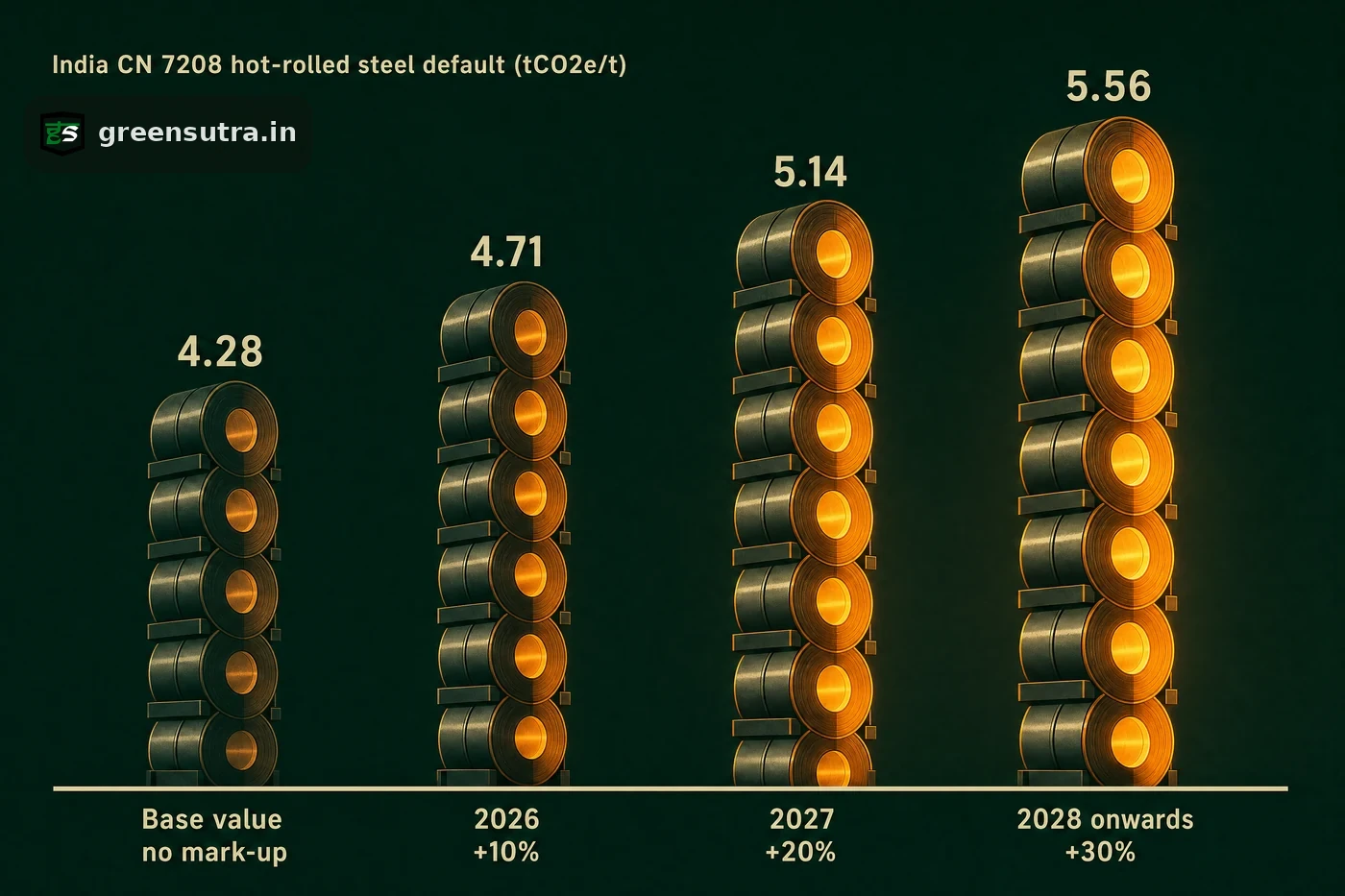
CBAM default values for steel carry a regulatory mark-up of 10 percent in 2026, 20 percent in 2027 and 30 percent from 2028 onwards under Implementing Regulation (EU) 2025/2621. For Indian hot-rolled flat steel (CN 7208) the base default of 4.28 tCO2e per tonne becomes 4.71, then 5.14, then 5.56.
How the mark-up schedule works
Implementing Regulation (EU) 2025/2621 fixes a year-based mark-up on the default values for cement, iron and steel, aluminium and hydrogen. It is 10 percent for goods imported in 2026, 20 percent in 2027 and 30 percent from 2028 onwards. The Commission must revise defaults and mark-ups by December 2027 at the latest, so the 2027 and 2028 rates may change. The mark-up sits on top of the country-specific base default, and the marked-up figure, not the base, is what the CBAM Registry uses to work out the number of certificates. The schedule does not depend on the origin or the importer, and the same percentages apply to every default value in those four sectors. Fertiliser defaults carry a flat 1 percent from 2026. Certificates are due for the embedded emissions minus the free allocation adjustment. That deduction shrinks each year: the CBAM factor is 97.5 percent in 2026, and from 2034 nothing is deducted for free allocation. In 2026, 2.5 percent of the benchmark is no longer deducted. That figure is not 2.5 percent of the embedded emissions. Because the mark-up rises while the deduction shrinks, the default path becomes more expensive on both counts at once.
The escalation on hot-rolled flat steel (CN 7208)
A single product line shows the whole schedule. India’s base default for hot-rolled flat steel under CN 7208 is 4.28 tCO2e per tonne, and the mark-up lifts it in steps:
| Period | Mark-up | India default, CN 7208 (tCO2e/t) |
|---|---|---|
| Base value | none | 4.28 |
| 2026 | +10 percent | 4.71 |
| 2027 | +20 percent | 5.14 |
| 2028 onwards | +30 percent | 5.56 |
The full India table across pig iron, DRI, bars and stainless products sits in the sibling answer on CBAM default values for Indian steel exports.
Why the mark-up exists
The mark-up covers installations whose real emissions sit above the producer-country average. Recital 4 of Implementing Regulation (EU) 2025/2621 says installation-specific data from third countries is hard to verify, so a conservative proxy is applied. Recital 5 adds that the mark-up is phased in to avoid immediate price impacts. A declarant that uses verified emissions data for steel declares the installation’s actual figure with no mark-up at all. As of 19 October 2026, each year on defaults up to 2028 prices more emissions than the last. Both paths can be modelled year by year in the CBAM cost calculator before installation data is prepared with a CBAM consulting service for verification by an accredited verifier.
Sources: Implementing Regulation (EU) 2025/2621 · Regulation (EU) 2023/956