


A CBAM monitoring plan lists the precursors used in each production process, and the name and country of each outside supplier. Element 14 of Annex II, point A.5 to Implementing Regulation (EU) 2025/2547 requires both. Guidance No. 3 says a supplier’s actual emissions count only with a verification report covering the period the precursor was made. Otherwise default values apply.
What the plan records for each bought precursor
Annex II, point E(2) sets the data sets:
- the country of origin;
- the producing installation: unique identifier where available, UN/LOCODE, full address in English and coordinates;
- the production route;
- the sector parameters listed in Annex IV;
- specific embedded direct and indirect emissions, averaged over the supplier’s most recent reporting period;
- the start and end dates of that period;
- the quantity used in each production process.
Point E(3) adds that where the data received are incomplete or inconclusive, default values apply to that quantity.
When supplier data counts
Guidance No. 3 gives examples of supplier data that is not duly verified. They include no verification report, a report for the wrong period, a negative opinion, or a verifier without accreditation for the sector. By default a bought precursor is presumed made in the same calendar year as the complex good, and the operator can show its verifier otherwise.
Precursors produced in the EU, or in a country exempt from CBAM, count as zero embedded emissions. Their free allocation and carbon price are reported as zero too.
Example: two slab suppliers
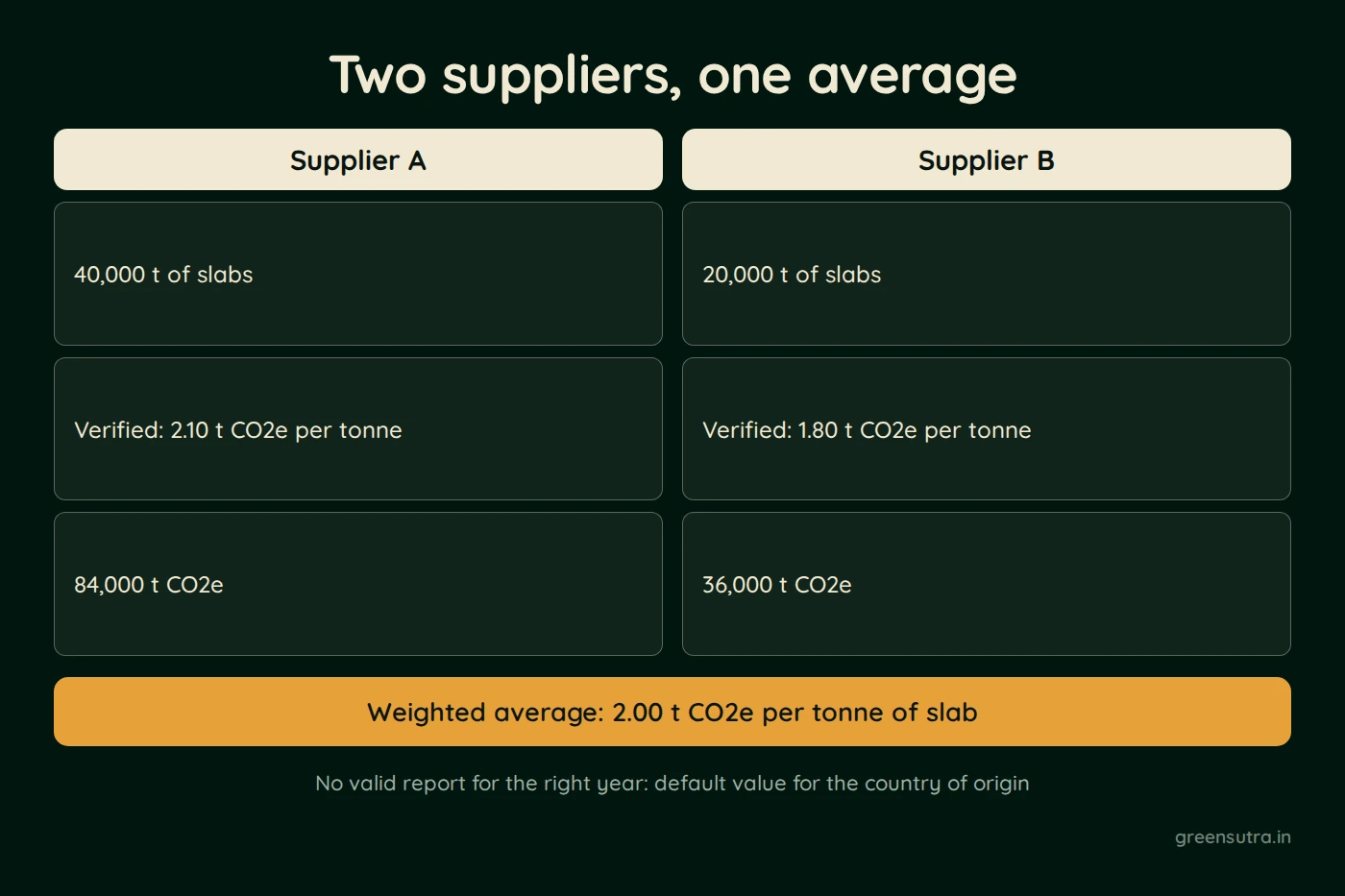
Example. A rolling mill uses 60,000 t of slabs in 2026. Supplier A sends 40,000 t with a verified 2026 figure of 2.10 t CO2e per tonne, and Supplier B sends 20,000 t with a verified 1.80. The weighted average is (40,000 × 2.10 + 20,000 × 1.80) ÷ 60,000 = 2.00 t CO2e per tonne of slab. If B had no valid report, its 20,000 t would take the default value for its country of origin.
First-in, first-out stock rules are voluntary, and they cannot be used for 2026, because no verified data exists for earlier years.
Sources: Commission Implementing Regulation (EU) 2025/2547, Guidance No. 3, CBAM methods for the calculation of emissions embedded in goods
What a supplier hands to an EU importer is covered in What emissions data must a non-EU supplier give its EU importer for CBAM?. The plan as a whole is in CBAM Monitoring Plan in 2026. GreenSutra’s CBAM solutions cover precursor data collection, and the CBAM guide covers default values.