


An installation cannot use an April to March financial year as its CBAM reporting period from 2026. Article 1(5) of Implementing Regulation (EU) 2025/2547 defines the reporting period as the calendar year in which the good was produced. The transitional rules allowed a fiscal year only where it gave better data, and that option has gone.
What the regulation says
Recital 23 gives the reason: a calendar year makes it simpler to use the right period for the goods produced. Articles 7 and 13 then set presumptions about which year applies.
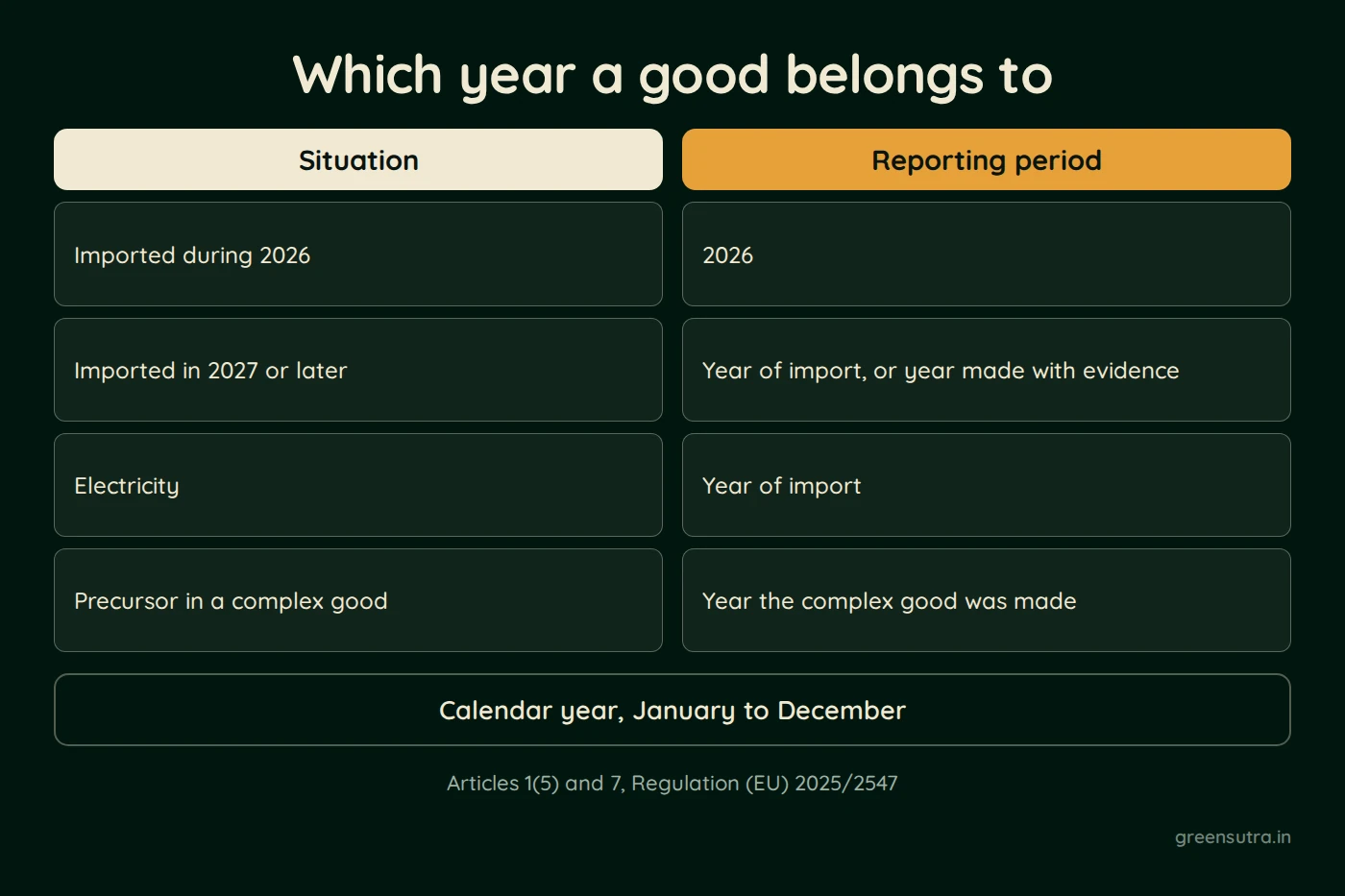
| Situation | Reporting period |
|---|---|
| Goods imported into the EU during 2026 | 2026 |
| Goods imported in 2027 or later | By default the calendar year of import; the year of production where there is sufficient evidence of it |
| Electricity imported | The year of import |
| Precursors used in a complex good | By default the year the complex good was made; another year if the operator shows it to the verifier |
No reporting period can start before 2026, because the methods apply only from that year. Recital 26 adds that the same period applies to the free allocation adjustment and to any carbon price paid.
Example: an Indian rolling mill
Example. A mill keeps its books from 1 April to 31 March. Its 2026 CBAM reporting period still runs from 1 January to 31 December 2026. Coil made in December 2025 and imported in February 2026 takes the 2026 period, because every good imported during 2026 does. Coil made in November 2026 and cleared in January 2027 falls in the 2027 period, unless there is sufficient evidence that it was produced in 2026.
The mill therefore closes meter readings, fuel purchases and production totals by calendar month. Both periods can then be built from the same records.
What it means for the plan
Guidance No. 2 lists fixing the reporting period as the second of seven steps before the plan is written. The plan states the calendar year and sets data flows to match it. An example checklist in the Commission’s verification guidance of 24 August 2026 asks whether stockpiles and tanks are taken into account, so a stock reading at 31 December matters.
Sources: Commission Implementing Regulation (EU) 2025/2547, Guidance No. 2, Quick guide for non-EU operators, Guidance No. 3, CBAM methods for the calculation of emissions embedded in goods, Guidance on CBAM verification and accreditation, 24 August 2026
The plan’s other contents are in CBAM Monitoring Plan in 2026. An installation can check its data against these rules through the CBAM discovery, and GreenSutra’s CBAM solutions set out how the work runs.