

A better CBAM monitoring method counts as unreasonably costly only where its annual cost exceeds its benefit, under Annex II, point A.3(8) of Implementing Regulation (EU) 2025/2547. The benefit is an improvement factor multiplied by EUR 80 per tonne of CO2e. Spending up to EUR 4,000 a year on better monitoring never counts as unreasonable.
The parts of the test
| Part | Rule |
|---|---|
| Benefit | Improvement factor × EUR 80 per tonne of CO2e |
| Improvement factor | Gain in measurement uncertainty, in %, × the related emissions over the reporting period; or 1% of the related emissions where uncertainty does not change |
| Cost | Depreciation over the equipment’s economic lifetime, under point A.3(8); Guidance No. 3 counts only the extra cost over existing equipment, such as upkeep, a shutdown to install it and other reasonable costs |
| Floor | Up to EUR 4,000 a year in total is never unreasonable |
Related emissions are those of the source stream or emission source concerned, of a quantity of measurable heat or electricity, or embedded in a material or precursor. In the transitional period the reference price was EUR 20 and the floor EUR 2,000.
Example: a meter that costs too much
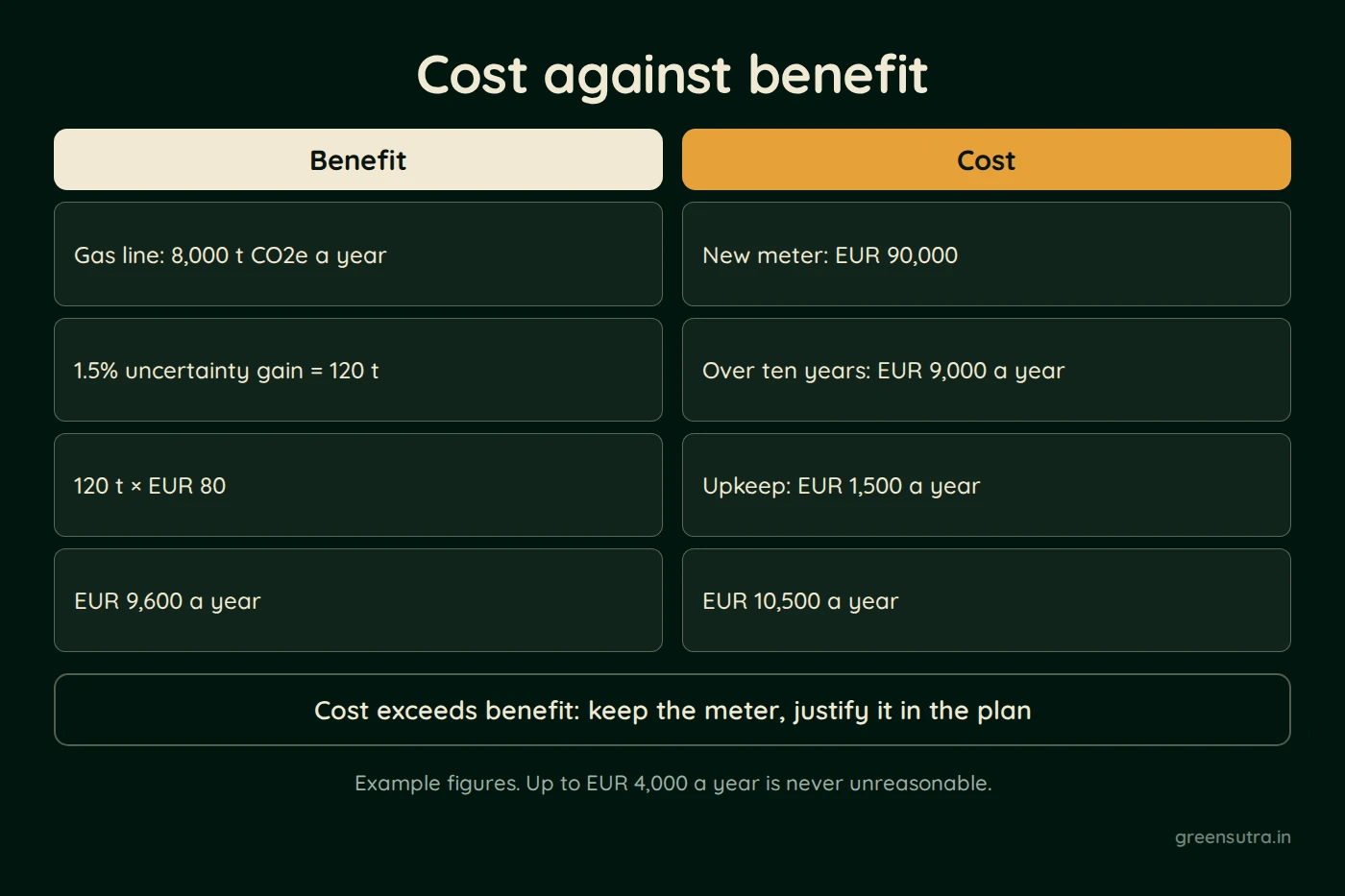
Example. A natural gas line accounts for 8,000 t CO2e a year. A new meter would cut uncertainty from 3.0% to 1.5%, a gain of 1.5 percentage points. The improvement factor is 1.5% of 8,000 t, or 120 t, so the benefit is 120 t × EUR 80 = EUR 9,600 a year.
The meter costs EUR 90,000 over a ten-year life, which is EUR 9,000 a year, plus EUR 1,500 a year to maintain. At EUR 10,500 a year the cost exceeds the benefit, so the operator may keep the existing meter.
What goes in the plan
The claim needs a written justification in the monitoring plan. Guidance No. 3 says the cost-benefit calculation is attached to the plan. Point A.3(8) has the justification re-assessed at the regular checks, which point A.3(6) sets at least once a year.
Where the better data source is technically feasible and costs no more than its benefit, point A.3(3) says it is applied without undue delay. A separate route covers methods that are technically not feasible, such as no space for equipment, safety concerns or technology not available in the country. That case also needs a written justification in the plan. The verifier checks both during verification.
Sources: Commission Implementing Regulation (EU) 2025/2547, Guidance No. 3, CBAM methods for the calculation of emissions embedded in goods, Guidance on CBAM verification and accreditation, 24 August 2026
A second worked example, where the better meter passes the test, is in CBAM Monitoring Plan in 2026. The CBAM cost calculator shows what defaults would cost instead, and GreenSutra’s CBAM solutions cover the plan itself.