


A CBAM monitoring plan must contain at least the 22 elements listed in Annex II, point A.5 of Commission Implementing Regulation (EU) 2025/2547. They run from the plan’s date and version, through goods, production processes, monitoring methods, boundaries and flows, to a control system for data quality. Article 5(6) of the same regulation requires the plan in English.
The 22 elements, in the legal order
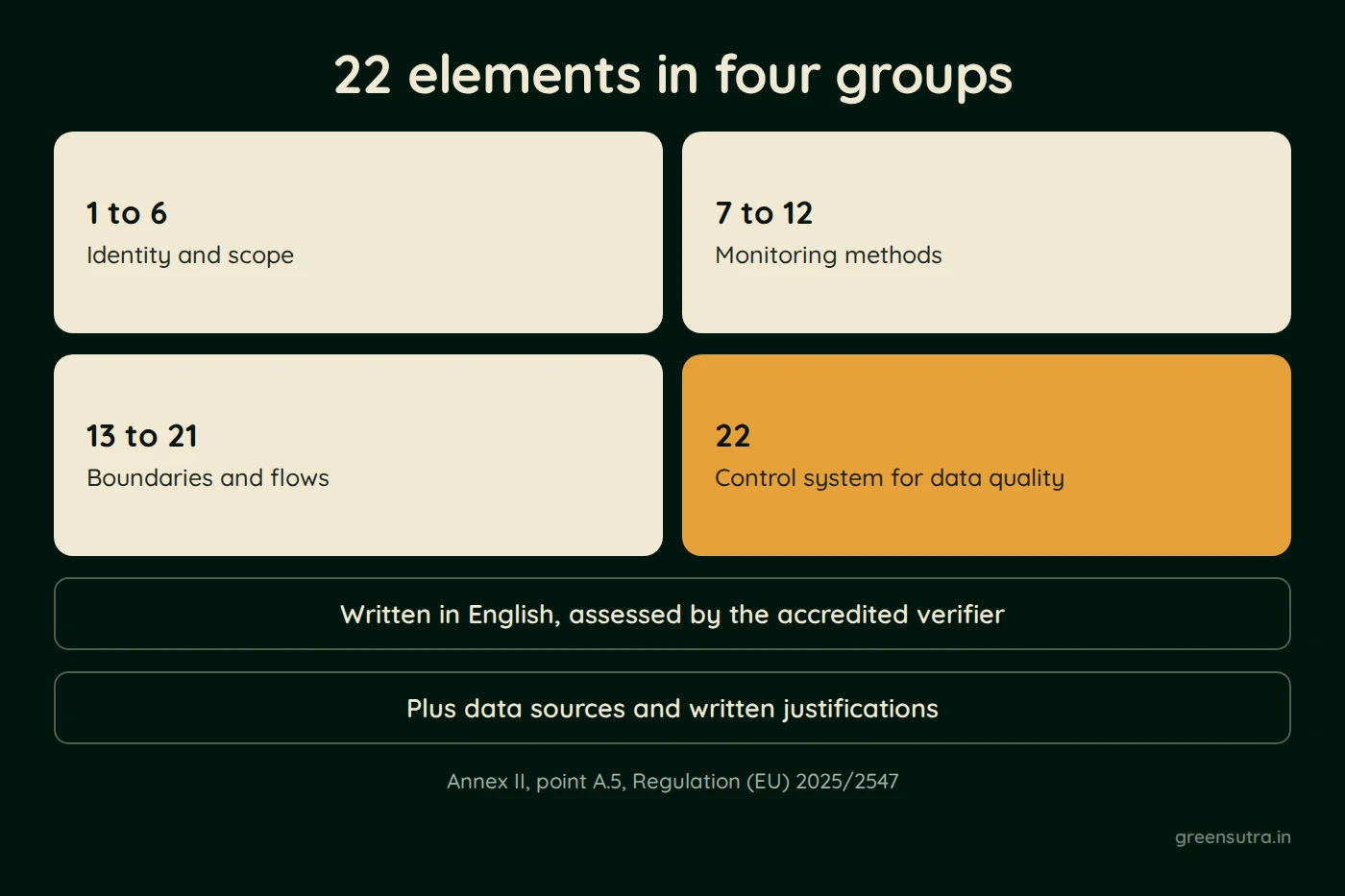
| No. | What the plan sets out |
|---|---|
| 1 | Date and version number of the plan |
| 2 | The installation and its production processes |
| 3 | Goods by CN code and functional unit, with clinker or nitrogen content where relevant |
| 4 | CBAM production processes and routes, and the goods from each |
| 5 | Any non-CBAM goods per process, with quantities |
| 6 | The CBAM benchmarks for the free allocation adjustment |
| 7 | Monitoring method per process: formulae and input data, or measurement systems and where each instrument sits |
| 8 | How calculation factors are found, with the sampling plan |
| 9 | Source streams and emission sources of each process |
| 10 | Source streams on the standard or mass balance method |
| 11 | Emission sources measured continuously |
| 12 | Perfluorocarbons from primary aluminium |
| 13 | A diagram of boundaries that shows no double counting and no data gaps |
| 14 | Precursors per process, with each outside supplier’s name and country |
| 15 | Zero-rated fuels and how zero-rating is shown |
| 16 | Measurable heat imported or exported, and how it is attributed |
| 17 | Electricity made on site, and how |
| 18 | Evidence for actual indirect emissions, where used |
| 19 | Evidence for actual emissions of electricity imported into the EU, where used |
| 20 | Waste gases produced, used, imported or exported |
| 21 | CO2 capture, storage or use, with the receiving party |
| 22 | A control system: calibration, risk assessment, IT quality, segregation of duties, internal review, corrections, outsourcing and records |
More than the list
Other parts of Annex II add to the plan. It records the data sources chosen for each data set and any corroborating sources. Where a better method is technically not feasible, or would cost more than it brings, the plan carries a written justification. The unreasonable costs test sets out how that second case is worked out.
The Commission’s Guidance No. 3 of 14 August 2026 reproduces the list as a template operators may adapt, as long as the minimum elements stay. No competent authority approves the plan. The Commission’s verification guidance of 24 August 2026 says the verifier assesses it, usually as part of the verification.
Sources: Commission Implementing Regulation (EU) 2025/2547, Guidance No. 3, CBAM methods for the calculation of emissions embedded in goods, Guidance on CBAM verification and accreditation, 24 August 2026
Five of the elements are filled in for a fictional steel rolling mill in CBAM Monitoring Plan in 2026, and the wider rules in the CBAM compliance guide. GreenSutra’s CBAM solutions cover writing the plan, kept separate from the verifier.