

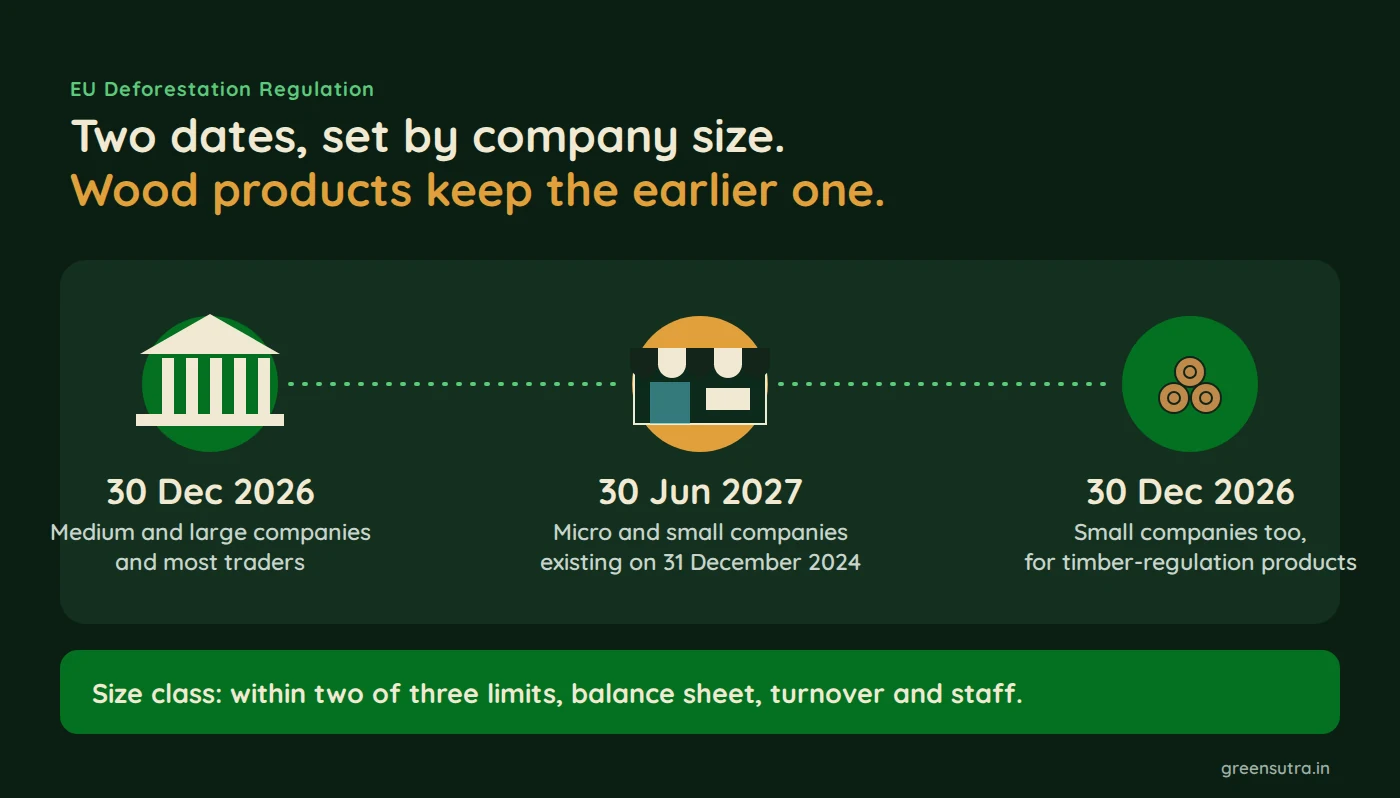
Medium and large companies must comply with the EU Deforestation Regulation (EUDR) from 30 December 2026, as must most traders and downstream operators. Micro and small companies that existed as such on 31 December 2024 have until 30 June 2027, except for wood products the old EU Timber Regulation covered, where their date is also 30 December 2026.
How is company size judged?
The regulation uses the EU accounting directive’s size classes, whatever the company’s legal form, and individuals trading in their own name count too. A company belongs to a class if it stays within at least two of three limits: balance sheet, net turnover and staff numbers.
| Class | Balance sheet up to | Net turnover up to |
|---|---|---|
| Micro | EUR 450,000 | EUR 900,000 |
| Small | EUR 5 million | EUR 10 million |
Member States may raise the small limits to EUR 7.5 million and EUR 15 million. Medium companies go up to EUR 25 million and EUR 50 million.
Which products keep the earlier date for small firms?
Everything the EU Timber Regulation already covered, including logs, fuel wood, sawn wood, panels, joinery, wooden packing, frames, pulp and paper, wooden furniture under certain headings and prefabricated wooden buildings. The answer on Indian wood and paper exports lists the codes.
Example: a small importer with two product lines
Example. An EU importer founded before 2024 has a balance sheet of EUR 4 million and turnover of EUR 9 million, under both small limits. Its coffee imports fall under the regulation from 30 June 2027. Its wooden furniture imports, a timber-regulation product, fall under it from 30 December 2026.
Does the later date carry down the chain?
Yes, for those goods. Under the Commission’s guidance, when a small operator supplies goods under its later date, the deferral also covers the downstream operators and traders who buy them.
What applies only to large companies?
Large operators, the ones above the medium limits, need a compliance officer at management level and an independent audit function. They also report publicly each year on their due diligence system. Large downstream operators and traders have to register in the EU information system. Small producers in low-risk countries that sell their own crop have a lighter regime altogether, described in the due diligence statement answer.
The history of these dates, and whether they could move again, is in the answer on postponement.
Where this comes from: Regulation (EU) 2023/1115, Articles 2(30), 11, 12 and 38, as amended by Regulation (EU) 2025/2650; Delegated Directive (EU) 2023/2775; Commission guidance, OJ C/2026/3896, section 3.
More on this: EUDR guide · EUDR compliance
Reviewed by Team GreenSutra on 26 October 2026.