

Most of them are. Wooden furniture, wooden seats, pulp, paper and many wood articles fall under the EU Deforestation Regulation (EUDR). Printed matter left the list in December 2025, and bamboo, rattan and used goods are outside. Risk follows the country where the wood was harvested, and each piece needs the location of that forest.
Which products are in, and which are out?
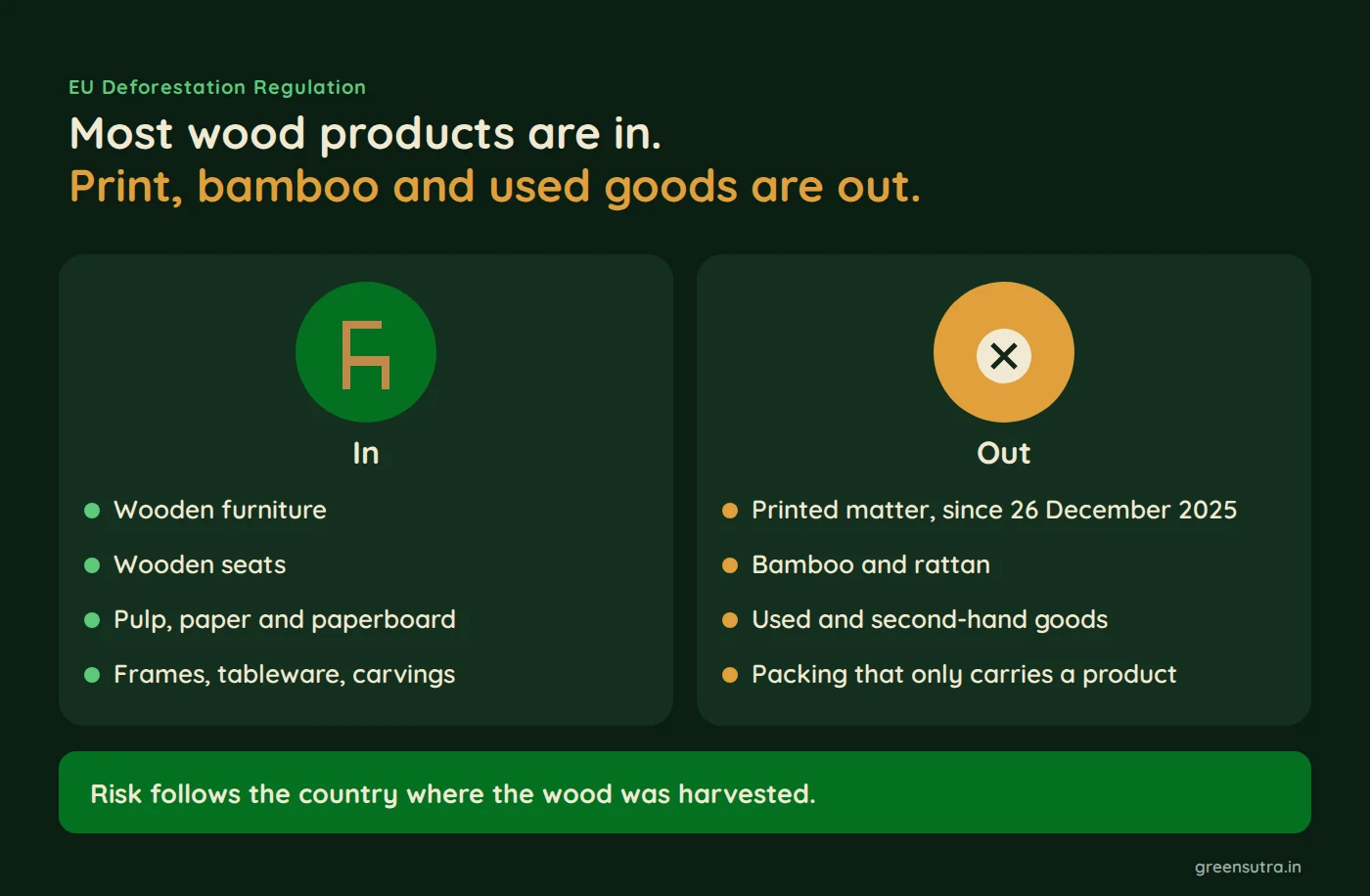
| Product | Position on 26 October 2026 |
|---|---|
| Wooden furniture and parts, headings 9403 30 to 9403 60 and 9403 91 | In |
| Wooden seats, six listed codes under heading 9401 | In |
| Pulp, paper and paperboard, and articles made of them | In, with exclusions below |
| Wooden frames, tableware, marquetry, statuettes and other wood articles | In |
| Printed books, newspapers, pictures and other printed matter | Out since 26 December 2025 |
| Bamboo, rattan and other woody materials | Out |
| Used and second-hand furniture and wood products | Out |
Paper and board packing used only to carry another product is outside, and so is printed material that only accompanies a product, such as a manual. A carton sold as a product in its own right is in.
Example: one exporter’s catalogue
Example. A Jodhpur exporter ships a wooden dining table (heading 9403 60) and upholstered chairs with wooden frames (9401 61 00): both are in. A bamboo stool and the printed catalogue that goes with the order are out. The carton the table travels in is out too, because it only carries the table. According to the Commission’s guidance, a table made entirely from reclaimed demolition timber would be out, but any new wood in it brings it back in.
What information does wood need?
The common and scientific names of each tree species, and the geolocation of the forest plots the wood came from. For boards and paper made from mixed species, each species that may have been used is listed. Simplified due diligence depends on where the wood was harvested. Furniture made in India from Indian-grown wood can rely on India’s low-risk status, as the answer on Indian coffee exporters explains. Furniture made from imported timber takes the risk level of the country the timber came from.
Does the date differ for wood?
For small EU importers, yes. Furniture under heading 9403 and paper were covered by the old EU Timber Regulation, so small importers start on 30 December 2026 for them. Wooden seats, tableware, marquetry, carvings and similar small wood articles were not, so small importers get the later date for those. Wooden frames were covered, so they keep the earlier date. The dates by company size are set out separately.
Where this comes from: Regulation (EU) 2023/1115, Articles 9(1) and 38 and Annex I; Regulation (EU) 2025/2650, Article 1; Delegated Regulation (EU) 2026/2102, Annex; Commission guidance, OJ C/2026/3896, sections 7 and 9.
More on this: EUDR guide · EUDR compliance
Reviewed by Team GreenSutra on 26 October 2026.